
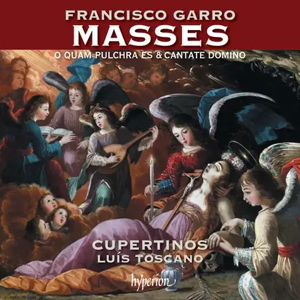
Francisco Garro (c.1556-1623)
Masses and Motets
Cupertinos / Luís Toscano
rec. 2023, Basilica do Bom Jesus, Braga, Portugal
Hyperion CDA68438 [69]
2023 marked the 300th anniversary of the death of this little-known Portuguese master who worked in the period often called the ‘Golden Age of Portuguese Polyphony’. I’m not sure why this release has had to wait in the vaults for over two and a half years, but it’s good to have it now.
This is the fifth recording by this fine choir of Portuguese sacred works from the end of the Renaissance and like the other composers in this series, such as Duarte Lobo and Manuel Cardoso, Garro demonstrates the conservative attitude of the time, as these composers lived into the early Baroque and took little notice of developments elsewhere.
But we should, of course, dig deeper. The excellent booklet, not only contains an in-depth essay on the composer and the music recorded by Luis Toscano and José Abreu, but also illustrations including the title page of Garro’s two published works (1609) that is the Choirbook itself and a set of incomplete part books. We have also a couple of gorgeous illustrations of pages from that publication including the Kyrie from the Missa Cantate Domino. The problems with Garro and his surviving output are several. First, there was much confusion about his name which is misspelt on the publication, as Garri. This, curiously, led to early scholars thinking his name was Francisco Garcia, a situation not cleared up until the twentieth century. Then there is the problem of missing part books, or books being scattered in differing libraries and therefore needing, in part at least, to be reconstructed. As some of the works are polychoral, this meant that a considerable number of part books were needed. I’ve tried to simplify this complex situation, but I trust that you grasp the general thrust of the problem.
The Missa O quam pulcra es is based on a lost motet and is lyrical and relatively simple with homophonic passages and others with a not-too-complicated use imitative counterpoint. Similar comments could be made about the five-part Asperges me (Psalm 50) and In principio erat verbum, the opening words of St. John’s Gospel. The rest of the music on the disc is in eight parts and for double choir including the joyous Missa Cantate Domino and in addition to the normal sections includes a glorious Alleluia movement. Especially splendid here is the way the composer often moves between triple and duple time and how we hear some rapid and rhythmically exciting repetitions of text often with syncopations which then contrast with long, lyrical and even quite melismatic lines. One’s attention is always held and the text is conveyed convincingly which, as a sign of the church’s decrees at that time, has many moments of homophony, especially in the ‘’Credo’, making the text always audible.
The first three works for double choir are Parce mihi, Domine, Responde mihi and Spiritus meus. These are settings of chapters from the Book of Job and come from Garro’s ‘defunctorum lectiones’ also for double choir. To quote the booklet essay ‘The transcription and reconstruction of the missing voices was undertaken by José Abreu following a comparative study of the three incomplete collections….’. They are very moving works, uncomplicated in many ways with some, but not excessive use of close imitative counterpoint, so that the words are clearly expressed.
The choir is fresh voiced, and their tone quality is clearly focused. Luís Toscano’s tempi are ideal for allowing the music to be expressively shaped. I’m not sure if the acoustic of the vast late-Renaissance Basilica in Braga (pictured in the CD casing) is responsible or the sometimes-busy counterpoint, but the diction is, unfortunately, not always distinct, so it’s good that we have all of the texts which have been well translated. This is a very welcome addition to our knowledge of this fascinating period in Portugal’s still underrated musical history.
Gary Higginson
Other review: Dominic Hartley
Buying this recording via the link below generates revenue for MWI, which helps the site remain free
Contents
Parce mihi, Domine
Responde mihi
Spiritus meus
Asperges me
Missa O quam pulcra es
In principio erat verbum
Missa Cantate Domino















Thankyou Sir for this review. Cupertinos’ five CDs so far for Hyperion all featuring composers from this wonderful period in music have been most interesting and the series is indeed eminently collectible. Perhaps the reason for the delay in putting out this recording may be explained by the change in the musical directorship of the group at the end of 2023. From the start of the following year Pedro Teixeira began to lead the singers and it was he who conducted when they came to Wigmore Hall last summer. I wasn’t lucky enough to be there but I recorded the broadcast on Radio 3. That concert featured music by Estêvão Lopes Morago and Estêvão De Brito as well as works they have already committed to record and a little bit of Garro too incidentally. Maybe we may get CDs from those unjustly neglected voices next on Hyperion.