
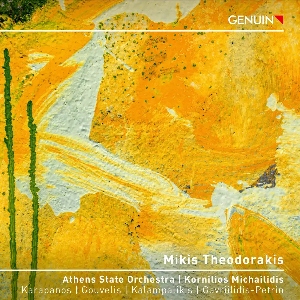
Mikis Theodorakis (1925-2021)
Orchestral Works
Sinfonietta for Flute, Piano and String Orchestra (1947)
Rhapsody for Guitar and Symphony Orchestra (1982-3/1995)
Rhapsody of Violincello and Symphony Orchestra (1997)
Stathis Karapanos (flute), Titos Gouvelis (piano), Orestis Kalampalikis (guitar), Timotheos Gavriilidis-Petrin (cello)
Athens State Orchestra/Kornilios Michailidis
rec. 2024, The Rehearsal Room, Megaron Concert Hall, Athens, Greece
Genuin GEN25562 [84]
In a way, it has been unfortunate that Mikis Theodrakis, whose centenary was in 2025, is remembered across the world as the composer of the famous tune for the film Zorba the Greek (1964), as the rest of his vast output of concertos, oratorios, ballets and operas has been overlooked. It is possibly equally unfortunate that he has been known for his political involvements; he was a resistance fighter during the brutal civil wars of the 1950s, exiled several times and tortured. His music was banned by the military junta into the 1960s, by which time he was internationally well-known. His political views found their way into his huge Seventh Symphony (1983) (INT 3131 2) subtitled ‘Spring Symphony’ in which he forces joy out of those earlier, troubled times.
This generously filled disc begins with an early work his Sinfonietta which can be thought of as a double concerto for Flute and Piano, as both are given equally important material which is passed between them. It is not a virtuoso work but has an introspective, pastoral mood, its melodies reminiscent of some distantly remembered Byzantine modal chant. This certainly applies to the first movement marked Prelude and Chorale, Adagio. The middle movement, a Scherzo, is a light, tripping Greek dance, not scored as heavily as those of Skalkottas. The dark Finale marked Andante mosso, begins with a throbbing bass and has a funereal mood before opening out in a more optimistic climax.
The hopelessly concise booklet notes contrive in only about seventy words to describe the Rhapsody for Guitar and Symphony Orchestra. This began life as ‘Romancero Gitano’ (1967), a setting of poems by Lorca and was apparently very popular at the time. This version, for which the composer dropped the solo voice and the chorus, was commissioned in 1983 and dates from 1995. It falls into eight movements and lasts for a tedious thirty minutes or more. The titles of the movements, such as ‘Ballad of the accursed’ (movement 1), ‘Died for Love’ (movement three) ‘The arrest of Antonito Combrino’ (movement five), suggest a powerful work with a political backdrop but the banality of most of the music never rises above anything other than the level of pleasing wallpaper. The material is often overworked, as in the ‘The Gypsy Nun’, and rhythmically it only occasionally raises the heat. It seems that Combrino is not a real person and it’s curious that he dies in the second movement but is arrested in the fifth. At times the musical language, which is partially folk melody inspired, reminded me of Alan Hovhaness but that would be doing the Armenian composer a disservice. I’m sure that the performers do all that they can to make this music live, but I won’t be listening to it again.
The reason why I feel that the Rhapsody for Cello and Symphony Orchestra is more successful is the nature of its melodic material. The composer had wanted to compose a work for cello and orchestra all his life and this proved to be his final symphonic work although he still had more than twenty years to live.
It is in nine shortish movements, and each employs a melody he had composed in between 1986 and 1995. The stimulus for these melodies can be appreciated by studying the Greek names of the movements, the first being ‘Efterpi’ (the Muse for lyric poetry and music) and the third ‘Melpomeni’ (the Muse of tragedy). Most movements are lyrical and of a moderate tempo, but others are a little more aggressive and dramatic such as ‘Kaliopi’ (normally spelt Calliope) a goddess of song and dance and ‘Terpsihori’ or Terpsichore also associated with song and dance. This work is not only beautifully played but pleasingly recorded and spaced so that I found it to be the most enjoyable work on the CD.
As far as one can tell, the performers bring the best out of this music. It’s unlikely that you will ever hear much of Theodorakis in the UK or indeed most of Europe, so it might be that this disc appeals to you. It certainly makes easy, late evening listening.
The colourful booklet contains brief comments on the music and biographies of the composer and the performers. It comes in an attractive cardboard casing.
Gary Higginson
Buying this recording via the link below generates revenue for MWI, which helps the site remain free














