
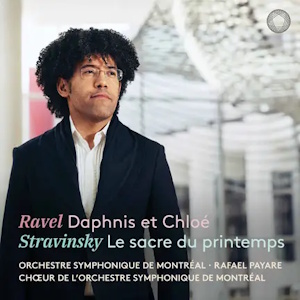
Maurice Ravel (1875-1937)
Daphnis et Chloé, M.57
Igor Stravinsky (1882-1971)
Le sacre du printemps
Orchestre symphonique de Montréal/Rafael Payare
Pentatone PTC5187665 [2 CDs: 89]
I am a Payare fan, having found his Symphonie fantastique (review) to be the best of modern times and thoroughly enjoyed his Verklärte Nacht (review); here he again tackles two classic works with his Montreal orchestra, recording for the Pentatone label. They make for an interesting, if unconventional pairing, the idea behind that being that apart from their contemporaneity – the Ravel being first performed in 1912 and the Stravinsky in 1913, both by the Ballets Russes – “beneath their differences, these two works share the same evocative power, where orchestral color becomes a dramatic language in its own right” (conductor’s note). I suppose you could say that about any number of putative combinations, but I’m not complaining as I love both works and have indeed produced a survey of recordings of Daphnis et Chloé, of which there are so many recommendable versions – but I particularly like Dutoit and Ozawa. My favourite recordings of The Rite of Spring are by the youthful Ozawa once more, in Chicago, and three by Bernstein (review) so again, the competition to Payare’s latest release is stiff and the question, as ever, is do we “need” yet more recordings of staple repertoire? The novelty and convenience of the pairing partially address that, but of course are of no consequence if the playing is unexceptional.
This orchestra has a proud tradition of excelling in French music, nurtured under the long tenure of Charles Dutoit, and his 1980 recording is one of my two prime recommendations. Under Payare, the opening is immediately noticeably idiomatic, being suitably subtle, diaphanous and mysterious. The wordless chorus is smooth and homogeneous, dynamically nuanced and fluid. (Oddly, it is not credited anywhere but I assume that it is the regular Chorus of the Montreal Symphony Orchestra.) Indeed, nothing about this performance is crude or over-stated; elegance prevails. I am newly struck in this recording by how some of the dances such as the “Danse légère et gracieuse de Daphnis“ remind me of episodes in Vaughan Williams’ ballet Job; after all, RVW studied with Ravel in Paris and there are definite links in their use of shimmering, colourful orchestration and unusual harmony – both use the octatonic scale to suggest otherworldliness, harps and woodwind to create a pastoral mood, and rise to great brass climaxes for moments of high drama. The wind machine in “Lyceion’s Dance” is not overdone, the choral passage before the entry of the pirates is highly atmospheric and their appearance energised but very precisely articulated. The “Danse suppliante de Chloé” is sinuous and exotic with some lovely woodwind playing, especially from the cor anglais. Crucial to the success of any recording of Daphnis et Chloé is the opening of the third tableau, “Lever du jour” (Daybreak), here liquidly portrayed by the brace of fluttering flutes and piccolo over the smooth choral melisma. More virtuosic solo flute-playing graces the penultimate “Pantomime” movement before a spirited “Bacchanale” sharply punctuated by clattering timps and the chorus’ urgent cries. I have no hesitation in adding this to my list of favourite recordings.
However, Gallic grace and refinement are hardly prerequisites of The Rite of Spring; clearly a re-set is required yet I cannot help feeling that some of the restraint which was apt for the Ravel spills over too readily into Payare’s delivery of the pounding quavers following the quiet introduction. It lacks fervour and attack and comparison with my favoured versions above only serves to confirm that impression. I hesitate to use the word “boring” but this performance never really takes off. Ten minutes in and I find myself thinking that this sounds like a very competent rehearsal by an orchestra which can play the notes but is waiting for a fire to be lit under it – and despite sporadic outbursts from the drums and brass that never happens. I confess to real disappointment but it seems that Payare is not temperamentally in sympathy with the music. The scurrying conclusion to the first part, “L’adoration de la terre” (track 8) is more rousing but the opening to Part II lacks intrigue. Again, the great thwacks accompanying the “Glorification de l’Élue” are momentarily arresting but that tension is not sustained and the final frenzy desired never really materialises. Sadly, “going through the motions” comes to mind…
In short, this account reminds me of Gergiev’s similarly enervated and uninvolved 1999 recording and I must return to conductors who ride the whirlwind.
Overall, I must report that this a mismatched marriage of works, one wholly successful, the other a misfire.
Ralph Moore
Buying this recording via the link below generates revenue for MWI, which helps the site remain free













