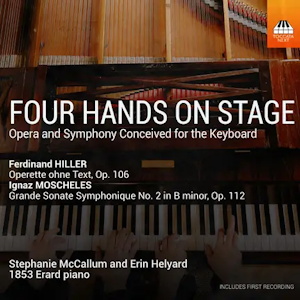
Four Hands on Stage: Opera and Symphony Conceived for the Keyboard
Ferdinand Hiller (1811-1885)
Operette ohne Text Op.106 (publ.1864)
Ignaz Moscheles (1794-1870)
Grande Sonate Symphonique No.2 in B Minor Op.112 (1845)
Stephanie McCallum (piano primo), Erin Helyard (piano secondo)
rec. 2025 Recital Hall West, Conservatorium of Music, Sydney, Australia
Toccata Next TOCN0042 [79]
This is the third in a continuing, one hopes, series which explores the less-well known piano four-hand repertoire from its heyday in the 19th century, venturing a little into the 20th. The first two discs are Four Hands for France (review) and Four Hands at Home (Toccata Next TOCN0031). The reviewer considered the performances “perfection”. I would be extremely sparing with this word but I can agree that the performances in the third volume are of a consistently high standard.
The piano duet repertoire is huge and, like solo piano music, vast swathes of it lie forgotten. Yet at one time it was an essential part of domestic entertainment. It brought music into the home and allowed people to get to know work that they would otherwise be unlikely to have the opportunity to hear: four-hand arrangements of symphonies, overtures, ballets and more sat alongside thousands of original works. In an ironic twist, compact discs and streaming platforms are introducing us to piano four-hand music that we would not otherwise hear. I think I can safely say that both the works here sit firmly in that category. Ferdinand Hiller and Ignaz Moscheles created a new genre with works that would normally be vocal or orchestral. They wrote pieces specifically for piano duet rather than arrangements.
Hiller was born within a year or two of such giants as Chopin, Liszt, Schumann and Mendelssohn. In his years in Paris and Leipzig, he was firmly in the circle of these composers. In Leipzig, he was Mendelssohn’s deputy. He went on to be Kapellmeister in Düsseldorf and Cologne, where Max Bruch was among his pupils. His vast output takes in most genres, though it is heavy on piano and vocal music. There are at least nine operas, none successful. It was in other fields that he made his mark as a composer. Eight of his operas are of the conventional type with singers, a chorus, orchestra, libretto as well as, one assumes, scenery and the other accoutrements of the spectacle that opera had been from the outset.
The ninth opera, heard here in its first recording, is an operetta without text, a one-acter that re-imagines the elements of romantic opera in terms of piano duet. An overture is essential, of course. The majestic chordal opening to Hiller’s work gives way to a second section, lyrical and reminiscent of Schubert in its theme. More spirited music makes up the rest of the overture and suggests that even in its darker passages this is not a melodrama.
Mendelssohn is the model for the Maiden’s Romance, a touchingly sentimental number; the gentle mood is soon dispelled by the urgent Polterarie, an exuberant crowd scene in which one can hear shouting voices within the tumult. “Polterei” means “rowdiness” (hence poltergeist, noisy spirit) but some of the music is far too jaunty to imply a violent mob. A jolly hunters’ chorus brings early German romantic opera to mind, especially Weber, but Schumann is a big influence in this rollicking ride. This particular chorus had a life outside the operatta when it was given text and arranged for male choir and three horns. The romantic lead then has his time in the spotlight in a rather sad but beautiful romance while the duettino to my mind clearly features soprano and baritone in animated discussion.
Hiller’s drinking chorus is more earthy than Verdi’s frothy brindisi. I love the description of its doleful slow middle section: Katzenjammerlichlamente (“hangovery lament”, German Katzenjammer, literally “cat’s wail”, combined with Italian lamento). The riotous drinking is left behind as marching footsteps approach; oddly enough for a march, I kept thinking of Waltzing Matilda in part of its theme. The terzetto begins with a lower voice but grows in complexity as first another voice then a third add their threads to the weave. I have to say that the intricate writing appeals, and I would love to hear this actually given to voices. The ladies of the chorus join in a waltz over a teasing rhythmic accompaniment, and then we get a dance number that contrasts the rhythmic vigour of the hunters’ chorus with a sinuous waltz. All hands are on deck for the closing scene, a grand finale that ties the work together with music from the overture.
The work seems to have been widely performed at the time. Hiller himself joined Clara Schumann in a performance. While acknowledging its charm and skill, critics wondered about its limited appeal as a concert piece, a consideration that holds today. How would you programme it? Hopefully this recording will at least inspire some duettists to take it up and explore its dramatic and melodic inventiveness.
Like his friend Hiller, Bohemian pianist and composer Ignaz Moscheles was friendly with many musicians. Those included Beethoven, whose music he actively promoted, and Mendelssohn, a one-time pupil who became a close friend. Moscheles lived long enough for his classical side to be old-fashioned compared to the likes of Liszt, Chopin and Wagner. He was nonetheless an influential figure in 19th century music. His music was well received even if his single orchestral symphony from his mid-thirties was reviewed negatively. Critics deemed it “laboured” and “mediocre”, while Schumann’s diary noted “don’t write a second one, Moscheles!” He evidently took the poor reception to heart. Orchestral, mostly concertante, works are thin on the ground in the remaining forty-odd years of his life. He concentrated on piano music, with songs and chamber music along the way.
The present work clearly filled Moscheles’s desire to write a symphony but employing the instrument that was his soul. The first of four movements starts with grand gestures that suggest brass over tremolando strings. This andante patetico introduction precedes the allegro proper, jauntily optimistic even if the central development has plenty of drama amid its skilfully woven textures. The introductory music makes a reappearance before the coda. The andante espressivo is a gentle song without words whose only outbursts are brass and wind interjections as the strings play sequences of descending runs – or at least that what I feel is suggested.
Moscheles brings bluff humour to his scherzo alla tedesca antico, like some slightly tipsy German minuet. The trio has more grace with its delicate decorated figuration. The longest movement, the finale, echoes some of the first movement’s introductory theme. Moscheles introduces a chorale – Lob, Ehr und Preis – after this and before he gets into the stern allegro con brio; these ideas both feature strongly in the movement. Echoes of Mendelssohn can be heard in the outer movements, and the chorale is an even closer connection. Mendelssohn wrote his second symphony Lobgesang just a few years earlier. After attending a Vienna performance, Moscheles wrote how it stood so far beyond the music around it: “it was an enormous pleasure for me but it was though I was sitting on a piece of lush grass surrounded by a sheet of ice”. We can imagine the finale as a celebration of Mendelssohn (he was to die just four years later with Moscheles present as he passed).
As with Hiller’s work, there would seem to be limited scope for public performances for a symphonic piano duet sonata. Certainly, however, those who enjoy playing duet transcriptions of Beethoven symphonies may find is a logical next step. The music is engaging, and I defy anyone to spurn the delightful scherzo.
As I said, the performances are first-rate. Stephanie McCallum and Erin Helyard play again their 1853 Erard. It has an appealing tone and allows great contrast of textures. This is a fine addition to this continuing series, and I hope it is not the last.
Rob Challinor
Buying this recording via the link below generates revenue for MWI, which helps the site remain free