
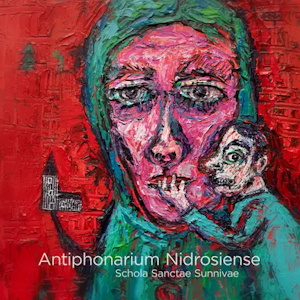
Antiphonarium Nidrosiense
– Gregorian chant from Nidaros
Henning Sommerro (b. 1953)
Praeludes & Interludes*
Schola Sanctae Sunnivae
Anne Kleivset (conductor)
Vegar Sandholt (bells), Oluf Dimitri Røe (fiddle and vocals), Lars Sitter (percussion)*
rec. May 2023, 2024 and 2025, Nidaros Cathedral, Trondheim, Norway
2L-181-SABD [2 Hybrid SACD + Blu-ray: 143]
Based in Trondheim, ensemble Schola Sanctae Sunnivae was established in 1992 and specialises in preserving Gregorian chant associated with Nidaros and Norwegian medieval history, restoration and recording significant parts of Gregorian chant material preserved from Nidaros and now stored at the Royal Library in Copenhagen. The Schola’s activities have resulted in several CD productions, including a previous 2L album from 2010, Plainchant from Norway (review) which also includes music by Henning Sommerro.
This double-disc album revives one of Norway’s greatest medieval treasures. The manuscripts sung here were written for Nidaros Cathedral in Trondheim between 1250 and 1275, surviving the Reformation having been recycled as bindings for someone’s accounts. What we have here are chants for four feasts from the Liturgy of the Hours: St Olav (the national saint), the Exaltation of the Cross, Saints Peter and Paul, and Mary Magdalene.
This is the biggest result of Anne Kleivset’s extended project to date, working with Professor Eugeen Liven d’Abelardo to reconstruct this manuscript. It is sung superbly and recorded in Nidaros Cathedral by Morten Lindberg in stunning sound, with the acoustic of the cathedral very much a part of the listening experience, especially in SACD surround sound.
Subtly framing and enhancing each set of chants and using musical material drawn from the Medieval originals, Henning Sommerro has composed a series of Praeludes & Interludes that create a certain amount of contrast around this Liturgy of the Hours. They have been inserted where the traditional liturgy would have featured scripture readings, either that or making a transition into each hour of prayer. These mostly brief passages create an intriguing blend of ancient and modern, with bells inspired by the carillon of Nidaros Cathedral, and the deep resonance of a marimba being somewhat out of place and time while somehow inhabiting a comparable spiritual space. Oluf Dimitri Røe’s fiddle is introduced later in the programme, adding its own folk-music air of melancholy. When these instruments join the voices of Schola Sanctae Sunnivae we get a true blend of old and new, not dissimilar in effect to saxophonist Jan Garbarek’s work with the Hilliard Ensemble.
Schola Sanctae Sunnivae’s vocal style comes from the very earliest of written performance indications, thus giving this ancient music a feel of authenticity, and a link to a past both vanished and, in this way, recoverable. This was never music intended for concert performance, and there is no way we can reproduce the religious significance of its origins today. Even with Henning Sommerro’s additional pieces these hours of unison female voices are perhaps best taken as a kind of immersive, minimal experience. Gregorian chant had its big trend in the mid 1990s and has subsided in popularity since, but with the ‘Holy minimalism’ of more recent years it can still have its place. Even as a big fan of much of this kind of music such an extended quantity of monody can seem pretty relentless, though the second Officium disc of this set is more contrast-filled, with Henning Sommerro’s additions taking on a more substantive role. This release is very nicely presented with its two SACD hybrid and Blu-ray discs, with a booklet that includes all sung texts and lots of photos and annotations.
Dominy Clements
Buying this recording via the link below generates revenue for MWI, which helps the site remain free
Contents
In natalacio beati Olavi Martyris
Ad primas vesperas
Ad matutinas
In exaltatione Crucis
Ad primas vesperas
Ad matutinas
Officium SS. Apostolorum Petri et Pauli
Ad primas vesperas
Ad matutinas
Officium Mariae Magdalenae
Ad Laudes
Ad secundas vesperas













