
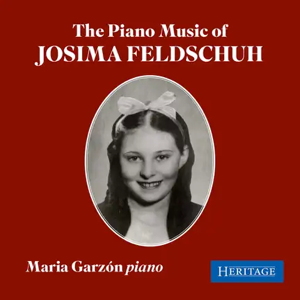
Josima Feldschuh (1929-1943)
María Garzón (piano)
rec. 2026 St George’s Church, Pinner, Harrow, UK
Heritage HTGCD115 [68]
Josima Feldschuh was one of those unfortunates whose birth brought them into a time when their culture, rights, lives and very identity were threatened by the rise of fascism. She was born in Poland to a musical family and became a gifted pianist at a young age under her mother’s guidance. When she was just eleven, the Nazis forced Jews into the Warsaw ghetto, but her musical life continued. In March 1941, she debuted in Mozart’s Piano Concerto No.9 with the Jewish Symphony Orchestra, alongside some of her own compositions.
The Feldschuh family managed to escape the ghetto in 1943, but tragically Josima contracted tuberculosis and died at fourteen in April that year. Incredibly, several of her compositions also escaped the turmoil and confusion of the war. The scores are now preserved in the Yad Vashem archives. The archive has digitised her musical notebooks. A note in the booklet says that María Garzón has made a performing edition, which explains the slight discrepancies between what is written and what is heard. It must be said that the music is all Feldschuh’s, nothing added. For instance, the middle section of the Rhapsodie is repeated, so the piece is more balanced; the arpeggios of The Murmur of a Stream are doubled – to give more of a feel of flow to the accompaniment – but unchanged harmonically.
At their best, the pieces here are highly evocative, so those repeated notes in the Rhapsodie suggest a cimbalom, especially combined with the unusual scale formed by its rising and falling patterns. The rhapsodic element is in its contrasting sections, a short reflective motif and a series of rising chords. The tale that the bird tells in Feldschuh’s op.1 is evidently fairly jolly, considering that it is a quirky polka full of the bird’s trilling. The restless water in The Murmur of a Stream is represented by flowing arpeggios. They accompany a dark-hued folk-like theme that moves from treble to baritone, pausing only to allow the accompaniment to slide chromatically within its bass register.
The first of the four sections that make up the Oriental Suite is first cousin to the theme of the previous work. It is a fantasie that contrasts a simple alberti bass with dramatic unison octaves. The other movements are an elegiac mazurka, a fantasy similar to the first and another, slightly happier mazurka. The overall feel is redolent of Polish folk music with no sense of the Orient that I can discern.
The mazurka was evidently close to Feldschuh’s heart: six more follow. Chopin is an obvious model and some of the decoration in the final three explores his writing style. In her notes, Garzón describes op.7 as the most melancholy but I find all but the quite light-hearted first mazurka in A major have an elegiac, sad quality. As an aside, op.7 and op.9 are in C minor and G sharp minor respectively, not the major keys described in the notes. Another dance is the stamping dance describing Village Musicians. Doubtless this is fun for the dancers, all humour and stomping on the floor, all the more so if they are merry courtesy of liquid refreshment. Musically, it comes across as a rather grim and stern piece.
The six-minute waltz is the second longest work after the Oriental Suite. It is a very elegant slow waltz in several sections, much like Chopin’s model, though Chopin’s ghost does not hover over this salon creation. It is mostly restrained but has some delicately sparkling figuration along the way. Another Polish dance, the Kujawiak, is next, a sort of Polish polka, though this example morphs into a waltz in its central section. Then there are two Sabbathiades, pieces for resting-day performances. Like the Kujawiak, the first leaves its opening material, a sombre Jewish melody, to venture into waltz territory. The second continues the melancholy feel of so many of these pieces and features the triplet repeated note figuration that was evidently a Feldschuh signature motif.
We have heard mazurkas and waltzes, so perhaps a nocturne is expected. This attractive if sad piece has something of Chopin in the flow of its line. The disc closes with a Sonata, perhaps the first movement of a longer work that was left unfinished at Feldschuh’s escape and untimely death. It follows classical models with echoes of Mozart and Haydn.
María Garzón has done an admirable job in lifting these pieces from the tattered-edge pages of a single music book, all that remains of a promising talent. For her, these are musical jewels. It cannot be denied that they are attractive in their modest way, though for me they mostly represent the potential that was lost. Who knows where this young composer, eager to show what women could achieve in music, would have done had she not been struck down barely into her teen years.
Rob Challinor
Buying this recording via the link below generates revenue for MWI, which helps the site remain free
Contents
A Bird Tells a Story Op.1
Rhapsodie Op.2
The Murmur of a Stream Op.3
Oriental Suite Op.4
Mazurek No.1 Op.5
Mazurek No.2 Op.6
Mazurek No.3 Op.7
Mazurek No.4 Op.8
Mazurek No.5 Op.9
Mazurek No.6 Op.10
Village Musicians Op.11
Waltz Op.12
Kujawiak Op.13
Sabbathiade No.1 Op.14
Sabbathiade No.2 Op.15
Nocturne Op.16
Sonata Op. 17













