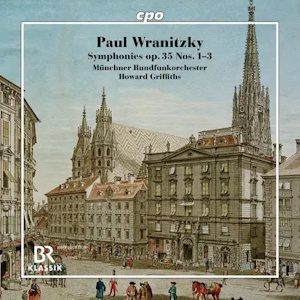
Paul Wranitzky (1756-1808)
Symphonies Op 35
Symphony in C major No 1 (P1)
Symphony in G major No 2 (P40)
Symphony in Eb Major (P32)
rec. 2024-25, Studio 1 des Bayerischen Rundfunks, Munich
Munich Radio Orchestra/Howard Griffiths
cpo 555 715-2 (72)
Composer Paul Wranitzky was born in what was then called ‘Bohemia’ and settled in Vienna. He made a great success of composing for the city’s orchestras and chamber ensembles, the Emperor and his family – especially Maria Theresa – and for the theatre. Very little of his music has been recorded, so in typical cpo style, these little masterpieces have been brought to life.
There are upwards of fifty symphonies by Wranitzky as well as sixty string quartets and other chamber works; there are also some choral pieces. He was not unknown to Haydn or Beethoven, whom, it seems, and probably not surprisingly, he often visited. But as you listen to these works, it is also not surprising that his symphonies were so popular even competing with Haydn. For a while in the 1780s, these works were heard very regularly in Leipzig at the Gewandhaus concerts, and they were published. His successful singspiel Oberon, King of the Elves (1789) would surely have been known to Weber who admired him. By 1800, Wranitzky was in the centre of Viennese musical life.
The three symphonies recorded here were published in that year by the reputable company of André and formed the conclusion to a set of nine which were started in 1797, one of which was a so-called ‘Peace Symphony’ in C minor Op 31 (Chandos 9916). It’s also worth looking out for Wranitzky’s Symphonies Opp. 31 and 5 (cpo 777054-2), again conducted by Howard Griffiths (2005).
Each of these four symphonies is in four movements, and the format is similar and typical of the period with the Menuetto being placed third; in the Eb symphony the graceful lyrical lines reminded me of J.C. Bach. The second movement is the slowest but, in the C major Symphony, is given unusual impetus by being marked Allegretto con moto. The ensuing Minuetto is actually a little steadier being marked Un poco allegretto – perhaps a precursor of the sort of pieces Beethoven was to compose as his so-called Menuettos.
You might agree as you listen that the music surely ranks alongside Haydn and at times even Mozart – and there is no doubt that Wranitzky is a fine composer and orchestrator, especially with his attractive use of woodwind, most noticeably in the finale of the Eb Symphony. However, on more careful consideration, one realises that he mostly lacks the wit of Haydn, even though his music is by no means solemn, and he lacks the arresting, individuality of the ideas heard in Mozart’s symphonies – but he does, generally, hold your attention.
The performances are excellent and convey the energy encountered in these works, particularly in the sonata-form opening movements. The recording, likewise, is immediate and spacious. Even more remarkable, to my mind, is the in-depth analysis of each movement which you can read (admittedly in a tiny font) by Bert Hagels. It is quite surprising to read of the wide-ranging modulations that the composer employed. Hagels also writes a great deal about the not-always-happy biography of this rather mysterious and overlooked composer.
You don’t need to be an especial devotee of early Viennese symphonies to enjoy this music; I suggest that they are, without doubt, worth exploring.
Gary Higginson
Buying this recording via the link below generates revenue for MWI, which helps the site remain free