
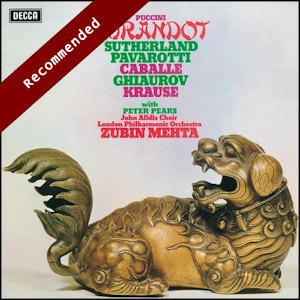
Giacomo Puccini (1858-1924)
Turandot
La principessa Turandot – Joan Sutherland
Calaf – Luciano Pavarotti
Liù – Montserrat Caballé
Ping – Tom Krause
Pang – Pier Francesco Poli
Pong – Piero De Palma
Timur – Nicolai Ghiaurov
L’imperatore Altoum – Peter Pears
Un mandarino – Sabin Markov
John Alldis Choir; Wandsworth School Boys’ Choir
London Philharmonic Orchestra/Zubin Mehta
rec. 10-22 August, 1972, Kingsway Hall, London
Italian text, English, French & German translations included
Decca 4871873 SACD [118]
Over the last few years, I’ve reviewed several of the reissues by Decca of landmark recordings in their catalogue, including the Solti Ring, Britten’s War Requiem and Karajan’s 1972 recording of La Bohème. These have been sumptuous – and expensive – remasterings and I’ve greatly admired every one of them. There’s been one recording, though, that I’ve been very keen to hear in the remastered SACD format: the 1972 recording of Turandot conducted by Zubin Mehta and sung by a stellar cast. Now here it is. I’ve long thought that the CD version of this recording sounds marvellous but I wondered what difference the SACD enhancement would make.
I once asked my colleague Ralph Moore why his collection of recorded surveys did not include one for this opera. He explained that in his opinion the Mehta recording was ‘untouchable’. He will have heard far more recordings of the opera than I have but my own experience of the CDs supported that view. In fact, Ralph has gathered together comments on a number of these ‘untouchable’ recordings, including Turandot, and you can read his thoughts on the Mehta set here. Returning to this recording after a while has only confirmed for me that Ralph was right to declare it as an ‘untouchable’. It is one of those recordings of which one can truly say, there wasn’t a weak link in the cast. Let’s consider the key elements.
Right at the start we hear the Bulgarian baritone Sabin Markov (1935-1993). His may be one of the less famous names in the cast, and his role is a limited one, but he makes a most impressive Mandarin; his delivery is strong, firm and authoritative. Much more prominent in the action are the three ministers, Ping, Pang and Pong. They’re not the most sympathetic of characters – they’re far too interested in protecting and advancing their positions at court. They also have an unpleasant side, as shown at the end of Act II, scene 1 when they say with some relish ‘Let’s go and enjoy the umpteenth execution’. Tom Krause, Pier Francesco Poli and Piero De Palma bring these self-centred characters vividly to life. Much of their music is fast paced, and their delivery has pin-point accuracy. Puccini does give them one episode in which the trio can show their lyrical qualities. That comes earlier in Act II, scene 1 where they wistfully recall their rural properties away from the imperial court; all three are in fine voice during this passage.
Peter Pears was a very surprising choice to sing the role of the Emperor; how much persuading did he need, I wonder? I don’t know who thought of Pears for this part but the decision was inspired. He was sixty-two when the sessions took place so he has credibility as a senior statesman. What strikes me, though, is the sound of his voice. It’s more open-throated than I have been accustomed to hearing at this stage in his career and also darker. For me, though, the key thing is that Pears sounds a bit different from the other cast members and I think that, given he’s portraying an ageing emperor, that’s quite fitting. His contribution is as fine as his involvement was unexpected.
Another Bulgarian singer, the bass Nicolai Ghiaurov, took the role of Timur. He’s highly impressive. His voice is full, rich and very evenly produced. I think Roger Pines hits the nail on the head in his booklet essay when he comments that Ghiaurov “lavishes on Timur’s music his unmistakable mahogany timbre, as well as a grandeur the role is often denied”. I’d add to that my own observation that the two things which draw me to Ghiaurov’s portrayal and move me are the compassion and dignity which one hears. Vainly does he try, in Act 1, to dissuade Calaf from pursuing Turandot. Just as affecting is his dignified distress after Liù’s self-sacrifice in Act III, scene 1.
The role of Liù is taken by Montserrat Caballé. I learned from Roger Pines’ essay that by the time this recording was made Caballé had retired the role from her repertoire. What a good job she agreed to reprise the part for this recording. Incidentally, among the many photographs in the lavish booklet are two showing Pavarotti as Calaf in a 1977 production at the San Francisco Opera. Pictured with him, in the title role, is Caballé. Here, she’s quite wonderful as Liù. Her delivery of ‘Signore, ascolta!’ in Act I is very moving; Caballé’s singing is very expressive and technically superb. Everything that Caballé sings engages our sympathies completely and nowhere more so than in Act III where she defies Turandot by refusing to give up the secret of Calaf’s name. ‘Tu che di gel sei cinta’ is deeply felt, dignified and defiant.
We have to wait until Act II, scene 2 to hear Turandot herself – though she appears earlier, without singing, to deny clemency to the Prince of Persia with a dismissive gesture. It’s worth the wait, though. Joan Sutherland’s ‘In questa Reggia’ is magnificent. Her singing of this aria is imperious and compelling, even when she’s not in full voice. At ‘Quel grido e quella morte’ the voice opens up to its full splendour. She had never sung the role of Turandot prior to this recording – nor would she in the future – but you would never know. The booklet includes an essay by Katherine Cooper in which she discusses Sutherland and the role of Turandot. She comments that the high tessitura actually suited Sutherland’s voice, as did her experience in other roles. I think, though, that one of the most interesting points that Ms Cooper makes comes when she discusses the question of temperament. She observes that, as Turandot, Sutherland “radiates a glacial, ethereal queenliness which amply justifies the many ice metaphors in the libretto”. I didn’t read this essay until after I’d finished my listening but I think that the glacial quality, allied to imperiousness, fits with what I heard. In the Riddle Scene, which is a high point of the entire performance, Sutherland conveys Turandot’s shifting emotions, from the haughty manner in which she poses the riddles to her great apprehension when Calaf solves them all. Later on, in the big scene between Turandot and Calaf in Act III – another high point – sparks really fly on both sides. Here, Sutherland’s singing is magnificent, her characterisation absolutely riveting. Would she have been wholly convincing on stage as Turandot? We shall never know, but on this recording she triumphs.
Pavarotti is just as impressive. My goodness, 1972 was something of an annus mirabilis for him. In October he would achieve a huge success as Rodolfo in Karajan’s superb recording of La Bohème (review). Just a couple of months before that assignment he was Calaf in this recording. Of course, everyone is familiar with his singing of ‘Nessun dorma’, but don’t bother with his 1990 Three Tenors version, or the later ones; this 1972 performance, given when he was in sovereign voice, is the real deal. I should hasten to add that the rest of his singing in this recording is equally fine. In the booklet, the tenor Freddie de Tommaso expresses the view that Pavarotti was “very brave to take the role on”. He observes that by 1972 he had not essayed the role on stage and, furthermore, that the part of Calaf was a dramatic role, somewhat removed from his hitherto signature roles. Of course, in a studio recording, Pavarotti would have been able to pace himself to an extent that’s not possible in a staged performance. Even allowing for that, though, I think his achievement here is significant. Every time he sings I am struck by the open-throated ease and the ardour of his singing. Furthermore, there’s often a terrific dramatic edge to his performance – he’s riveting in the Riddle Scene, for example. Consistently, his voice has a clarity and ring to it that is truly exciting.
Having commented on the soloists, I should add that the chorus singing and orchestral playing is of the highest possible order. It was probably quite a novel collective experience for the LPO to participate in an opera in those days but they play marvellously and as to the manner born. Every aspect of the John Alldis Choir’s contribution is exciting. The young singers from the Wandsworth School Boys’ Choir also do very well indeed. Clearly, the two choirs had been thoroughly prepared by their respective directors, John Alldis and Russell Burgess.
Presiding over all this was Zubin Mehta. Then aged thirty-six, he already had several years under his belt as Music Director of the Los Angeles Philharmonic, though I don’t know how much opera he had conducted. He’s on fire here. He clearly galvanised the chorus and orchestra – all the big moments are thrilling – and he keeps the action moving forward with a sure hand. He also appears to be at one with all his soloists. Did he ever do anything better in the recording studio, I wonder? I rather doubt it.
The musical side of this recording is memorable; what about the sound quality? The sessions took place in London’s Kingsway Hall, an ideal venue for a big-scale work such as this, Decca assembled not just a superb cast for this project but also a most distinguished technical team consisting of producer John Mordler and engineers Kenneth Wilkinson, James Lock and Peter Van Biene. In whatever format you listen to this Turandot, I defy anyone to say that the sonic results are anything less than spectacular. The several big ensembles have a thrilling amplitude and a panoramic, wide-stage sense. Left-right and front-to-back perspectives are expertly achieved by the engineers. The recording has a terrific dynamic range and is ideally balanced; you don’t miss a note from any of the soloists but, just as importantly, all the inner detail is fully audible. There are several points in the score when distant voices are heard; in each case it’s evident that the production team took considerable trouble to get the distancing just right. There’s tremendous immediacy and impact to the sound. In short, this is a recording with genuine presence. Can it be improved on through remastering?
This latest iteration of the recording is a new DSD remastering from the original analogue master tapes. The remastering engineer was Ian Watson, working with reissue producers Dominic Fyfe and Andrew Rolland. When I first listened to the SACDs I thought the recorded sound was superb but the next step was to attempt some comparisons with my CDs.
It had been a little while since I’d listened to the CDs and it was pleasing to be reminded just how handsome the music sounds in that format. I chose my comparison sections carefully and I set up my system so that I could play each of the selected passages simultaneously on my two Marantz players, switching back and forth between them as the music played. First, I listened to the opening few minutes of Act I. On CD the sound was bright and immediate, yet not lacking in depth. There was great presence to Sabin Markov’s voice, and, indeed, on all the voices. The SACD had a similar impact but I felt there was a touch more fullness and depth to the sound. Comparison with the CD suggested that the remastered sound was a bit less bright (which I welcome) and also offered a little more bass – though on CD the bass is scarcely lacking. The voices of Caballé and Ghiaurov seemed to be a little more to the fore when I listened to the SACD. Pavarotti’s voice has a thrilling edge to it in both formats. Next, I listened to Liù’s solo ‘Signore, ascolta!’ and Calaf’s ‘Non piangere, Liù!’ which immediately follows it. Truth to tell, there was little to choose between the two formats.
My next samples came from Act II. I listened to the crowd greeting the Wise Men, bearing the answers to Turandot’s riddles (‘Gravi, enormi ed imponenti’’). This sounds magnificent in both formats and, again, hand on heart, I found little to choose between them. I came to the conclusion, though, that the CD sound was a little brighter and I preferred the slightly greater body and fullness of the SACD. Then it was on to the key sonic test of any recording of this opera: ‘In questa Reggia’ and the subsequent Riddle Scene. Whichever format you choose, the Decca engineers made a superb job of this extended episode. Sutherland’s voice is like a laser, both on CD and on SACD. When it comes to her hurling out the challenges of the three riddles to Calaf and his responses, the electricity in the performance is palpable and the engineers convey this vividly. Once again, I found the SACD sound had just a degree more body and richness, though the CD is mightily impressive too.
Perhaps inevitably, my final comparison was ‘Nessun dorma’. For this, I slightly changed my methodology. I listened to the CD and SACD one after the other on my CD player. This meant that I sacrificed the SACD stereo layer but as these are hybrid discs, I thought that was a legitimate test and it meant I was hearing both discs through the same player and circuitry. Once again, the SACD demonstrated rather more depth and presence as compared to the CD but this time the result was a bit more in favour of the remastered sound.
Where do these comparisons leave us? Obviously, different equipment will produce different results. I think the remastered sound is superb but the recording comes across marvellously on CD as well. A while ago, I reviewed three of the four instalments of Decca’s Ring cycle and came to the conclusion that the SACD remastering was a clear winner, not only when compared to the original CD releases but also to a subsequent Blu-ray reissue of the cycle. If I’m honest, I don’t think the difference between the CDs and SACDs of Turandot is as significant. Out of interest, I looked back at my review of the Karajan recording of La Bohème and saw that I’d reached a similar conclusion. I suspect the truth is that by the early 1970s Decca engineering was so good that it’s more of a challenge for a remastering process to ‘squeeze more juice’ out of a recording than is the case when remastering a recording from, say, the early 1960s. If you already have this classic recording of Turandot on CD you may feel that you can rest content. However, it could well be worth sampling the short extracts which some retailers make available online in order to reach your own conclusions. If you don’t already own this recording then the remastered sound will thrill you, I’m sure. It then comes down to price. Currently, UK retailers seem to be offering this new version in either the SACD or Vinyl LP versions (three LPs) for just over £100 – I haven’t heard the LPs. A digital download may be a more affordable option, especially if you already own the CDs. As an example, I see that Presto Classical are advertising digital downloads in four formats at prices which are significantly cheaper than the discs or LPs. However, it seems that no digital booklet is available and therefore you’ll miss out on the documentation which accompanies the physical sets.
The documentation accompanying the SACDs is lavish. Everything comes housed in a stout and handsome box, which is LP-size. I’ve referred throughout this review to the ‘booklet’ but, frankly, that’s almost an insult. You get four excellent essays and the full libretto, with translations in three languages; the essays, though, are only in English and German. There are also copious illustrations. The documentation, like the performance and the recorded sound, oozes quality.
There are one or two presentational differences between the new release and the CD version of which readers may like to be aware. For the sake of clarity, my CD set appears to date from 1984; I don’t know if there have been later versions, which may not be identical. The most significant difference is that on my CD set it was necessary to make a break between discs immediately before ‘In questa Reggia’ (the CDs have running times of 56:08 and 61:00). Nowadays, much longer playing times are feasible so all of Acts I and II are contained on the first SACD, which runs for 78:01; Act III is contained on the second disc (39:38). For this new release Roger Pines has written an excellent essay which focusses mainly on the recording itself. (William Weaver’s equally good essay about the opera, written for the 1973 original release, is common to both CD and SACD.) Pines points out that Decca used the pruned version of Alfano’s completion of Act III, as has been the case with most recordings. Oddly, though, in the booklet for these SACDs Decca only print the libretto up to the end of Act III, scene 1, whereas in the CD booklet they gave us the libretto for the fragmentary bit of scene 2; that’s much more satisfactory for domestic listening and I wonder why a different approach was taken this time round.
The bottom line is this. Decca’s Turandot is a magnificent achievement. It’s one of those recordings that truly deserves that old tag ‘A classic of the gramophone’. It belongs in any opera lover’s collection. The recording is now fifty-four years old and it still sounds superb. My colleague Ralph Moore said this: “It is astonishing that this remains the principal recommendation for a stereo, studio recording after so long. There are plenty of others I value highly…but none has the advantage of the big, warm analogue sound we are given here and none fields a quartet of great singers like this; they are all at their very best in 1972. Furthermore, we hear Mehta conducting the recording of his career…” I could not agree more and I strongly suspect that it will retain its ‘best in show’ tag for some time to come.
One final thought. On more than one occasion in the past, we auditioned in the Musicweb Listening Studio the Decca remasterings to which I referred in my opening paragraph. Almost invariably, my late colleague Len Mullenger commented that the work which he would most like to see given the SACD treatment by Decca would be Britten’s own classic recording of Peter Grimes, made in December 1958. I wouldn’t disagree. It would be a great way to mark the 50th anniversary of the composer’s death if Decca could give this important recording a refresh. I rather think the results could be spectacular.
John Quinn
Buying this recording via the link below generates revenue for MWI, which helps the site remain free













