
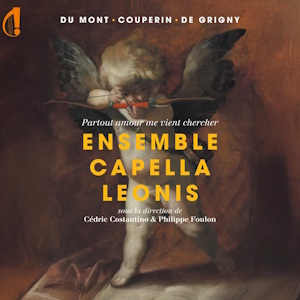
Partout amour me vient chercher
Ensemble Capella Leonis/Cédric Costantino, Philippe Foulon
rec. 2022, Chapelle-Haute, Saint-Michel-l’Observatoire, France
Lyrics and translations included
Reviewed as a download
Indesens IC094 [79]
It is always nice to encounter a recording which leaves the well-trodden paths and this disc just such a recording, in terms of both the repertoire and the way it is performed.
The programme is devoted to music written in France during the 17th century, covering the reigns of Louis XIII and Louis XIV. That in itself is not unusual; quite a number of recordings include such music, either vocal or instrumental, sacred or secular. Most items here are specimens of secular vocal music, generally known as airs de cour. However, the core of the programme is the oeuvre of Henry du Mont, who is almost exclusively known for his sacred music.
Du Mont was not of French birth. He was born near Liège in the Southern Netherlands – the present-day Belgium – and worked for a while in that region as well as in Maastricht. It is probably in Liège where he was influenced by Léonard Hodemont (c1575-1636) who from 1619 to 1633 was maître de chant of the Cathedral. He was strongly influenced by the new Italian concertato style, as his compositions prove. This also left its mark in the oeuvre of Henry du Mont, and that comes to the fore in Cantica Sacra of 1652, the first publication of music by Du Mont. The Italian features in this collection are manifold. It contained the first sacred compositions with a basso continuo part ever printed in France. The declamatory style in the solo parts – both in pieces for few voices as well as solo passages in four-part compositions – reflects the Italian concertato style. This goes hand in hand with eloquent text expression. Also Italian is the use of instruments in a concertante role.
Du Mont’s presence in Paris is documented for the first time in 1643 when he was appointed organist of St Paul. In the next years he developed into an important figure in the Parisian music scene and in 1647 he was granted French nationality. In 1660 he was given the post of organist to Queen Marie-Thérèse whom Louis XIV had just married. In 1663 he became one of the sous-maîtres of the Royal Chapel, a position he first shared with three colleagues but from 1668 onwards with only one of them, Pierre Robert. He was a prolific composer of grand motets. He did not invent this genre, but – together with Robert – he developed it into the main form of sacred music during the reign of Louis XIV.
Du Mont is rather well represented on disc, but if I have a look into my collection of recordings, these exclusively focus on his sacred music. However, he also composed secular works. They are called chansons, but stylistically they belong among the genre of the air de cour. Such pieces came in two kinds: on the one hand songs for a solo voice (or a few voices) with lute accompaniment, and later with basso continuo, and on the other hand polyphonic airs, which were meant for performance by professionals. The latter are included in the collection Meslanges, published in 1657. What is especially interesting – and there they may be different from polyphonic airs by other composers – is that they open with instrumental introductions in two parts for violins or viols. In a later edition Du Mont added a third part. The chansons are also set for three voices, but can be performed with two; in such cases one voice can be performed instrumentally. In these pieces Du Mont again added a basso continuo part, which is optional. These features show that Du Mont, like many of his contemporaries, was pragmatic. His indication that the chansons can be transposed also attests to that.
The musicologist Myrielle Schnewlin, in her liner-notes, mentions that Du Mont adopted elements of the French style in that he wrote his chansons in the bipartite form of the French air de cour. He also “exercised a certain restraint in the expression of emotions.” It is interesting here to quote the music theorist Marin Mersenne, about the difference between French and Italian airs. The latter “depict as best they can the passions and affections of the soul and mind; for example, anger, fury, spite… one would almost think they are touched by the very same affections they represent while singing; whereas our French are content to flatter the ear and use a perpetual sweetness in their songs; which impedes their energy”. An example of this is the last item in the programme: Ô mort, l’objet de mes plaisirs by Antoine Boësset. However, he was (and still is) highly appreciated for a reason. His airs are certainly expressive, but in a different way, and one can only admire his melodic gifts. This air is a superb example of his art, and a worthy conclusion of the programme.
There is one other genre in Du Mont’s oeuvre that is given some attention here, although with just one specimen. Quand l’esprit accablé is a setting of a paraphrase of Psalm 4 (known under the Latin title of Quem invocarem). It is taken from the Airs à 4 et quelques-uns à 3 en forme de motets à la fin du livre, sur la paraphrase de quelques psaumes et cantiques de Messire Antoine Godeau from 1663. Godeau (1605-1672) was a bishop who in 1633 published his French Paraphrases of the Psalms, and completed them in 1648. These were meant as an attempt to convert Protestants to the Catholic Church. During the Reformation in France, the church had discovered how popular the Huguenot Psalter was and how much attraction it exerted. Michel Laplénie, in the liner-notes to the recording “French Psalms of Catholics & Huguenots” with his ensemble Sagittarius (Et’cetera, 2014), states: “Faced with the enormous success of the Huguenot Psalter, the Catholic authorities began to mobilise their own resources and, after a literally combative phase (religious wars, banning of the Psalter) it was decided to mount a more subtle ‘counteroffensive’ by opposing the Huguenot Psalter with a French Psalter translated by catholic poets.”
The oeuvre of Du Mont is extended here with pieces by contemporaries. The best-known of them is Louis Couperin, member of a dynasty of keyboard players, and in particular organists, who were active as such until the late 18th century. According to the liner-notes, he played the violin, but that is a mistake: he was rather a player of the viol, which explains why his oeuvre includes some pieces for a consort of viols. Étienne and Charles Richard were both masters at the harpsichord. The two pieces included here are attributed to one of them. The problem is that their works are only signed with their family name. It is impossible to know for sure whether a piece has been written by which of the two brothers; they can also be of the pen of their father Pierre.
With Dubuisson and Sainte-Colombe we are in the realm of music for the viola da gamba. This was one of the most revered instruments in 17th-century France. Jean Laquement Dubuisson was one of its first masters. Over 110 of his pieces are known; all of them are for unaccompanied viola da gamba. Monsieur de Sainte-Colombe was one of the great virtuosos of the viola da gamba, whose life and identity is a bit of a mystery. Here we have a piece by his son, about whom we know even less than about his father. For no clear reason he is called Jean here, but the recent recording of his complete oeuvre by François Joubert-Caillet and his ensemble L’Achéron (Ricercar, 2024) does not mention a Christian name. I also don’t know where the years of birth and death given here come from. He has been identified with a gambist of that name who appeared in Edinburgh and with one that played in London, but neither of them seems to be the Sainte-Colombe le fils who is included here.
At the start of this review, I mentioned that this recording not only leaves the well-trodden paths in the selection of the repertoire, but also in the way it is performed. That especially concerns the use of instruments. As indicated, Du Mont opens his chansons with an instrumental episode. These are intended for viols, as the viola da gamba was the main string instrument at the time. Violins were almost exclusively used in dance music and as part of the opera orchestra. However, here we find a whole battery of instruments, which are not only used for the instrumental episodes in Du Mont’s chansons, but also in most of the instrumental items (the two pieces for viola da gamba solo are the exceptions).
The programme opens with a piece attributed to the latest composer in the programme: Nicolas de Grigny. He was a highly respected organist, who left one book of organ pieces, including a mass and five hymns, as well as one separate piece. The Ouverture en G resol b par Mr Degrigni could be another piece of his pen, but other members of his family were also active as musicians, which makes it impossble to be sure it is indeed written by Nicolas. This work is performed here on viola d’amore, oboe, two chalumeaus, bassoon and virginals. These same instruments also play in the next piece, Du Mont’s Partout amour me vient chercher. Using different instruments than indicated by the composer was a common practice in the baroque period, but the question is always whether it works. In some cases, it does not. For me the most striking example is Louis Couperin’s Les Carillons de Paris. It is intended for the organ, and I think that it is much more effective played that way than here on oboe, piccolo violins and chalumeau. The Sarabande attributed to Étienne Richard is played on the virginals; it is followed by a double which is performed on a quartet of viole d’amore and tenor chalumeau, which is given a solo role.
Apart from the issue whether the different line-up works well – which is partly a matter of taste – the question is whether the use of some instruments is historically justified. I already mentioned the use of a virginal. On the basis of what I have read in New Grove, it is unlikely that this instrument was used in France. In other cases, one wonders whether some instruments were already known in the 17th century. The viola d’amore was played in late 17th-century Austria (Heinrich Ignaz Franz Biber, for instance, wrote parts for it), but in France in the mid-17th century? The chalumeau is another case. The chalumeau as we know it nowadays (in the liner-notes wrongly described as the predecessor of the clarinet) was used in the 18th century. New Grove mentions a collection of music from 1698 as one of the earliest known sources. The fact that the instruments played here are copies of chalumeaus from around 1700 also points in the direction of a time of existence well after most of the music performed here was written. In other cases, I can’t find anything substantial about the origin and history of an instrument, such as the violoncello d’amore. It is a shame that the booklet does not include information about the history of the instruments and their role in France in the 17th century.
The question, of course, is whether these things really matter. In his introduction to the recording in the booklet, under the title ‘The Colours of Melancholy’, Gabriel Garrido writes: “The instrumentations presented here reflect a certain French gentleness and melancholy, both in the choice of instruments and voices. The blending of timbres takes us away from what we typically hear in historically informed performance. This is a deliberate choice: to lift a veil on private music-making in domestic settings or to explore the fascination of early music scholars, who played with whatever old and new instruments were at hand.” Elsewhere we read: “The goal of this recording is, in fact, not to reproduce a historical instrumental ensemble, but rather to evoke an attitude of the time towards a volume such as Dumont’s, whose writing invites all sorts of instrumental experimentation.” I can’t help but note here a difference from the pretensions of the ensemble as expressed in their biography: “We make it a point of honour to reproduce works with an instrumental palette faithful to the practices of the time, chosen to best serve the musical dramaturgy and the emotions of the text.” I’ll leave it at that, and invite the reader to make up his/her own mind.
Despite the above, this disc is an important addition to the discography. The main reason is the attention given to a part of Henry du Mont’s oeuvre that is hardly known. The only other disc with comparable repertoire I have found is one by the ensemble Musica Favola (Musique en Wallonie, 2010). Du Mont was one of the truly great composers of the 17th century. I have heard quite some music of his pen over the years, and I have always been impressed by its qualities. His sacred music is expressive, and although his chansons are indeed more restrained, they are certainly expressive, but in a different way. This part of his oeuvre deserves more interest, and that also goes for the psalm paraphrases, which are probably closer to his sacred music in Latin. The performances by the Ensemble Capella Leonis are impressive. I can’t remember having heard it before; I hope to hear it again. The singers – Marie Najma and Helena Bregar (dessus), Maximin Marchand (bas dessus), Brice Claviez-Homberg (haute-contre), Benjamin Coutarel (taille), Benoit Descamps (bass) – are outstanding. They have lovely voices, which blend perfectly. They sing with admirable fluency, showing that they are well versed in this kind of repertoire. In Bannissons la mélancolie they show their capabilities in declamatory singing. The psalm Quand l’esprit accablé is a model of expression, and that is perfectly conveyed by the singers. I am happy that they consistently use historical pronunciation, which fits the music so much better than modern pronunciation.
The instruments are also brilliantly played, and it is certainly interesting to hear some uncommon ones. However, their participation in this repertoire raises quite some questions. In this review I can only note them, not discuss them extensively. Those who are interested in 17th-century French music should definitely investigate this disc. It is musically enjoyable and gives much food for thought.
Lastly, some comments about the production. The aim of this recording is to shed light on domestic music making, as Gabriel Garrido writes. The acoustics have the appropriate intimacy. It is praiseworthy that the booklet includes a specification of the line-up for each track. That is most helpful. Also included is an indication of the sources from which the pieces are taken and a specification of the instruments. The original lyrics are followed by an English translation, except the last item, which is a shame. I have already noted some inaccuracies in the liner-notes. The English translation is not entirely satisfying; in several cases viole is translated as viola, which is rather confusing; the correct terms are viol or viola da gamba.
Johan van Veen
http://www.musica-dei-donum.org
https://twitter.com/johanvanveen
https://bsky.app/profile/musicadeidonum.bsky.social
Buying this recording via the link below generates revenue for MWI, which helps the site remain free
Contents
Nicolas de Grigny (1672-1703) (attr)
Ouverture en G-resol-b par Mr Degrigni
Henry du Mont (1610-1684)
Chanson II: Partout amour me vient chercher
Air spirituel VII & Chanson XX: Quand l’esprit accablé (Cum invocarem)
Chanson VII: Je n’ay jamais parlé
Chanson I: Laisse moy soupirer
Louis Couperin (1626-1661)
Les Carillons de Paris
Henry du Mont
Chanson III: Bannissons la mélancolie
Étienne Richard (1621-1669) (attr)
Sarabande & double
Henry du Mont
Chanson IX: Je ne sçay ce que c’est
Charles Richard (1620-1652) (attr)
Prélude d’orgue
Jean Laquement Dubuisson (1622-1680)
Fantaisie
Henry du Mont
Chanson V: Ô mon coeur! Osez-vous aymer Silvie?
Jean de Sainte-Colombe (1660-1720)
Fantaisie en rondeau
Antoine de Boësset (1586-1643)
Ô mort, l’objet de mes plaisirs














Johann van Veen,
J’ai beaucoup de respect pour la langue anglaise aussi j’écris en français : je voudrais vous remercier profondément pour avoir parlé de ce disque, et d’avoir parlé des chanteurs qui le méritent tant ainsi que de l’auteur de la notice de Disque de Myrielle Schnewlin avec son grand travail. Votre notice est rare et précieuse pour nous les musiciens, merci du fond du coeur.. Pour vous inviter à poursuivre votre réflexion musicologique, la notice indique de façon informative la provenance des carillons de Couperin, le manuscrit Philidor des Vieux airs et le manuscrit de l’arsenal pour la contre voix, un manuscrit de premier violon d’orchestre (celui-là même de Degrigny) aussi les Carillons n’ont jamais été pour orgue mais pour violons (et même pas pour violes). De même je vous invite à lire le livre sur le clavecin en France de J.P. Brosse où l’on décrit l’amour pour la facture Rüclkers en Drance, et enfin l’argumentation sur la naissance des chalumeaux en France à cette époque précise de Gilles Thomé, jointe à ce disque dans la notice même, et je reconnais l’absence de description des violes à causes des nombreuses notices de disque de Philippe Foulon qui en parlent abondamment, notamment sur l’amour des violes anglaises. Je suis très reconnaissant à Hicham Leftari d’avoir fait bénévolement la traduction anglaise et malgré nos relectures oui il y a eu des petits soucis, mes excuses pour laes anglophones. L’esprit du disque c’est exactement l’esprit de “à la maison” de l’époque autant des amateurs que des spécialistes, l’esprit des laboratoires de l’époque, et si ce n’est pas cet instrumentarium exact, il est certain que les Meslanges de Dumont ont été propices à des laboratoires qui sonnaient dans le genre. Enfin la question sous-jacente à ce disque qui a reconstruit une ouverture perdue plutôt que d’y mettre les fantaisies pour 5 violes de Louis Couperin, inaccessibles, c’est qu’en est-il du manuscrit Oldham après le décès du regretté musicologue et sa présence cachée à Cambridge, comment peut-il être étudié dans sa pagination, sa reliure son contenu, comment peut-on rendre à la postérité ce précieux contenu. Votre intérêt pour la musicologie et votre plume pourrait vraiment aider à faire de ce trésor national français en territoire anglais une question majeure soulevée par votre journal. Merci encore beaucoup. Cédric Costantino