
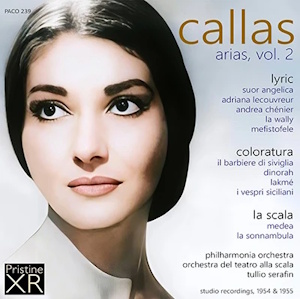
Callas Arias, Vol. 2:
Lyric & Coloratura arias (1954), & La Scala Scenes (1955)
Maria Callas (soprano)
Philharmonia Orchestra (1-10) & Orchestra del Teatro alla Scala (11-13)/Tullio Serafin
Details of contents beneath review
rec.1954, Watford Town Hall, UK & 1955, Teatro alla Scala, Milan (11-13)
Pristine Audio PACO 239 [79]
Volume 1 of Callas arias was a “Recommended” issue a year ago (review); Pristine follows that up here with this very-well-filled second volume remastered into Ambient Stereo and I quote here from the Producer’s Note: “This second volume brings together…a single Puccini aria from the September 1954 sessions, the complete programme of her celebrated Lyric and Coloratura recital, and three La Scala scenes recorded the following year. Originally issued across separate Columbia recital LPs, they now form a coherent portrait of Callas moving between intimacy, virtuosity and full operatic tragedy.”
The programme begins with the sole Puccini item and one immediately notices both the richness of Callas’ lower register and the plangency of her timbre; she invests every phrase with such steadiness of line and legato, and intensity of feeling – sometimes with the suggestion of a sob – and yes – sheer beauty of sound, despite the slight pulse in the vibrato. Her soft singing in the two arias from Adriana Lecouvreur is a dream, and again, the plunges into her lower register are so arresting; then the final A-flat in “Io son l’umile ancella” is beautifully poised. For me, however, the acme of her art is to be heard in her rendering of “La mamma morta”; this is one of the lyric arias but they contain elements of verismo passion and the power of her voice comes through strikingly when she leans into higher, louder passages. She narrates Maddalena’s torment and redemption via divine love with great depth of emotion, culminating in a ringing top B. The aria “Ebben? Ne andrò lontana” from La Wally was of course lent extra fame and glamour via American soprano Wilhelmenia Wiggins Fernandez’ performance of it in the 1981 French cult film Diva, but Callas had already given it all the lustre it deserved in her searing account here.
All the while, her mentor Serafin provides ideal accompaniment, giving her room to breathe and expand; his contribution and that of the orchestra are both considerably enhanced by Andrew Rose’s Ambient Stereo treatment, bringing the instruments forward without the least covering her voice. As a result, purely orchestral passages such as the introduction to the aria from Mefistofele are here brought into new prominence.
The four so-called coloratura arias here demonstrate Callas’ versatility, moving from Rossini, through Meyerbeer and Delibes into middle-period Verdi. She is Figaro’s “volpe soprafina” (sly fox) incarnate in her playful, knowing delivery of Rosina’s defiant aria but the characterisation never comes at the expense of the clarity of the divisions – no mugging for comic effect, just neat vocalisation. She switches effortlessly to the sweet, naïve Dinorah and provides a masterclass in ornamentation: runs trills, gruppetti, mordents, arpeggios – the lot. The same is true of the extended, elaborate melismata opening Lakmé and the subsequent aria is captivating, ending on a full, secure, rounded top E. The brilliance of her singing is such that we reviewers often forget to comment upon the lucidity of her Italian diction. The Verdi bolero aria is weightier than the preceding three but contains many opportunities for her to show off her agility – and remember, this was a voice that could sing Turandot, Gioconda and several Wagner roles. She caps the display with another, slightly thinner, top E.
While she did not sing it as often as Norma, Violetta or Tosca, Medea was still one of her signature roles and no one since has touched her supremacy in the Italian version of the opera. See my survey of Medea for more discussion of her various assumptions; suffice it to say that here she once again provides a searing portrait of the wronged, vengeful sorceress in the most celebrated aria.
It is almost a wrench to move from the filicide Medea to another wronged, but much more fragile woman, Amina, La sonnambula, the delicate Fach of her two arias being so different from the dramatic heft required for Medea. In a sense, the final two tracks here serve as a paradigm of her versatility, being poles apart in idiom – yet equally impressive.
Ralph Moore
Availability: Pristine ClassicalContents:
Lyric arias: Suor Angelica, Adriana Lecouvreur, Andrea Chénier, La Wally, Mefistofele
Coloratura arias: Il barbiere di Siviglia, Dinorah, Lakmé, I vespri siciliani
La Scala scenes: Medea, La sonnambula
PUCCINI Suor Angelica
01. Senza mamma (5:36)
CILEA Adriana Lecouvreur
02. Ecco: respiro appena… Io son l’umile ancella (3:49)
03. Poveri fiori (3:13)
GIORDANO Andrea Chénier
04. La mamma morta (4:53)
CATALANI La Wally
05. Ebben? Ne andrò lontana (4:52)
BOITO Mefistofele
06. L’altra notte in fondo al mare (7:29)
ROSSINI Il barbiere di Siviglia
07. Una voce poco fa (6:53)
MEYERBEER Dinorah
08. Ombra leggera (5:42)
DELIBES Lakmé
09. Dov’è l’indiana bruna? (8:06)
VERDI I vespri siciliani
10. Mercè, dilette amiche (4:01)
CHERUBINI Medea
11. Dei tuoi figli (4:55)
BELLINI La sonnambula
12. Compagne, teneri amici… Come per me sereno (5:49)
13. Oh! se una volta sola… Ah! non credea mirarti… Ah! non giunge (13:57)













