
Karl Richter (conductor)
The Complete Teldec & Ducretet-Thomson Recordings
rec. 1953-1963
Contents beneath review
Warner Classics 1200214258764 [18 CDs]
Having reviewed two sets of Nikolaus Harnoncourt’s recordings with the Concertgebouw Orchestra and the Chamber Orchestra of Europe, I now turn to a conductor whose performances he condemned, Karl Richter. Historically-informed, period-instrument recordings were my introduction to music from the Baroque and Classical eras. Given my academic interests in setting literary and musical works in their historical contexts, my initial belief was that compositions should be played on instruments resembling those for which they were conceived. I have come to accept, however, that historical evidence informs performance but cannot eliminate interpretation because events documented only by vague written descriptions are impossible to recreate, and today’s scholars and performers have their own viewpoints. Even Harnoncourt acknowledged that his meticulously researched readings did not (and could not) replicate what the original audiences heard. Recognising that early Baroque scores merely outlined each work’s irreducible elements, Harnoncourt arranged Claudio Monteverdi’s Il ritorno d’Ulisse in patria and L’incoronazione di Poppea by augmenting the instrumentation, which may have been ascetic out of practical necessity for the initial performances. Rather than adhering to the score monomaniacally, Harnoncourt hypothesised that Monteverdi would have welcomed extra instrumentalists participating ad libitum.
In light of Harnoncourt’s willingness to embellish Monteverdi, his antipathy toward Richter is ironic. Though their performing methods differed, they agreed that historical musical events cannot be reconstructed. Richter made a conscious artistic decision to use modern instruments, as well as choirs and orchestras larger than those common in the eighteenth century. A recent formulation of the principle that an eighteenth-century score does not fully delineate how it must be performed comes from the period-instrument conductor Harry Bicket in an interview in conjunction with his new recording of George Frideric Handel’s Giulio Cesare in Egitto: ‘18th-century scores are at best a sketch and so much of style was understood by Handel’s orchestra that there was no need to write it down. This means that questions of tempo, articulation and colour evolve naturally, depending on the cast and the dramatic tension of the scene’. I concur with Bicket that musical scores were guides rather than absolute final statements, and would add that his observation underscores the creative role of interpreters in realising them. When recording the same opera for Archiv Produktion/Deutsche Grammophon, Richter transposed some vocal lines to suit his singers rather than assembling a cast whose voices approximated those specified in the score, a practice consistent with the composer’s own working methods. Handel and his contemporaries treated their own compositions as adaptable rather than fixed and definitive. If there had been more revivals of Giulio Cesare during the composer’s lifetime, it is plausible that subsequent versions would have differed from the one that has become familiar to modern audiences.
The scorn heaped on Richter’s recorded legacy, much of it polemical, piqued my curiosity to find out whether a prolific artist for so many labels, who had been appointed in his youth as organist at the Thomaskirche in Leipzig and later elected Thomaskantor (a post he refused), could possibly be as bad as many critics have asserted. Warner Classics has collected Richter’s entire output for Telefunken-Decca (Teldec) and Ducretet-Thomson, comprising his oeuvre from 1953-1963, into one convenient box. Not every recording contained herein is a first choice, but many, especially Johann Sebastian Bach’s harpsichord concerti, Brandenburg Concertos, and several cantatas, offer dazzling keyboard playing, emotional intensity, and moderately fast tempi that contradict the platitude that he was always slow. Anyone without ideological biases against modern instruments will be pleasantly surprised by Richter’s prowess as an organist and harpsichordist, as well as his direction of works by Bach, Handel, and Wolfgang Amadé Mozart, among others. What comes across powerfully in the present set is Richter’s awareness that performance conventions from the past do not have to determine our options today. For me, Richter exemplifies artistic freedom, unconstrained by literalism. Listeners who dismiss Richter prima facie should be advised that clichés, such as ‘old fashioned’, are value judgements pertaining to perceptions of art, not properties inherent in the works themselves.
Richter’s tempi in the harpsichord concerti (BWV 1052, 1061, 1064, and 1065), recorded in the mid-1950s, are similar to Trevor Pinnock’s with The English Concert, recorded for Archiv Produktion roughly 25 years later. Richter and the other soloists use 20th-century harpsichords, and the chamber orchestra consists of modern instruments. Genuine interpretive flair and passionate commitment from everyone concerned make these performances delectable because there is no hint of routine. These were not the first recordings of these works, and, in terms of popularity, Richter’s BWV 1052 stands in the shadow of Glenn Gould’s roughly contemporaneous account. Of similar vintage, Richter’s unsentimental, intimate readings of the Brandenburg Concertos are taken at tempi similar to those adopted by Harnoncourt with Concentus Musicus Wien in 1964. The accounts of the second and sixth concerti by Richter and ‘his Chamber Orchestra’, to quote the disc sleeve, are particularly mesmerising.
Animated by propulsive rhythm and a finely judged balance of structural logic, drama, and poetry, the performances of Bach’s Goldberg Variations, BWV 988, Partitas, BWV 825–830, and sundry organ works reveal Richter’s formidable keyboard technique. Perhaps to fit the harpsichord works onto fewer long-playing records, he omitted all the repeats. Rather than his preferred 20th-century revival double-manual harpsichord built by J.C. Neupert, I wish that he had played a modern piano to enrich the sonic texture. These recordings might have been more successful commercially and better known today if they could have been marketed as less eccentric alternatives to Gould. At the organ, his emphasis on architecture makes the complex polyphony and counterpoint clear and precise.
The cantatas and the Weihnachtsoratorium were close to Richter’s heart and, for me, are the core of this collection. These readings feature stylish music-making: tempi and articulation correspond to the content of the sung texts. This approach provides a sense of spirituality to compensate for these cantatas having been extracted from their liturgical contexts. Richter commissioned top-tier vocal and instrumental soloists and exploited the expressive range of modern instruments in performances that give enormous satisfaction on repeated listening. Vocal soloists include Hertha Töpper, Peter Pears, and Kieth Engen.
Directing from the console, Richter imbued Handel’s Organ Concertos, Op. 4 and 7, with impetus and robustness. To fill the empty spaces that Handel left in the written music, Richter improvised; to add gravity, he used the foot pedal; to ensure rhythmic vitality, he directed the orchestra with sharp, steady beats. Apart from Handel and Bach, this set contains a Flute Concerto in D Major attributed spuriously to Franz Joseph Haydn, as well as symphonies by Carl Philipp Emanuel Bach and Johann Christian Bach. Mozart is represented with performances of the Requiem, the Symphony in A Major, K. 201, the Concerto for Flute and Harp, and Flute Concertos Nos. 1 and 2. Richter’s interpretations prefigure stylistically those by Neville Marriner in the 1970s and 1980s: medium-sized, modern-instrument orchestras that helped pave the way for period-instrument ensembles. Richter’s divided violin sections (the first violins seated on the left and the second violins on the right in an antiphonal layout) keep the intricate contrapuntal musical lines in dialogue. Accentuating the fugues and counterpoint, Richter’s intense, lean approach to the Requiem (in the version completed by Franz Xaver Süssmayr) builds coherence between the diverse sections of this uneven masterpiece. With a total timing of around 51 minutes, urgency, precision, and crisp Latin enunciation take precedence over the grandeur and lushness favoured by Karl Böhm and Herbert von Karajan.
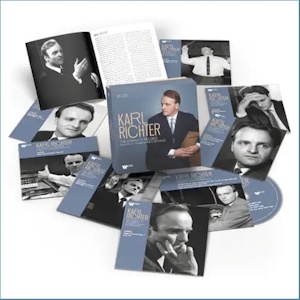
As with similar sets issued by Warner Classics, this one comes in an attractive box with the CDs in cardboard jackets featuring different photos of Richter on the front of each and detailed contents listed on the back. The remastering has opened up these vintage recordings, most of which are in early stereo, so that there is enough presence and dynamic range for musical details to be clearly audible. The generously-illustrated booklet contains an informative essay in English, French, and German. It is a pity that the sung texts have not been included because these would add value to this high-quality release: having to read the lyrics on a computer or tablet defeats the purpose of buying a physical product. Otherwise, this release invites renewed interest in a substantial part of Richter’s legacy that inaugurated the shift from large scale performances to historically-informed outings.
Conclusion: Reflections on Richter’s Legacy
Much more than just a transitional figure, Richter was a great musician whose artistry merits respect on its own terms. Richter’s interpretations have been alleged to lack ‘transparency’ and to sound ‘ponderous’. ‘Transparency’ is often misconstrued as an aesthetic goal when it was likely an incidental by-product of the instrumental forces usually available in the eighteenth century. To the best of my knowledge, no composer represented in the present set actively sought transparency. Could the period-instrument movement have been influenced by Minimalism without being aware of it? Regarding the issue of weightiness, it is arguable that many cantatas and the Passions have sung texts that warrant solemnity. Whether Richter’s interpretations are ‘problematic’ is a matter of opinion.
Even with antique instruments and diligent observation of articulation and other aspects of eighteenth-century musical rhetoric, context is an equally important, though underappreciated, aspect of historically informed performance. Therefore, listening to Bach’s cantatas on recordings or in concerts is at odds with their original cultural, historical, and religious settings. Purists must hear Bach’s sacred music exclusively during liturgical services (Gottesdienst) on the specific days of the year for which he intended each piece. To understand the texts that Bach set, a further prerequisite is to have read Martin Luther’s translation of the Bible, as well as writings by other theologians who influenced Bach, in the original language.
My intention is not to undermine the period-instrument movement, which is where my own journey into Baroque, Classical, and early Romantic music began. I call for flexibility and open-mindedness to the vast array of interpretive possibilities. History shaped the present; its accumulated wisdom must guide musical progress. Understanding that instruments and ensemble sizes evolve continuously, Richter employed opulent forces. Given that eighteenth-century composers routinely rearranged their own music for the resources available, modern musicians are more than justified in choosing which instruments to play.
Before declaring that Richter is ‘inaccurate’ or ‘no longer acceptable’ (to cite some of the aspersions cast upon his performances), consider that ‘authenticity’ takes many forms. When situating Richter chronologically in the reception history of Bach’s music, it becomes obvious that he was not a blind follower of inherited tradition. He created a distinctive style that inspired connoisseurs and fellow musicians, including some who became leaders in the period-instrument revolution, to fall in love with Bach’s music.
Daniel Floyd
Buying this recording via the link below generates revenue for MWI, which helps the site remain free

Contents
CDs 1-13
Johann Sebastian Bach: Keyboard Concerto in D minor, BWV 1052 · Concerto for Two Keyboards in C major, BWV 1061 · Concerto for Three Keyboards in C major, BWV 1064 · Concerto for Four Keyboards in A minor (after Vivaldi), BWV 1065 · Goldberg Variations, BWV 988 · Partitas Nos. 1-6, BWV 825-830 · Flute Sonata No. 1 in B minor, BWV 1030 · Flute Sonata No. 2 in E flat major, BWV 1031 · Brandenburg Concertos Nos. 1-6 BWV 1046-1051 · Christmas Oratorio, BWV 248 · The Art of Fugue, BWV 1080 · Toccata, Adagio & Fugue in C major, BWV 564 · Toccata & Fugue in F major, BWV 540 · Toccata & Fugue in D minor, BWV 538 ‘Dorian’ · Chorale Partita BWV 768 · Fantasia in G major, BWV 572 · Trio Sonata No. 3 in D minor, BWV 527 · Trio Sonata No. 6 in G major, BWV 530 · Pastorale in F major, BWV 590 · Cantata BWV 4 ‘Christ lag in Todesbanden’ · Cantata BWV 12 ‘Weinen, Klagen, sorgen, Zagen’ · Cantata BWV 127 ‘Herr Jesu Christ, wahr’ Mensch und Gott’ · Cantata BWV 137 ‘Lobe den Herrn, den mächtigen König der Ehren’ · Cantata BWV 140 ‘Wachet auf, ruft uns die Stimme’ · Cantata BWV 160 ‘Ich weiß, daß mein Erloeser lebt’
CDs 14-15
George Frideric Handel: Organ Concertos, Op. 4 Nos. 1-6, HWV 289-294 · Organ Concertos, Op. 7 Nos. 1-6, HWV 306-311
CD 16
Carl Philipp Emanuel Bach: Symphony in D major, Wq. 183/1 · Flute Sonata in G minor · Christoph Willibald Gluck: Orphée et Euridice: ‘Dance of the Blessed Spirits’ · Franz Joseph Haydn: Flute Concerto in D major · Johann Christian Bach: Sinfonia in B flat major, Op. 18 No. 2
CDs 17-18
Wolfgang Amadeus Mozart: Flute & Harp Concerto in C major, K. 299 · Flute Concerto No. 1 in G major, K. 313 · Flute Concerto No. 2 in D major, K. 314 · Andante in C major, K. 315 for flute and orchestra · Symphony No. 29 in A major, K. 201 · Requiem in D minor, K. 626














A very good review Daniel, thank you! You have whetted the appetite for this set. I also appreciate your honest views and response regarding HIP and non-HIP. Thank you for approaching Richter with open ears and mind. I hate it when artists of Richter’s calibre are dismissed with a mere wave of the hand, just because he used larger orchestras and choirs, and preferred singing a melody instead of clipping it. What a pity he never finished his Bach cantata cycle for Archiv. Still, as conductor and keyboard soloist he left a considerable legacy. The fact that it is still being reissued speaks for itself.