
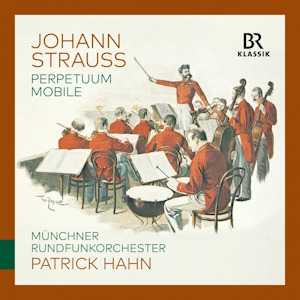
Johann Strauss II (1825-1899)
Perpetuum mobile
Johannes Silberschneider (conférencier)
Münchner Rundfunkorchester/Patrick Hahn
rec. live, 2023, Prinzregententheater (Tausend und eine Nacht: Intermezzo), 2025, Bavarian Radio studio 4, Munich, Germany
BR Klassik 900353 [54]
The monumental Johann Strauss II: the complete orchestral edition (Naxos 8.505226), released in 2011, offers no fewer than 52 CDs of waltzes, marches, polkas, polka-mazurkas, quadrilles, gallops, romances, overtures and preludes. However, of all the hundreds of individual pieces that the box set contains, comparatively few are well known today. Indeed, An der schönen bluen Donau, Frühlingsstimmen, the Tritsch-tratsch polka and a handful of other familiarly and insistently hummable compositions could probably be accommodated on just a couple of CDs. There would certainly be space for the so-called musical jest Perpetuum mobile and the Der Zigeunerbaron overture, both of which feature on this new release. They are joined here by a selection of pieces that are, I venture to suggest, hardly known to anyone other than Strauss specialists. Who, after all, has heard a performance of the Carnevalsbilder waltz lately or, for that matter, ever encountered Klänge aus der Raimundzeit at all?
Putting aside one or two of the more intriguing items on the programme for later consideration, let us take a brief look at the others. The Revolutions-marsch, a relatively early work, was an expression of support for a Hungarian uprising. Strauss subsequently disavowed it after the revolutionaries’ failure. The music, appropriately Magyar in tone, has an attractive main theme. Nonetheless, the composer’s reluctance to deploy the brass renders it less emotionally rousing than one might have expected, given its political/military context. Neither does its duration of less than three minutes help its cause. Failing to live up to its intended ambition, the piece struggles to make much of a real impact. Indeed, if you had never heard it before, you would probably think it less likely to precipitate a national uprising than to open a village garden fete.
The Intermezzo from Tausend und eine Nacht – based of course on the stories of the Arabian nights –delivers its own very different atmospherics at rather greater length. In spite of the repeated critical and commercial failure of the operetta in which it appeared, the piece became a deservedly successful standalone lollipop in its own right. Strauss’s depiction of the mystic East is, though, lushly Romantic, entirely European in flavour and, as a consequence, utterly inauthentic. Even the greatest admirer of the composer’s music would be forced to concede that it is more suggestive of Budapest than Baghdad.
Allow me an aside. Strauss’s Russian contemporaries, the composers of the Mighty Handful, may also have been inauthentic. Yet, at least through their inquisitive exploration of central-Asian folk music, they were making a genuine effort. In case you missed it, by the way, back in 2014 Türkiye’s Borusan Istanbul Philharmonic Orchestra performed a fascinating version of Rimsky-Korsakov’s Scheherazade. They sought to “easternise” it by augmenting the instruments of a conventional symphony orchestra with, among others, a darbuka, a def, a bendir and a kudüm. The performance was an enchanting, if flawed, experiment.
Strauss wrote the quick polka Vom Donaustrande and the Carnevalsbilder waltz in 1873. They incorporate themes from his operetta Der Carneval in Rom that had premiered that same year. Neither piece need detain us for long. At just 2:41, the former is necessarily short, as few dancers would be able to maintain its frantic pace for much longer than that. The latter may be more substantial but its melodies, while perfectly pleasant and appropriate for the ballroom, are easily forgotten. Here, one suspects, Strauss was composing on autopilot.
Nordseebilder, a fairly substantial waltz, comes in here at 8:29. Its most attractive feature is a dreamily romantic opening that Strauss had been inspired to write on his honeymoon. Thereafter, however, his inspiration seems to flag. The piece segues into a more typical waltz that, once again, fails to come up with anything in the way of those big tunes that make a handful of his waltzes so effectively memorable. Nearly a decade ago, Dan Morgan reviewed a disc of the composer’s waltzes performed by the Wiener Symphoniker under Yakov Kreizberg. He seemed somewhat surprised to find Nordseebilder on the programme. With a remarkable degree of restraint and understatement, he merely observed: “Not Strauss at his best”.
Two more tracks feature music that derives from works composed not for the ballroom but for the stage. They are the 1885 three-act operetta Der Zigeunerbaron and Strauss’s only opera Ritter Pásmán, a three-act comedy that was a major flop when staged in 1892. The former’s relatively well-known overture, a well-constructed pot pourri of attractive melodies, takes us back to the land of paprika, tokaji wine and gypsy fiddlers. And that is exactly where we remain as a solo Zigeuner violinist introduces Ritter Pásmán’s lively and tuneful csárdás, one of the few moments in the opera to generate much in the way of critical approval. As Göran Forsling observed in his review referenced above, after two full acts that are pretty much a snooze-fest, the csárdás “rings out with rhythmic elan and colour, and the orchestra seems revitalised, as though they have also been waiting for this”.
Let us now turn to the three remaining tracks. The “musical prelude” Klänge aus der Raimundzeit is performed in a version edited by the Austrian composer and conductor Max Schőnherr. As I listened to it for the first time, before reading Guido Johannes Joerg’s interesting and useful booklet notes, I recognised, much to my surprise, a few passages that made me think that I was listening to a piece that had not been composed by Strauss at all. The explanation is that Klänge commemorates the Austrian playwright and actor Ferdinand Raimund. As a consequence, Strauss digs into musical history and incorporates into the work a number of other composers’ melodies from around the period of Raimund’s death in 1836. Thus, Klänge showcases a few musical motifs or even quite substantial passages taken from the compositions of those great rivals Johann Strauss I and Joseph Lanner (notably one of the main themes from Lanner’s 1842 masterpiece, the famous Schönbrunn Waltz). Other passages derive, it seems, from various long-forgotten stage works of the same era.
There are two versions of the much more familiar Perpetuum mobile on this disc On track 1, it is played absolutely straight, but on the tenth and final track – supposedly differentiated from the preceding main programme by its meaningless designation as a “bonus” – we hear the same piece in a version 30 seconds or so longer. The discrepancy is explained by the fact that a contemporary rap reworking of Fritz Herms’s 22-line verse Wieder mal Urlaub has been appended to Strauss’s original score. The text is delivered, as we shall see, in German-of-sorts (translated into English for the purposes of this review). It turns out to be rather appropriate to Strauss’s theme of perpetual motion:
Why must these fools / all drive on a Friday? / Drive a bit, look around a bit, / drive a bit, get stuck in traffic a bit, / chat a bit with the ladies. / But then we’re moving again / so our spirits lift once more / and the kids are overjoyed / at the thought of ice cream and the sea. / And then we’re off again, / a huge relief to me, / but the little one needs the loo, / and there we are, stuck again. / Dad always has to wait, / then he gets to start up again / and back into the car we go, / driving on a little further, / driving, driving, driving, stopping, / snacking, refuelling, taking a pee, / all just minor trifles. / It’s already getting warm in Italy.
The newly-added rap sequence maintains the original music’s rhythmic pulse while a speaker delivers Herms’s text. One of rap’s most obvious characteristics, yet one which will appear somewhat strange to anyone who is more familiar with other forms of vocal expression in music, is the way in which relentlessness of vocal delivery is prioritised over the application of much (or, indeed, sometimes any) emphasis or light and shade to individual words. Another feature, particularly noticeable when those words reject spontaneity in favour of following a pre-written text, is that rapping does not demand much precision in the way of diction. Thus, to give just a brief example, Herms’s lines und die Kinder freuen sich sehr / auf Gelato-Eis und Meer hereemerge, according to the booklet notes, as only a rough verbal approximation: und de kinda freun si sehr / auf dschelatoeis und meer.
Those “words” are rapped by Johannes Silberschneider. BR Klassik’s accompanying German and English documentation describes him neither as a Referent nor a speaker but – rather grandly yet inexplicably – in French, as a conférencier. (Did, I wonder, Jay-Z, Eminem or Tupac Shakur ever characterise themselves thus?) He has been hired for this high-profile release, so we can, I think, assume that he is an accomplished performer. Although that particular qualification may not be enough to tempt some dyed-in-the-wool MusicWeb readers to listen to his track, I actually think that it is well worth taking a couple of minutes to do so. Not only will the experience broaden one’s musical horizons, but it might even generate some unexpected street cred with the kids. And, after all, there is nothing to lose because, let us remember, track 10 is a “bonus”.
Many readers will already be familiar with conductor Patrick Hahn. Over the past few years, he has been quite busy in the recording studio, as demonstrated by my MusicWeb colleagues’ reviews of Viktor Ullmann’s Der Kaiser von Atlantis, Mosaïque and other works by Marcin Stańczyk, Alexander Zemlinsky’s Eine florentinische Tragödie, Andrew Lloyd Webber’s Requiem and Ethel Smyth’s opera Der Wald. On this latest CD, branching out into very different repertoire, he and his orchestra’s accomplished players deliver fine, idiomatic and well-recorded accounts of Strauss’s scores.
You may recall from the lines reproduced above that versifier Fritz Herms describes many of life’s more humdrum activities as simply “minor trifles”. It is hard to deny that many of the pieces showcased on this new disc warrant much that same description. Nevertheless, it is a tribute to Patrick Hahn and the members of the Münchner Rundfunkorchester that they manage to make them sound, at least for a moment or two, not only very enjoyable but somewhat more substantial than the rather ephemeral pieces that they actually are.
Rob Maynard
Buying this recording via the link below generates revenue for MWI, which helps the site remain free
Contents
Perpetuum mobile – ein musikalischer Scherz, op.257(1861)
Nordseebilder waltz, op.390 (1879)
Revolutions-marsch, op.54(1848)
Ritter Pásmán, op.441: csárdás(1892)
Intermezzo from Tausend und eine Nacht, op.346 (1871)
Der Zigeunerbaron, op.332: overture (1885)
Vom Donaustrande, quick polka, op.356 (1873)
Carnevalsbilder waltz, op.357 (1873)
Klänge aus der Raimundzeit, op.479(1898)
Perpetuum mobile – ein musikalischer Scherz, op.257(1861)– version with rap













