
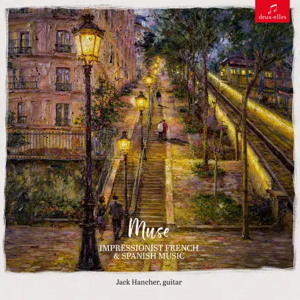
Muse
Jack Hancher (guitar)
rec. 2025, St Michael’s Church, Chalton, UK
Reviewed as a 24/192 download
Deux-Elles DXL1228 [62]
I had the pleasure of reviewing Jack Hancher’s previous and debut album The Memory Garden in 2024 and was impressed by his clean, clear, well focused and compelling playing. His second album is no disappointment in terms of his performance skills and is a pleasure to listen to and review. Since The Memory Garden he has performed across America and Europe, including a performance with the Swedish Chamber Orchestra under the baton of Christian Karlsen, and has performed live on BBC Radio 3’s In Tune numerous times. 2026 highlights include a first tour of Australia, and a debut with the Royal Philharmonic Orchestra.
In the CD notes, Jack tells us “The idea of this programme actually predates the first album. The seed was planted when I was in Paris a few years ago. I’d played a concert and afterwards I took myself for a walk around Montmartre, which is where Satie lived for just over 10 years. I ended up walking past his house with his music on my headphones. As I was listening, I began thinking it could work quite well on the guitar. At that point I hadn’t heard his music played on guitar.”
Most of the pieces have been arranged for guitar by Jack himself, as shown in the track information. He explains: “Arranging from the piano onto guitar, you’re grappling with compromise. You lose several things, whether it be range of notes, dynamic range, or importantly with this music, the number of notes possible to play at once. I ended up arranging more melodic pieces, because they offer an opportunity to add things that a pianist can’t. I wanted to keep as much of the harmony in there as I could, because that’s really at the heart of what draws me to Debussy and Ravel”.
The first three pieces on the album are by Debussy. They start with La fille aux cheveux de lin, Préludes Book 1 L. 117 No. 8. It is, of course, a familiar melody played here with clarity yet a light touch. Next, we have Danse bohémienne, L. 4). Despite its title, the work is more like a polka; the arrangement played here has a lively rhythmtempered with a certain elegance and precision. The final Debussy track is The Little Shepherd, a delicate piece played gently by Jack. Next is a piece by the Spanish composer and pianist Manuel de Falla, composed as an homage or tribute: Homenaje “Le tombeau de Claude Debussy”. This short piece is a pivotal work in the guitar repertoire, dedicated to the memory of Claude Debussy, demonstrating how he influenced De Falla’s stylistic approach. The track is slow and what it perhaps lacks in melody is well compensated for by Jack’s meticulous playing and sense of rhythm. The French/Spanish connection runs throughout this CD; all of the composers featured on the disc were inspired by each other in one way or another.
We are next treated to a short piece by the Spanish composer and pianist Federico Mompou: Cançons i danses No. 6a. Played slowly and delicately, it is a nostalgic, melodic work. Mompou, too, was inspired by Debussy, but he also took influence from Satie. My colleague Zane Taylor reviewed an album of Mompou’s music arranged for guitar Misteriós – Transcriptions for Guitar Volume 1in 2024, which he described as “delicate and intimate music”.
Albéniz and Debussy were friends and there were times where they were almost trying to imitate one another. Debussy described Iberia by Albéniz as one of the masterworks in piano composition in the 20th Century. Debussy’s La sérénade interrompue was influenced quite heavily by Albéniz and vice versa with Albéniz’s El Puerto. Isaac Albéniz’s Capricho Catalan is a relaxed, melodic tune and one of the works arranged for guitar and played on the CD by Jack. His playing is gentle yet precise.
The CD also contains three works by Erik Satie all arranged for guitar by Jack. He comments in the CD notes about the Satie pieces “The arranging process was also far more straightforward” (compared to other composers). The first is Gnossienne No.3, played gently and it seems effortless. The second is Gymnopédie No.1 played slowly, quietly and softly; affording it a certain grandeur; it’s a delightful track. Finally, Gnossienne No.1. is slightly faster but certainly not brisk and equally pleasing to listen to.
Three further pieces by Maurice Ravel are arranged by Jack. His comments on these works are “Technically, I’ve certainly pushed myself, particularly in the case of the Ravel Menuet Antique. I don’t think it’s been done on solo guitar before, at least not to my knowledge. I think I’ve just about managed to find a way to make it work and keep the main essence of the music in there. It’s without a doubt one of the most challenging pieces I’ve worked on, but I’m very glad it’s made it onto the album.”
Menuet Antique is lively and light, crisply played, the melody of the original piano piece is not lost in this skilful arrangement. Á la manière de Borodine M. 63 (In the Style of Borodin), is a much shorter work but again is lively and tuneful. In the original version Ravel captures Borodin’s distinctive compositional style, known for its richness and wonderful orchestrations; once again, Jack has done a masterful job of arranging it to demonstrate his capabilities on the guitar.
Ravel’s Pavane pour une infante défunte, M.19 is, of course, a very familiar tune, full of lush melodies. Jack explains “So the arranging was a lot of experimentation and trying different keys. It was a frustrating process at times, because one section might work in a certain key, but the next section would be unplayable.” The result is an apparently simple piece which manages to maintain the colour and beauty of Ravel’s original work.
The final composer is Antonio José. Ravel said of him that “[h]e will become the Spanish composer of our century”, but unfortunately, he was executed aged only 33 during the outbreak of the Spanish Civil War, and his music was essentially undiscovered until the 1980s. He didn’t play the guitar himself, and he wrote mostly at the piano. The work featured on this CD is his four-movement Sonata for Guitar, his only work for guitar; it is a challenging piece which has become a key work in the guitar repertoire. The four movements are allegro moderato, minuetto, pavanna triste and finale. Itis full of delightful, delicate little melodies and shifting tempos, very pleasing to listen to.
A great second album from Jack demonstrating clearly not only his magnificent playing skills but also his ability to arrange music for guitar, creating a very engaging and melodic disk. The sleeve notes, which I have relied on heavily in order to complete this review, are excellent.
Ken Talbot
Buying this recording via the link below generates revenue for MWI, which helps the site remain free
Contents
Claude Debussy (1862-1918)
La fille aux cheveux de lin, Préludes Book 1 L. 117 No. 8 (arr. Jack Hancher)
Danse bohémienne, L. 4 (arr. Ansgar Krause)
Children’s Corner: The Little Shepherd 8 (arr. Jack Hancher)
Manuel de Falla (1876-1946)
Homenaje “Le tombeau de Claude Debussy”
Federico Mompou (1893-1987)
Cançons i danses No. 6a (arr. Jack Hancher)
Isaac Albéniz (1860-1909)
Capricho catalan, Op. 165 No. 5 (arr. Jack Hancher)
Erik Satie (1866-1925)
Gnossienne No.3 (arr. Jack Hancher)
Gymnopédie No.1 (arr. Jack Hancher)
Gnossienne No.1 (arr. Jack Hancher)
Maurice Ravel (1875-1937)
Á la manière de Borodine, M. 63 (arr. Jack Hancher)
Menuet antique, M. 7 (arr. Jack Hancher)
Pavane pour une infante défunte, M. 19 (arr. Jack Hancher)
Antonio José (1902-1936)
Sonata for Guitar













