
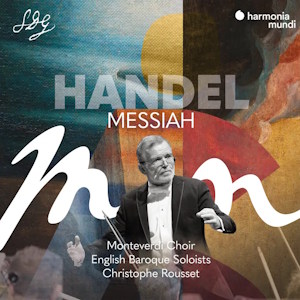
George Frideric Handel (1685-1759)
Messiah ((1741-1750)
Ana Viera Leite (soprano), Dame Sarah Connolly (alto), Andrew Staples (tenor), William Thomas (bass)
Monteverdi Choir, English Baroque Soloists/Christophe Rousset
rec. live, 10-16 December 2025, St Martin-in-the-Fields, London
Libretto and commentary in English, French, and German included
Reviewed as WAV download
Harmonia Mundi HMM905428.29 [2 CDs: 134]
All lovers of classical music will have their favorite recording(s) of Messiah. Despite its dated performance practices, I have a lingering fondness for Sir Colin Davis’s 1966 recording (review); it was the first recording of Messiah I owned. I also like the sets conducted by Harry Christophers (twice), Peter Dijkstra (review), Justin Doyle (review), Stephen Layton (review), Nicholas McGegan and others. Consequently, I approach any new recording of the work with a great deal of curiosity about how it will compare with my favorites, both older and newer. This set compares very well indeed.
Any conductor who approaches Messiah has to decide on a version of the work to be performed. Christophe Rousset takes a conservative approach in choosing what most listeners will consider a fairly “standard” version of the work. I noticed only two slight variances from what I’d usually expect to hear. In the first part, the number He shall feed his flock is sung by the soprano soloist throughout, rather than the customary first verse for alto in F modulating to B-flat for the soprano soloist in the second verse. In the second part, the bass sings a shortened version of Why do the nations, which the soloist ends with a low E natural.Rousset takes a lively pace throughout – it does the Monteverdi Choir a great deal of credit that they could articulate all the sixteenth notes in All we like sheep given the pace he sets, yet he doesn’t miss the grandeur of the choral statements of “His name shall be called Wonderful, Counsellor, the might God, The Everlasting Father, the Prince of Peace” or the Hallelujah Chorus.
The excellence of the recording’s sound enhances such moments. The acoustic is spacious, so all the vocal lines of the choruses are distinguishable. They don’t blur together as is often the case. The accompanying booklet states that the recording was made during live performances from the 10th to the 16th December 2025, further indicating that the recording is “Live + Patch.” I presume this means that some post-performance polishing was done when an audience wasn’t present. I could not detect any noise from an audience at any time whilst listening to the set.
The performance has a splendid quartet of soloists. Portuguese soprano Ana Viera Leite sings with a purity of tone that is even throughout the voice’s registers and lithe in the part’s florid passages. Although Dame Sarah Connolly is known as a mezzo, her voice has the appropriate depth of the lower notes, all the way down to a G below middle C. Admirable as the women soloist are, the two men are particularly noteworthy. These parts are often given to men with smallish, light voices; not so here. Andrew Staples can sing with a bright burnished tone when necessary, and yet he also sings some lovely, pianissimo phrases in the recitative and air that being the oratorio. He shows the most feeling for the music of all the soloists. In William Thomas, we have a proper bass in a role that is often taken by a bass-baritone. His voice is big, dark, and deep. His rendition of The trumpet shall sound is one of the highlights of the recording. All the soloists add some simple and tasteful ornaments to their vocal lines.
There is a plethora of recordings of Messiah; I have a couple of dozen in my collection. This set goes right to the top of the list and I shall return to it frequently with pleasure.
Stephen Wells
Buying this recording via the link below generates revenue for MWI, which helps the site remain free













