
Charles Gounod (1818-1893)
Faust
Faust – César Vezzani (tenor)
Marguerite – Mireille Berthon (soprano)
Méphistophélès – Marcel Journet (bass)
Orchestra and Chorus of the Paris Opéra / Henri Büsser
rec. 1930, Paris, France
Pristine Audio PACO240 [2 CDs: 156]
Originally issued on twenty two-sided 78 rpm discs, this is surprisingly complete for a studio recording from as early as 1930, running as it does to over two and a half hours. Bearing in mind too, that the 1931 issue cost $30 in the USA and probably around £5 – as a premium imported product – in the UK; it was thus twice the average weekly wage and represented a considerable outlay, affordable only by the very comfortably off.
It contains the “traditional” cuts normal before the modern fetish for “completeness” ruled; as late as 1953, the studio recording conducted by André Cluytens made quite hefty excisions and I quote from my review of that: “the first two Acts are intact and there is a small cut in scene 17 Act III, but otherwise all the cuts are in the last two acts: Siébel’s Act IV exchange with Marguerite has gone, as have the will-o’-the-wisps’ and witches’ choruses, some music in the courtesans’ scene and the ballet… The final prison scene is given complete.” Büsser also leaves the first three acts essentially complete apart from some small internal cuts within individual numbers and he, too, cuts the entire Marguerite–Siébel scene at the beginning of Act IV – yet he retains the complete sequence of seven ballet numbers in the Walpurgis Night.
The cast is as starry as could be assembled at that time; the three principal singers are now legendary and the conductor had been a pupil of Gounod himself. As producer Mark Obert-Thorn observes in his note, “this recording captures an entire performing tradition at its height: the supple diction, conversational elegance and stylistic poise of French opera between the wars. Nearly a century later, it remains one of the most idiomatic and compelling recorded accounts of Faust.”
As much as I enjoy some of the individual numbers in this opera, I have never especially warmed to it; it has its longueurs and I understand how and why its popularity has waned over the years from being the most ubiquitously performed in the world to being just another repertory opera, long surpassed as the most popular French opera by Carmen. Nonetheless, I retain fond memories of the 1976 Covent Garden production with Mirella Freni, Nicolai Ghiaurov, Stuart Burrows and Thomas Allen, which I saw as a very young man, and have long enjoyed the hyper-complete – with appendices – Carlo Rizzi recording with Gasdia, Hadley and Ramey as probably the most recommendable; the rest of the recordings are flawed, and for that reason I have never undertaken a survey of them – although the only disadvantage to this landmark recording is the inevitable inferiority of its sound compared with modern accounts, and even that detriment pales as the listener’s ear adjusts and responds to the fine product of Obert-Thorn’s audio restoration skills. At its best, it is, as Allen observed, “Grand Opera at its grandest” and this recording captures that grandeur.
The sound is unbelievably full and clear; no one listening blind would think it was nearly a hundred years old, in that it sounds very like a live mono recording from the 50s – perhaps even better than that following this restoration. There is very little glare on the strings and plenty of bass depth.
Vezzani is my favourite French tenor alongside Georges Thill. Like Thill, his voice is hard to categorise but perhaps “French lirico-dramatico-spinto tenor” is as close as I’ll get because he could sing pretty much anything in any style from Grétry to Donizetti to Massenet to Verdi to Wagner with equal aplomb (although there is no evidence that he ever sang the last on stage; nonetheless, he made some superb recordings of excerpts). Its bright, thrusting nature in combination with his pellucid diction means that if you have some French, you may follow every word he sings without a libretto. “Salut, demeure” is a dream of vibrant passion capped by a ringing top C, and the accompanying solo violinist is very fine, too.
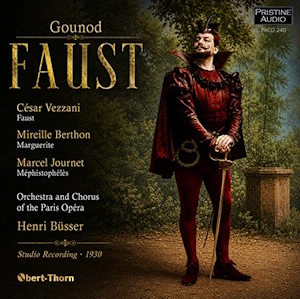
The great Marcel Journet was a frequent partner of Caruso and is here in his early sixties – although you would never guess it from the resonance and fluidity of his bass, despite some slight rustiness in the lowest notes. His Méphistophélès is all suave, saturnine mockery and he would steal the show were he not so impressively partnered. He hasn’t the inky tones of Ghiaurov or Christoff but is infinitely stylish. “Le veau d’or” is a tour de force. The cover image of him in the role conveys all his patrician hauteur.
Soprano Mireille Berthon – not to be confused with the younger, similarly named Berthe Monmart who also sang Marguerite – is a stylish, utterly secure singer capable of infusing her characterisation with psychological depth. I like her “old-fashioned” fast vibrato and the evenness of her vocal production throughout its range.
Baritone Louis Musy as Valentin is perhaps best remembered for his role as the father in the classic mono recording of Charpentier’s Louise, which I recommend in my survey of that opera. He is a full quarter-century younger here and in freshest voice even if it doesn’t have the dark, sensual ring of exponents of the role such as Robert Massard, Robert Merrill or Leonard Warren.
The supporting cast and chorus are of course entirely idiomatic, adding to the value of this remarkable document. It must have been greeted as something of a miracle on its first issue and it still wears its age very well.
Ralph Moore
Availability: Pristine ClassicalOther cast
Valentin – Louis Musy (baritone)
Dame Marthe Schwertlein – Jeanne Montfort (mezzo-soprano)
Siébel – Marthe Coiffier (soprano)
Wagner – Michel Cozette (baritone)













