
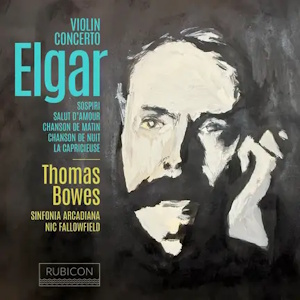
Edward Elgar (1857-1934)
Violin Concerto in B minor, Op. 61 (1910)
Salut d’amour Op.12
Chanson de nuit Op.15/1
La Capricieuse Op.17
Sospiri Op.70
Chanson de matin Op.15/2
Thomas Bowes (violin)
Sinfonia Arcadiana/Nic Fallowfield
rec. 19 & 20 December 2022 (Violin Concerto) and 3 May 2026, Studio 1, Abbey Road, London
Rubicon RCD1224 [72]
Thomas Bowes has yet to gain ‘household name’ status when it comes to commercial record releases, though he has appeared on the Lyrita label in Eleanor Alberga’s admirable First Violin Concerto (review). Bowes is well known as a concertmaster and soloist for numerous film scores, and the seeds for this recording were planted back in 2006 when he was given encouragement by the great film director Ken Russel who, on hearing him play the concerto, dubbed him ‘the magician’. Two decades later, working in the same Abbey Road acoustic in which Elgar recorded the concerto with Yehudi Menuhin in 1932 and in which Bowes has regularly made movie recordings, the dream has been brought to life with the backing of an orchestra consisting of London’s finest session musicians.
“My relationship with Elgar’s concerto has been a constant source of emotional nourishment since my early teens, a constant friend, if you will, in times good and bad…This work speaks to those deepest and most secret regions of us all. It is, quite simply, one of the greatest love songs ever written; love’s fulfilment and its deepest sorrow and loss – spread over a lifetime’s journey.” Thomas Bowes’ clear affection for Elgar’s Violin Concerto comes through very effectively in this recording, and you only need hear his warmly expressive playing in the Andante second movement to be convinced of this. Bowes is lyrical and generous without being sentimental, not losing sight of the emotional balance this movement holds within the concerto’s more spectacular outer movements. Both of these allegros are hallmarked with clarity allied with excitement, as Bowes’ brilliant technique meets Elgar’s idiomatic but oft-challenging passagework. The nobility of the themes in the first movement are handled well, and there is an expansive feel throughout this performance that allows the ear to appreciate Elgar’s orchestration and each special moment as it occurs, though keeping 25 violins together proves a tricky task at some of his more hairpin corners. Comparing this to Philippe Graffin with Vernon Handley on the Avie label (review) shows where a greater sense of urgency can have its benefits, but I don’t have the sense that Bowes and Fallowfield linger excessively, even where Graffin undercuts the timing in the Andante by over two minutes. This is just all further evidence that great music can work well in differing interpretations and in any case, Bowes’ timings are close enough to Elgar/Menuhin to be entirely respectable.
The programme here is rounded off with five of Elgar’s shorter works newly arranged for violin and orchestra by Eleanor Alberga, Bowes’ wife and long-term musical collaborator. These are all very nicely put together, with a light countermelodic touches in Salut d’amour,quite some wit in La Capricieuse, and some red-blooded moments and plenty of detailed finesse elsewhere. The harp-enhanced atmosphere in Sospiri is quite magical, and Chanson de matin is the perfect closing number with us trilby-clad audience members all spilling out onto the rain-slicked streets whistling ‘that tune’. The orchestra is smaller in this later session, with the solo violin perhaps a touch closer in the mix than in the concerto but none the worse for that.
With Abbey Road’s Studio 1 packed with seasoned session musicians and unleashed onto this most symphonic of concertos you might be forgiven for clenching your teeth in expectation of a ‘Hollywood’ or version of this work, and there is something of this in the richness of character and string sheen in the orchestral part, though this is by no means a gloopy or heavy recording. When it comes to the solo this could however hardly be further from the truth, with a sense of nostalgia here and there but not an ounce of forced sentimenatlity. There is a rawness of emotion in Bowes’ playing where the score demands it, but this is exactly what this work needs – love, passion, heartbreak and reconciliation – all of those things that will always keep the best of Elgar’s music relatable.
Dominy Clements
Buying this recording via the link below generates revenue for MWI, which helps the site remain free













