
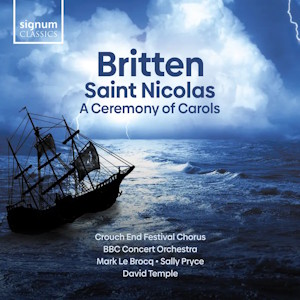
Benjamin Britten (1913-1976)
Saint Nicolas, Op 42 (1948)
A Ceremony of Carols, Op 28 (1942/3)
Mark Le Brocq (tenor); Sally Pryce (harp)
Crouch End Festival Chorus
Coldfall Primary School Choir; Hannah Brine Choirs; Members of Hertfordshire Chorus and other guests
BBC Concert Orchestra / David Temple
rec. 2020, All Saints Church, East Finchley, London & Alexandra Palace Theatre, London
Texts included
Signum Classics SIGCD649 [71]
It was only recently that I learned of this recording, though it was made and released in 2020. To my surprise, I discovered we had not reviewed it. Time to make amends, and it’s highly appropriate to do so in the year that we mark the fiftieth anniversary of Benjamin Britten’s death..
In my collection I already have a very fine version of the same coupling by Stephen Layton and the Choir of Trinity College Cambridge, which I reviewed in 2012. I also have the 1988 version (with a different and less generous coupling) by Matthew Best and the Corydon Singers, which was first released on the Hyperion label and subsequently appeared on the label’s mid-price Helios label, in which guise William Hedley reviewed it. I also have Britten’s own Decca recording (475 6156) but this was made in 1955 and it is more of archival interest nowadays. Except for a couple of points, I’ve deliberately refrained from making comparisons with either the Best or Layton recordings as part of my appraisal of David Temple’s recording of Saint Nicolas. That’s because Best used a choir of professional singers and Layton used a top-rank collegiate choir, reinforced with The Holst Singers. Temple, though, offers something rather different. In an introductory note in the booklet, he writes that Saint Nicolas “was essentially a community project for amateur musicians, involving Lancing College…as well as other local schools. In our recording I wanted to recreate this idea of the community. There are over 200 singers and only one, the tenor soloist, is a professional…. the performance celebrates the voices ‘of the people’”. The Hannah Brine Choirs, members of Hertfordshire Chorus (of which Temple is also the conductor) and other guest singers will have been brought in to fulfil the congregational role in the two hymns.
This may be a performance by amateur choral forces but no apology need be made for this. As I listened, following in my vocal score, I was much impressed by the attention to detail displayed by the Crouch End Festival Chorus in matters of dynamics (especially), accents and rhythms. Their discipline is excellent and their diction admirable. In addition to all of that, the sound which the choir makes is consistently pleasing. I noted also that the semi chorus contributions – all of them well sung – were properly distanced in response to Britten’s injunction that these voices should sing “in the gallery”. There is also a very significant contribution by the young voices of Coldfall Primary School Choir. Just over 40 children are named in the booklet. They are principally involved in the second movement, ‘The Birth of Nicolas’. My goodness, these young singers are as keen as mustard; they’re completely together and accurate while their words are crystal clear. Their music director Katherine Vetch had clearly done a great job in preparing them. Four members of the choir have small but telling solo roles; all four acquit themselves admirably. Out of curiosity, I took a look at the school’s website to see if the choir still exists six years on. It wasn’t clear if the choir is still in business. I do hope it is, because music is so important to young children and this youthful choir certainly seemed to be loving their exposure to Britten’s music.
Mark Le Brocq sings the title role. He makes a consistently good impression, singing with ringing clarity – of tone and diction – and no little commitment. I admired his eloquence in ‘Nicolas devotes himself to God’; the quiet last phrase is beautifully delivered. Later on, he’s characterful and committed in ‘Nicolas from Prison’ and he brings great intensity to ‘The Death of Nicolas’. I said earlier that I’d largely refrained from making comparisons with other recordings but I couldn’t resist reminding myself of Allan Clayton on the Layton disc. Clayton was at an earlier stage of his career at that time but his singing for Layton is outstanding. On a subjective basis, I still prefer him to any other tenor I’ve heard in this role but Le Brocq is excellent for Temple and I can safely say that no one hearing his contribution to this performance is going to be disappointed.
The BBC Concert Orchestra plays very incisively for David Temple – the leader, Nathaniel Anderson-Frank is most impressive in his solos in the first movement. The two pianists, Ben Dawson and Caroline Jaya Ratnam have a crucial role in this score; they play very well indeed. The only mild disappointment concerns the organ. I hasten to say I have no criticism of the playing of Malcolm Hicks but it sounds very much to me as if he was playing an electronic instrument. The organs on the Layton and Best discs are much more convincing; both recordings were made in London churches and will have used the in-situ instruments.
David Temple’s direction of the performance is assured and often dramatic. When one considers that he had a large number of amateur singers, many of them children, to lead and inspire his achievement here is significant. I’ve commented earlier on the attention to detail that his choirs display. Temple ensures that all the performers put this score across with conviction. Saint Nicolas isn’t one of Britten’s best works – my colleague William Hedley drew attention to some of the issues with the piece in his review of the Best recording, cited above. However, among the works that Britten composed in order to draw amateurs, and young people especially, into music-making at a high level, it is one of his most notable achievements. In addition, the music exerts a very definite and immediate appeal to audiences. Temple’s approach to the score is very convincing and he ensures that the listener fastens upon the work’s positive features rather than any weaknesses.
A Ceremony of Carols is very often heard in performances by a three-part choir of boy trebles. However, in his note accompanying the Stephen Layton recording, Mervyn Cooke explicitly states that the work “was originally conceived for a female choir” by Britten, and Hugh Bowden reminds us in his notes for this Crouch End release that the first performance of the work was given by the women’s voices of the Fleet Street Choir in December 1942. Both Layton and Temple use adult female singers; in Temple’s case he has 42 voices at his disposal. The crucial and wonderful harp part is played – superbly – by Sally Pryce, who also played on the Layton recording. Incidentally, I’m relieved that Temple – and Layton – used Britten’s original score rather than the SATB arrangement by Julius Harrison. I’ve taken part in a couple of performances of that version but I’ve never been satisfied with Harrison’s arrangement; tenors and basses just sound wrong in this music and Harrison had to tweak Britten’s original too much for my taste in order to accommodate four voice parts.
If tenors and basses sound wrong in this music then Temple – and Layton, too, for that matter – demonstrate triumphantly that adult female voices can be wholly successful. I noted with some interest that on his recording Stephen Layton used exactly half the number of singers that David Temple deployed – and though I’ve used the term female voices in referring to both recordings, two of Layton’s eight altos were male. The smaller size of Layton’s choir gives his version a beguiling intimacy but as I listened to David Temple’s splendid choir I was never once conscious of hearing a large ensemble.
The opening Procession (‘Hodie Christus natus est’) which Temple entrusts to just ten of his singers, all first sopranos, is wonderfully done. The singers begin in the distance and as they make their way to join their colleagues the effect is ideally managed, for which the engineers must also take credit. When we hear a mirror image of the music in the concluding Recession the effect is managed with equal success. I greatly enjoyed this performance of A Ceremony of Carols. Right from the start of ‘Wolcum Yole!’ the singing is alert, clear and together. The Crouch End ladies make a most attractive, fresh sound and, as in Saint Nicolas, the attention to dynamics and rhythmic accuracy is admirable. Those comments on the quality of the singing apply to the whole performance. I loved the spirited rendition of ‘As dew in Aprille’; once again, the care taken over dynamics makes all the difference. ‘This little Babe’ is a piece to which trebles bring a unique cutting edge which adult female singers can’t quite emulate; that said, the present performance is terrifically incisive. In the final number for the full choir, ‘Deo Gracias’, I was greatly taken with the vitality and excellent articulation of the performance.
Two other things should be said. Four members of the choir are involved as soloists; all acquit themselves excellently. Sally Pryce’s playing is, as I’ve already indicated, superb. It was an inspired decision on Britten’s part to use a harp in this work; Pryce shows just how important that decision was, not least in her wonderfully atmospheric rendition of the Interlude, based on the ‘Hodie’ plainchant melody.
David Temple clearly has this score at his fingertips; he leads a very fine, incisive account of this beautiful work.
The recordings were made in two separate venues, a couple of months apart. Saint Nicolas was set down in the secular environment of the Alexandra Palace Theatre, presumably in order to accommodate the large forces, while All Saints Church, East Finchley was used for A Ceremony of Carols. The same technical team was responsible for both sets of sessions: producer Isabella de Sabata and engineer Mike Hatch. The recorded sound captured in both venues is excellent. Signum’s documentation is excellent; David Temple and Hugh Bowden provide very useful introductions to the music in their respective essays.
This an excellent pairing of two of Britten’s most popular choral works.
John Quinn
Buying this recording via the link below generates revenue for MWI, which helps the site remain free














Ceremony and Nicholas are two of Britten’s finest works; along with a handful of others, like the War Requiem, the Purcell Variations, and the Serenade, these will be his legacy. This is the fiftieth year since his death, and few other of his works have managed to get into the standard repertoire, especially outside Britain. And it’s a good thing that we all don’t agree with this, nor about performances.
I much prefer boys singing Ceremony, for example, and there are multitudes to choose from, including European and US choirs. Guest and St John’s probably have the edge here, although Westminster Cathedral, New College, and of course the Willcocks, will have their admirers, including me. I have heard every Nicholas generally available, and many that aren’t. I will never hear a better Nicholas than Anthony Rolfe Johnson, and it surprises me he wasn’t mentioned. And Best’s is the best recorded, and most sincerely felt. The raptness of ‘God Moves in a Mysterious Ways’ hasn’t been matched, nor the quality of the boys’ singing. I also like the congregational contributions more than I do elsewhere, though this might be a recording issue: It needs resonance, like a cathedral, for full effect, and power.
Thank you for your most interesting comments, Terence.
You’ll have noticed that at the start of my review, I specifically stated that I didn’t intend to make comparisons with the Best and Layton recordings because these excellent versions were not directly comparable to the David Temple recording, which uses a large amateur choir. You’re right; I made no specific mention of Anthony Rolfe-Johnson – a singer I much admire – but I did provide links to reviews of the Best and Layton recordings, where his performance of the title role is discussed.
I agree with you that on the Best recording the opening of ‘God moves in a mysterious way’ is a very special moment but this is an example of where I think the Temple recording isn’t comparable to the others. Best’s singers begin the hymn very softly indeed. However, given that Britten specifically marked this verse to be sung by the sopranos, altos and congregation, I do wonder if he ever envisaged that the first verse would be sung iin such a hushed fashion.