
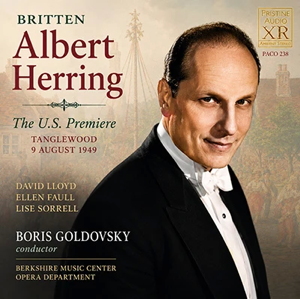
Benjamin Britten (1913-1976)
Albert Herring (1947)
Chamber opera in three Acts
David Lloyd (tenor) – Albert Herring
Ellen Faull (soprano) – Lady Billows
Elinor Warren (mezzo ) – Florence Pike
Irvin Nordquist (baritone) – Sid
Helen Spaeth (mezzo) – Nancy
Lise Sorrell (mezzo) – Mrs Herring
Berkshire Music Center Musicians/Boris Goldovsky
rec. live, 9 August, 1949, Theatre-Concert Hall, Tanglewood, USA
Pristine Audio PACO238 [123]
This new release from Pristine Audio brings the first ever general release of this example of the work of Russian/American conductor and broadcaster Boris Goldovsky. His name will probably mean nothing much to readers outside of North America but when I was a teenager, I welcomed Mr Goldovsky’s slightly accented tenor speaking voice into my home on an almost weekly basis via the opera broadcasts from the Metropolitan in New York. From the mid-1940s to the late 1980s, Goldovsky’s invaluable commentary about the opera featured on that day was always interesting and insightful. Unlike many commentators, he never spoke down to his audience and he often provided amusing anecdotes from his long performing career as a conductor and producer of touring opera companies that he worked for. Many of the musical analyses of those operas can be experienced today via his book “Good Afternoon Ladies and Gentlemen”, although without the numerous musical excerpts which he would play on a Knabe Piano to illustrate the commentary with.
This recording appears to have been sourced from a private archive, possibly originating from the Berkshire Music Center (now called the Tanglewood Festival). Pristine’s customarily professional job in restoring old mono recordings has had a big challenge in working with the master tapes of this opera. The original tapes suffered from considerable pitch variations throughout each reel. Producer and engineer Andrew Rose is to be commended for the painstaking care he lavished on this wonderful old document which might have survived in an utterly useless state were it not for his intervention. The chamber orchestra is vividly captured, except in some tutti passages where things become a bit murky. The voices are slightly recessed within a natural stage ambience and the words are fairly clearly caught throughout. Of course this will never replace Britten’s masterful first recording on Decca (review) but then it doesn’t aim to. On the whole I find this much easier to listen to in its entirety than I do the other historic document of the original 1947 English Opera Group cast as recorded on tour to Copenhagen (review), despite both having occurred the same year.
One’s enjoyment of this zippy performance may be affected by how much one responds to the question of a lack of British accents in an opera about British village life. All previous recordings of Albert Herring have in some way derived from, or been recorded, in the UK so the question of accents doesn’t really come up. However, in this one, the accents are all resolutely American sounding. The singers here had all been drawn from their summer resident studies at the Berkshire Music Center that year. In an opera where class divisions (and the accents which accompany them) are a consideration, this makes more of a difference than one might suspect. Yet, if one can manage to attune ones ears to the mostly New England cadences then one is in for a treat.
The most winning performance comes from the delightful David Lloyd as Albert. His youthful tone and bright, boyish charm go a long way to making one of the most captivating Alberts on any set. His delivery of the line about his “Virgin ransom” gets quite a hearty laugh from the audience. This is a wonderful document of a splendidly accomplished portrayal that would have otherwise been lost to posterity.
Most of the remainder of the cast range from adequate to extremely good. Ellen Faull’s Lady Billows is among the latter. Her solid dramatic soprano is a joy to encounter and it is only the fact that her voice is simply too youthful to be convincing as the old dragon who tries to run the village that prevents her from being ideal casting. Much the same could be said for Lise Sorrell’s admirably clear mezzo as Mrs Herring. Her compact and beautifully disciplined tone just doesn’t make a convincing figure of overbearing parental authority. She certainly doesn’t sound like a mother to anyone in this cast.
Elinor Warren makes a nicely waspish Miss Pike and she is well contrasted with Beverly Hunziker’s airy timbre, which illustrates the annoying Miss Wordsworth’s flightiness perfectly.
Among the men in the cast I rather enjoyed Joseph Contreras’ solidity of tone as Superintendant Budd. Although Irvin Nordquist does nothing objectionable as Sid, his vocal characteristics are simply too refined and gentlemanly to illustrate the good time, village lad that Sid should represent. However, there is a delightful and sympathetic Nancy from Helen Spaeth.
This recording contains significant applause only at the end of the opera, where it cuts off rather abruptly instead of fading away as is usually the custom. There is a smattering of applause when the curtain rings down during the interlude in the middle of the Second Act, somewhat obscuring some of the orchestral music which describes the villagers feasting themselves at the May King Fête. There are several instances of audience laughter encountered throughout which may be troublesome for some.
I began this review with Boris Goldovsky, so let me end there, with a comment that his direction brings clarity and purpose to this lovely and witty score. He observes all of Britten’s charming orchestral commentary, possibly with a bit more affection for it than the composer does on his Decca set. That may ultimately dictate whether one purchases this recording or not. Goldovsky’s reading shows a fondness for the work that Britten himself doesn’t indulge in. It is no less valid, I think. This set also has other attractions: plenty enough for a delightful evening of listening which will take one back to the American premiere production, caught only two years after the opera’s world premiere at Glyndebourne. It is really remarkable that Pristine enables one to do just that.
Mike Parr
Availability: Pristine Classical
Other cast
Joseph Contreras (bass) – Superintendant Budd
Beverly Hunziker (soprano) – Miss Wordsworth
Howard Fried (tenor) – Mr Upfold
James Pease (baritone) Mr Gedge
Nora Riggs (soprano) Emmie
Frences C. Cammuso (soprano) Cis
Bennett Eppes (treble) Harry













