
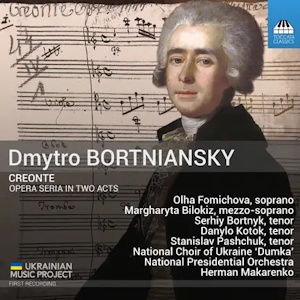
Dmytro Bortniansky (1751-1825)
Creonte (1776), opera seria in Two Acts
Creonte- Serhiy Bortnyk (tenor);
Antigona- Olha Fomichova (soprano);
Emone- Danylo Kotok (tenor);
Adrasto- Stanislav Pashchuk (tenor);
Ismena- Margharyta Bilokiz (mezzo)
National Choir of Ukraine ‘Dumka”;
National Presidential Orchestra/Herman Makarenko
rec. 2025-2026, Hennadii Udovenko Diplomatic Academy, Kyiv, Ukraine
booklet includes Italian libretto with English translation
Toccata Classics TOC 0807 [2 CDs: 139]
The music of Dmytro Bortniansky has only been familiar to me in old recordings of some of his Orthodox Choral settings, of which there is a significant number when compared to his operas: there are six in total. None of his operas survived into the 19th century, this is the first one to be resurrected for a modern audience in over 200 years. Bortniansky was active in Italy, primarily Venice, earlier in his career. This was followed by a brief stint in Vienna where he was acquainted with Salieri, who was then court composer to Catherine the Great. Bortniansky then headed back to Russia where he became court composer for Catherine’s heir, the Grand Duke Paul. His completed operas divide quite neatly into three composed for the Venetians, and a further three for the Duke’s small court in Pavlovsk. Creonte is the earliest of Bortniansky’s operas, and also is the earliest complete opera by a Ukrainian (also Russian) composer. One earlier work, Demofonte by Russian composer Berezovsky of which only a few numbers survived. The scores of both operas were considered lost until they were rediscovered in 2024.
Not surprisingly, Ceonte’s music is very well crafted in the Venetian classical manner of the time. In that respect it’s musical form sounds quite similar to the mid career works of Mozart and Haydn. The opera’s libretto is based on Sophocles but it has been given a happy ending. The arias have elegant musical lines and show off plenty of flexibility for the singers’, without going overboard. There is not the ability that both Mozart and Haydn acquired in their later works for illustration of emotional or psychological depths. In that sense the succession of arias here could easily be interchanged for one another without disturbing the drama in the slightest way. This is something that Creonte, along with many other opera seria have in common with one another. Where Bortniansky does impress is in his use of the chorus, which tends to sing en masse; providing commentary along the lines of the chorus in a Greek tragic play. This suggests that Mozart possibly knew of this score when he came to compose Idomeneo. The choral music has a power and presence that hadn’t really existed for opera prior to this date. Possibly Bortniansky’s exposure to Orthodox Church music was what brought this dramatic change about. Whatever the reason, it is for the choral pieces that one should try to hear this opera. The composer gave more music to them in the First Act than in the second, where they put in only two brief and disappointing appearances compared to their activity in the First Act. One really senses that in this single respect Creonte is something of a “missing link” between the perfunctory use of the chorus in opera seria such as Lucio Silla to the later more vital choral scenes of such works as Idomeneo and La Clemenza di Tito.
Recording an opera in a studio in Ukraine with constant drone attacks would seem to be an impossible task. The booklet mentions that recording sessions were often interrupted by such attacks which accounts for the 4-month span in the sessions. This has obviously been a labour of love for all concerned, and for that reason this deserves to be a commercial success. The first thing I noted about this recording is the general excellence of the sound. The engineers have rightly placed the performers, orchestra and the chorus at a slight distance from the microphones, resulting in a very realistic spatial presence. While listening one can actually map out in the mind the acoustical layout of the hall in which this has been recorded. Bravo! This puts many a recent commercial opera set to shame with their harsh balances and lack of care to reproduce an atmospheric sound, my recent review for Lucia di Lammermoor (review) being a case in point.
The cast is generally acceptable and some achieve beyond that. One has the impression that these are very young singers who might still be undergoing training. Serhiy Bortnyk has a light bodied, hazel tint to his tenor. He shows himself able to cope reasonably well with the more rapid passages. Still, one of Creonte’s failings is too many tenors, and not a single low voice. A tenor anti-hero becomes one of the incongruous elements of this score.
Margharyta Bilokiz possesses a really vibrant young mezzo, and as a singer she shows great promise for the future. Olha Fomichova’s Antigona is rather uneven at times. She is somewhat shrill in her upper range but she sings with great personal presence in the role and often seems the most assured of the cast.
Danylo Kotok’s Emone is challenged by some fairly difficult music to sing. He gets through it with sheer determination. Still his voice sounds at times like it still needs careful support and guidance if he is to reach his full promise. Similarly Stanislav Pashchuk’s Adrasto sounds to my ears very much like a student singer whose voice and confidence are still evolving. However, this should not be taken to mean that his voice is not pleasing, but with more experience he will make a greater impression.
Herman Makarenko conducts the excellent orchestra and choir with a sure, even hand. This is no small feat considering the challenges under which this recording was made. The recitatives are also sufficiently interesting in their dramatic responsiveness, sometimes their performance surpasses that of the arias. This CD is presented in a box case with a full libretto, with notes and translation also included. The break to change over to the second CD comes at an odd point, in the middle of a phrase of recitative but this is far from a serious issue.
Mike Parr
Buying this recording via the link below generates revenue for MWI, which helps the site remain free













