
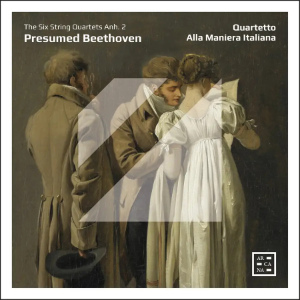
Ludwig van Beethoven (1770-1827)
Presumed Beethoven
The Six String Quartets Anh. 2
Quartetto Alla Maniera Italiana
rec. 2025, L’arboreto – Teatro Dinora, Modeino, Italy
Arcana A591 [2 CDs: 92]
The booklet notes for this release by Gabriele Riccobono tell us that the first known reference to these six quartets dates to September 1893, when August Artaria printed a catalogue of his collection of music manuscripts “deriving from the relations that my father and his predecessors had established… with the most important composers of their time.” The manuscripts for the quartets come with the description, “6 quartets for violin; attribution to Mozart dubious. Not engraved.” This refers to separate parts in the hand of a copyist, acquired in 1901 by the Berlin Staatsbibliothek, where they are still preserved. Mozart scholar Georges de Saint-Foix then attributed these works to the young Beethoven in an article from 1923 in the Rivista Musicale Italiana which makes initial arguments with regard to comparable handwriting found in scores by Beethoven in the British Library.
There are other comparisons made of musical motivic and formal resemblances to Beethoven though, as they also conform to the style of the period, there is no actual conclusive evidence either way. Other suspects for the composition of these quartets include Johan Baptist Wanhal or perhaps even Ludwig’s brother Kaspar Karl van Beethoven, but the conclusion made here is that further study is needed, and that this recording by the Alla Maniera Italiana quartet “intends to draw attention to these works in the hope of stimulating further research.”
The Alla Maniera Italiana quartet plays on period instruments and is dedicated towards historically informed performance of a wide variety of repertoire, but previously focussing on unexplored works in recordings on the Urania Records label of works by Francesco Pasquale Ricci and Francesco Zappa. I assume they use gut strings so there is that slightly raspier haze from each instrument when compared with modern wound or metal strings, but in general the quartet sound is full enough and the playing is characterful, accurate and idiomatic if not always absolutely perfect in the more twiddly corners. There is a ‘period’ feel here, but not in a way that gets in the way of the natural flow of this music.
What we have are five quartets in major keys and one in the minor. All have three movements with the exception of No. 6 which has two, and which closes with an Andante with variations. These are all very pleasant works in a classical style that you would expect from Mozart or Haydn or any number of composers of the period, including the young Beethoven. These are not insubstantial works, with durations between 13 and 17 minutes, so there is a fair amount of working-out of material within movements. This said, these are what would have probably counted as ‘light entertainment’ even when new, following harmonic conventions and with that narrow band of emotional expression that you can allow to wash over you, and that wouldn’t have had our sensitive 18th century audiences dropping their handkerchiefs in shock. There is lyrical charm in the slow movements, with a certain amount of gravity in, for instance, the Romance: Larghetto middle movement of No. 3. The minor key of No. 4 also provides quite a contrast with its enigmatic opening Fantesia, and some counterpoint in the Allegro that it precedes, suggesting a throwback to Baroque models.
This is labelled as a world premiere recording, and as the only version available of ‘Beethoven’s’ Anh. 2 quartets it serves us well with its nice recorded balance and entirely respectable performances. The two CDs are well presented in a foldout sleeve and with an informative booklet, the texts in which are printed in English, French and Italian. Whether these works are by Beethoven or not is an interesting historical question, and with their ‘dig-deep’ treatment of the musical material at hand it seems to me that they sound more like Beethoven than Mozart. That ‘pastorale/pesante’ quality at the end of No. 4 has the tiniest pre-echo of Beethoven’s Sixth Symphony, but this style was more widely fashionable at the time so it could easily just be a coincidence.
Even if it could be proven that these quartets were by Beethoven I don’t believe it changes the impact that these quartets have. I applaud the Quartetto Alla Maniera Italiana for tackling unknown repertoire instead of churning out new versions of old favourites, but if these performances do happen to shine a light on Beethoven’s early work then they reveal a composer with imagination and a lively talent, though not yet showing those exceptional qualities that would make them stand out from the crowd.
Dominy Clements
Buying this recording via the link below generates revenue for MWI, which helps the site remain free













