
Ralph Vaughan Williams (1872-1958)
From Ursula, with Love
rec. 1961-72
Albion Records ALBCD 072 [75]
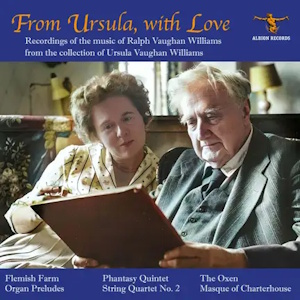
This CD collects a number of historic Vaughan Williams recordings curated by his widow, Ursula. These were entrusted to Stephen Connock, then Chairman of The Ralph Vaughan Williams Society in 1996. The advertising blurb states that fourteen of the album’s seventeen tracks have never been released commercially before. The recordings were transcribed by Pete Reynolds of Reynolds Mastering and finalised for this album by Ronald Grames.
The concert opens with music that is among the loveliest Ralph Vaughan Williams ever wrote. In fact, he himself thought it was some of the finest he had produced. Yet, it remains little known even to enthusiasts of the composer. The film The Flemish Farm (1943) is a quiet, patriotic wartime drama about Belgian servicemen who flee to Britain after the 1940 German invasion and embark on a secret mission back to Belgium to reclaim their unit’s buried flag.
The film has faded into obscurity, but RVW was impressed by the score and drew on it to make a Suite (1945). There are seven movements in all, lasting just under half an hour. The entire suite has been recorded before, on the Chandos and Marco Polo labels. On this album, the BBC Scottish Orchestra under Graham Treacher play just three movements. The first, Dawn in the Old Barn: The Passing of Lovers, is in the composer’s full blown pastoral manner, a delight. Much more sombre is The Dead Man’s Kit, which is lean and desolate, nodding towards the Symphony No.6. The final movement on this disc is In the Café, which the liner notes suggest is composed in a “popular musical idiom.” It is fun, even if conceived in less than happy circumstances. The listener may wish to enjoy this short suite simply as absolute music, divorced from the film’s plot. It could make a successful concert filler and go on to become popular.
There are currently eight recordings of Vaughan Williams’s Phantasy Quintet in the catalogues. I first heard it played by the Music Group of London on the EMI recording issued in 1974 (HQS 1327). There, it was coupled with the Sonata in A minor for violin and piano, as well as the Six Studies in English Folk Song for Cello and Piano. It has remained in my collection ever since. The Phantasy was a W.W. Cobbett commission completed in 1912. It was responding to Cobbett’s desire to revive the historic, single-movement English Elizabethan “fancy,” which generated many chamber works by British composers both well-known and now largely forgotten.
Vaughan Williams’s Phantasy Quintet (1912) is a warm, reflective chamber piece that moves in one continuous sweep rather than separate movements, unified by a central theme – although the tracks on this CD are divided into four “sections.” The mood shifts naturally between calm and wistful passages, from the deeply felt Alla Sarabanda to playful moments in the Burlesca, all influenced by RVW’s predilection for flowing melodies and folk-coloured harmonies. The Aeolian Quartet, with Kenneth Essex as second viola give an engaging performance that highlights both the Phantasy’s lyrical gentleness and its more spirited moments with unfussy assurance.
Even though some critics find Hodie structurally diffuse and uneven, calling it “overlong” and “one of RVW’s least compelling large choral works,” I love it. Ever since first hearing it on the BBC on Christmas Eve 1972, it has remained one of my seasonal fixtures. This very recording is the source of the extract heard on this disc. The Oxen, a wonderfully evocative Christmas poem by the agnostic Thomas Hardy, is beautifully served here: baritone John Carol Case and the Philomusica of London, under Donald Cashmore, give a suitably sensitive performance.
Vaughan Williams wrote precious little for the organ, despite having been a professional church organist in his younger days. The most significant example is the rarely heard Prelude and Fugue in C minor, dating from 1930; most of the other works associated with him are arrangements by other hands.
It is not certain what instrument the legendary George Thalben Ball used when recording RVW’s Three Preludes Founded on Welsh Hymn Tunes. Nevertheless, it is assumed that he played them on the Temple Church’s 1924 Harrison & Harrison organ, originally from Glen Tanar Castle, Aberdeenshire. Recorded back in 1961, Thalben Ball gives a convincing account of these three pieces.
There is a sense of the improvisatory about the first Prelude, Bryn Calfaria. The popular Rhosymedre is sincere, presenting the gorgeous melody twice in slightly different arrangements; it is small wonder that it is subtitled “Lovely.” Hyfrydol forms a powerful and celebratory finale, built on the well‑loved hymn tune composed by R. H. Prichard.
There are seven versions of the String Quartet (No. 2) in A minor (‘For Jean on her Birthday’) in the discography maintained by Ralph Vaughan Williams Society Trustee Jonathan Pearson. Some of these have been released in various editions. The earliest, dating from 1973 features the Music Group of London on the EMI Classics label (EMI HQS 1292). This is the edition I got to know the work by and is still my “go-to” disc.
For listeners who suppose that this quartet evokes cows and gates, the truth is quite different. In the sleeve notes for the above-mentioned record, Michael Kennedy advocates that listeners who regard this quartet as “serene” and “small” show “a grave misunderstanding of its true significance and nature.” He goes on to suggest that the first three movements are “permeated by the restless, troubled mood” of the Symphony No.6 in E minor. The first movement is tense, the Romance: Largo is “bleak, comfortless” and the Scherzo is “bitter.” The resolution of the Quartet comes in the final Epilogue which is calm and heart-easing. The present liner notes are correct in stating that “This second-string quartet is vital to a thorough understanding of Vaughan Williams’s deeply felt reaction to the Second World War, feelings which would find their ultimate expression in the Sixth Symphony of 1947.”
The Aeolian Quartet sympathise with the various moods of this piece and give a commanding performance, articulating the quartet’s troubled inner landscape with conviction and allowing its concluding calm to feel genuinely won.
Vaughan Williams’s contribution to the Charterhouse Masque performed in 1950 grew out of his association with the school he had attended between 1887 and 1890. Over the years he had returned several times as an honoured guest. Invited to write new material for the Masque, he agreed on the condition that Carmen Carthusianum, the school song, should be included so that performers and audience could join in a shared act of music-making. The resulting Solemn Music, first performed on 12 July 1950, wove together strands of Charterhouse’s musical heritage: fragments of the Carmen, onetime school master Edward Rendall’s 1911 Prologue tune, and his grave De Profundis, originally used to depict the expulsion of the monks in 1535-36. Vaughan Williams worked these elements into a final scene designed for the ceremonial entrance of all participants, culminating in a stirring, brilliantly orchestrated finale that sets the Carmen Carthusianum to William Horsley’s nineteenth‑century melody.
In this recording from Charterhouse, the School Choir and Orchestra are conducted by William Llewellyn.
Stephen Connock’s outstanding liner notes provide essential context for the listener. Because these recordings were made over an eleven-year span between 1961 and 1972, minor sonic allowances naturally must be made – though surprisingly few. Whatever slight limitations exist in the audio quality are overwhelmingly redeemed by the superb performances.
Ultimately, From Ursula with Love stands as a deeply touching and essential release that honours Ursula Vaughan Williams’s personal legacy towards her husband. By preserving these rare, previously unreleased archival treasures, Albion Records has given listeners an invaluable gift – making this release a must-have for any Vaughan Williams devotee.
John France
Other review: Nick Barnard
Buying this recording via the link below generates revenue for MWI, which helps the site remain free

Contents
Three extracts from Suite: The Story of a Flemish Farm (1943/1945): Dawn in the Old Barn; The Dead Man’s Kit; In the Café
BBC Scottish Orchestra/Graham Treacher
rec. 15 April 1965
Phantasy Quintet (1912)Aeolian Quartet (Sydney Humphreys (violin), Raymond Keenlyside (violin), Margaret Major (viola) Derek Simpson (cello) with Kenneth Essex (second viola)
rec.15 April 1965
Extract from Hodie (This Day)- A Christmas Cantata (1953-54): ‘The Oxen’
John Carol Case (baritone)
Philomusica of London/Donald Cashmore
rec. 16 December 1972
Three Organ Preludes founded on Welsh Hymn-Tunes (1920):
Bryn Calfaria; Rhosymedre; Hyfrydol
George Thalben-Ball (organ)
rec. 8 December 1961
String Quartet (No. 2) in A minor. For Jean on her Birthday (1944)
Aeolian Quartet: Sydney Humphreys (violin), Raymond Keenlyside (violin), Margaret Major (viola) Derek Simpson (cello)
rec. 20 October 1966
Solemn Music for the Masque of Charterhouse (Final Scene) (1950): Solemn Music; Finale
Chorus and Orchestra of Charterhouse School/William Llewellyn
rec. March 1972













