
Ralph Vaughan Williams (1872-1958)
From Ursula, with Love
rec. 1961-72
Albion Records ALBCD 072 [75]
Albion Records have a two-pronged approach to the promotion of the music of Ralph Vaughan Williams. On one hand, they are responsible for many exceptionally fine new recordings of much loved or unfamiliar music, presented in the best possible musical and technical light. On the other hand, they trawl the archives to restore to the catalogue – or often commercially release for the first time – performances of historical significance. From Ursula, with Love belongs to the latter category. Ursula was Vaughan Williams’s second wife in the last five years of his life. These recordings were sourced from her personal collection of private or broadcast recordings of her husband’s music. She donated this collection to the Vaughan Williams Society in 1996 with a view to making some of them publicly available. Pilgrim’s Journey and Hodie have appeared on earlier Albion releases, but I have not heard those performances.
The quality of Albion’s presentation is a given, with informative, detailed liner notes about the music and the performers/performances. The programme is more of a mixed bag. It ranges from a film score to chamber works and – the real rarity – a masque for the composer’s old school. I have to say I am less enthusiastic about this disc than previous ‘historical’ releases on this label. Technically, Albion have done a fine job. The sound is perfectly acceptable even in the works where the liner notes say there are “ deficiencies impossible to completely mitigate”. The majority of the recordings were made in the 1960s. The value then was that the main works presented here – The Flemish Farm, the Phantasy Quintet and the String Quartet No.2 – had not received modern commercial recordings at that point. Just an opportunity to hear this music domestically was a considerable plus.
The collection opens with three movements from the 1942 film The Story of a Flemish Farm. The previous year, Vaughan Williams’s score for 49th Parallel had been well-received; this was the follow-up morale-boosting movie. The liner notes mention that the composer reworked some of the unused material from this film in his Symphony No.6. That points to the calibre of the material and to the seriousness with which he approached writing for film. The problem with this performance is that the version is simply not that exceptional. The BBC Scottish Orchestra under Graham Treacher play three excerpts from the composer’s own seven-movement suite. The playing is competent, but it does make one realise how transformed “regional” orchestras have been in the intervening decades. Likewise, the recording is acceptable but lacks real ambience that this atmospheric score would benefit from. The shortcomings are clear when this is set alongside either of the modern recordings of the complete suite: Andrew Penny’s with the RTE Concert Orchestra on Marco Polo, and Rumon Gamba’s with the BBC PO on Chandos. The approach to tempi is markedly different. Gamba is quicker especially in the In the Café placed third in this selection and fourth in the original suite. This is certainly a film score worth hearing, and Penny is my preferred guide.
The other two largest works on the disc are the wonderful Phantasy Quintet and the String Quartet No.2,both played by the Aeolian Quartet (with violist Kenneth Essex joining for the quintet) in 1965 and 1966 respectively. For many collectors, myself included, the introduction to these works on record was via the Music Group of London versions from the early 1970s, led by the incomparable Hugh Bean. Once again, at the point these archive performances were made, there were probably no other options for domestic listening. In isolation – and by the measure of no choice – these are perfectly satisfactory performances. The sound recording, quite close and a little hard-edged, works more in favour of the uncompromising quartet than the modal ecstatic quintet. It is not clear whether the original recordings were single-take live performances or studio/for broadcast versions – there is no applause or discernible audience noise. But there are slight slips in ensemble and intonation, as well as issues of blend and balance, that suggest limited recording time. Perhaps I am too imprinted by the technical and spiritual warmth of the EMI/Music Group recording but this does not even begin to replace those recordings, let alone the multiple versions that have followed in more recent years.
Set between the two chamber works are performances that do command more attention. John Carol Case sings Thomas Hardy’s poem The Oxen which Vaughan Williams set – at Ursula’s suggestion – as part of his late Christmas Cantata Hodie. This excerpt is the only track that has been previously released. Carol Case, a stalwart of the recording studio, featured on many classic recordings in the 1970s especially. Boult’s stereo Sea Symphony and Apostles and Willcocks’s Five Tudor Portraits are just a small sample – but not this work. As the liner notes suggest, he sings here with “a warm even tone, a steady line, sensitivity to the text, and an awareness of the importance of clear diction”. This is the track most compromised in audio terms but Carol Case’s voice emerges with clarity even if now it does sound slightly old-fashioned in tone and placement.
Probably ticking all the “most valuable historical document” boxes are the Three Organ Preludes Founded on Welsh Hymn-Tunes played by George Thalben-Ball. This dates from December 1961 when Thalben-Ball would have been in his mid-sixties and not quite forty years into his near-sixty year tenure as organist and choir director of the Temple Church in London. The liner notes assume, but cannot be certain, that these preludes were performed on the church’s 1924 Harrison & Harrison instrument. The sound is a little cloudy and what I assume is some LP ‘swish’ can be heard. Yet the overall sound of the organ is well-caught and Thalben-Ball plays with commanding authority. Of course, more modern versions – notably David Briggs’s two-disc set “Burst of Acclamation” for Albion – can sonically encompass and expand a large church organ playing at full throttle. Even so, Thalben-Ball gives nothing to any other performer in terms of the sense of “rightness” in his playing.
The collection is completed by a piece that is both a rarity and an anachronism: music written for a British Public School Masque. Charterhouse School was Vaughan Williams’s Alma Mater, so it made sense for him to be approached and be willing to write music for The Masque of Charterhouse in 1950. The only surviving recording of a performance from 1972 is what the liner notes describe as an “overloaded tape”. That being the case, the Albion restoration team have done a commendable job. This performance, given by the pupils of the school, conveys well the full-throated if occasionally wayward enthusiasm of the event. This is a perfect example of Vaughan Williams’s ability to produce apt and attractive music that is fit for purpose, at a level appropriate to the performers concerned, yet still unmistakeably the work of the composer. The two excerpts here, Solemn Music and Finale,run for a total of just over nine minutes. There is no indication of how long the full score would last or how interesting it would be for non “Old Carthusians”.
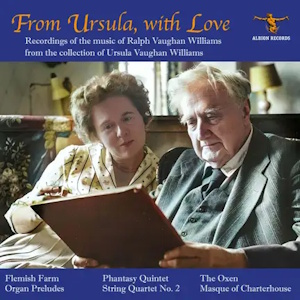
Except for the explicitly ‘occasional’ Masque, these are all fine – and familiar – works. As such, it is always a pleasure to encounter unfamiliar performances, but for collectors who already own other performances there is little on offer here that demands to be heard. Interesting: yes; compulsory listening: no. I suspect that, if it were not for the provenance, these recordings would not have been considered of such great historical value to demand exhumation. Of course, the quality of Albion’s presentation is a delight in itself (except I really do not like their preference for colourised photographs on the booklet cover) and the audio restoration makes the best possible case in each instance. This release, however, strikes me as one for the completists.
Nick Barnard
Previous review: John France
Contents
Three extracts from Suite: The Story of a Flemish Farm (1943/1945): Dawn in the Old Barn; The Dead Man’s Kit; In the Café
BBC Scottish Orchestra/Graham Treacher
rec. 15 April 1965
Phantasy Quintet (1912)Aeolian Quartet (Sydney Humphreys (violin), Raymond Keenlyside (violin), Margaret Major (viola) Derek Simpson (cello) with Kenneth Essex (second viola)
rec.15 April 1965
Extract from Hodie (This Day)- A Christmas Cantata (1953-54): ‘The Oxen’
John Carol Case (baritone)
Philomusica of London/Donald Cashmore
rec. 16 December 1972
Three Organ Preludes founded on Welsh Hymn-Tunes (1920):
Bryn Calfaria; Rhosymedre; Hyfrydol
George Thalben-Ball (organ)
rec. 8 December 1961
String Quartet (No. 2) in A minor. For Jean on her Birthday (1944)
Aeolian Quartet: Sydney Humphreys (violin), Raymond Keenlyside (violin), Margaret Major (viola) Derek Simpson (cello)
rec. 20 October 1966
Solemn Music for the Masque of Charterhouse (Final Scene) (1950): Solemn Music; Finale
Chorus and Orchestra of Charterhouse School/William Llewellyn
rec. March 1972
Buying this recording via a link below generates revenue for MWI, which helps the site remain free














