
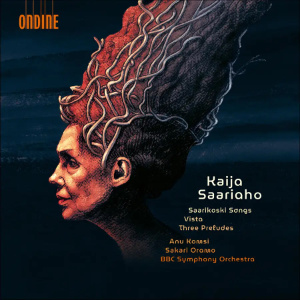
Kaija Saariaho (1952-2023)
Saarikoski Songs (2013-2020, orch. 2020/21)
Vista (2019)
Three Preludes (1981)
Anu Komsi (soprano), Marzi Nyman (organ)
BBC Symphony Orchestra/Sakari Oramo
Texts and translations provided.
rec. Helsinki Music Centre (Preludes); other dates & locations not given
Ondine ODE1512-2 [53]
Like many listeners, I first encountered Finnish composer Kaija Saariaho through her 2000 opera L’Amour de Loin, in the 2006 Harmonia Mundi recording by Kent Nagano (review). I was incredibly excited by the music, which can be described as Debussy’s Pelléas et Mélisande and Messiaen’s Saint François d’Assise with electronic instruments. It is a gorgeous, ethereal score. Quite different – but an equally rewarding experience – is her second opera, Adriana Mater (review), which is darker and more intense (although, interestingly, both were written by the same librettist: Amin Maalouf). I was not surprised to read that she had mentioned Berg’s Wozzeck as an influence. I do not believe her other three operas have been recorded yet, but on the strength of L’Amour de Loin and Adriana Mater she clearly ranks in the highest tier of 21st-century opera composers.
I will admit to finding some of her other works rather tough nuts to crack. Listening to Joanna Gutowska take on her cello music on the DUX label, it’s much more clearly timbral and academic than her vocal writing. Last year, the keyboardist Tuija Hakkila recorded her complete piano and harpsichord oeuvre on Ondine, and I can only agree with Stephen Barber that it’s ‘for Saariaho completists only’ (review). Clearly, something about the human voice inspires a shift in Saariaho’s compositional style, away from spectralism and toward something more impressionistic and romantic. Still very original, I hasten to add, but more accessible, at least for listeners like me.
This present release, also on Ondine, might be my favourite Saariaho album. The individual songs are a bit easier than a whole opera for a listener following along at home, and I think they blend her lush, romantic vocal style with aspects of spectralism in a way that sums up her whole artistic persona.
The five Saarikoski Songs were written throughout the 2010s and orchestrated in the early 2020s – the booklet tells us, quite poignantly, that Saariaho finished the last one just days before being diagnosed with the cancer that would claim her life. They run for 21 minutes and are clearly the nucleus of this album.
The title of the work refers to the Finnish modernist poet Pentti Saarikoski (1937–1983), and he merits a brief digression here, in large part because I see a lot of his character coming across in Saariaho’s wonderful settings. First, Saarikoski claimed of himself that he was the only person in the world who had ever translated both Homer’s Odyssey and Joyce’s Ulysses – I suspect he probably was. He was also a newspaper satirist, an unsuccessful candidate in parliamentary elections, and, according to his daughter, “a prime example of a European bohemian”. Saariaho’s website calls him “the enfant terrible of Finnish literature”.
The poems here come from his collection Alue (The District), published in 1973. A major theme in that work is the destruction of a forest near Helsinki to clear ground for housing. They are – with one exception – rather bleak. Saariaho matches the texts perfectly with dark, foreboding writing of her own.
A small note of complaint must be raised here. I do not know Finnish, but I found the translations offered in the booklet tough reading, in a way that got in the way of comprehension. For example, the opening couplet of The Face of Nature is given as: “But the face of nature is peaceful will be till the end of the world.” Lacking punctuation or a conjunction between ’is peaceful’ and ‘will be’ doesn’t quite work for me. When I put the same sentence into Google Translate, I read: “But the face of nature remains calm until the end of the world.” That sounds better. Then at the end of Snake and Bird, we read, “In me the bird and the snake unscrupulous!” which I puzzled over for a full minute and still do not understand. I could well believe that Saarikoski might be playing with language, and the texts may be convoluted and strange, but in that case, I would have liked the translations to give a clearer sense of what’s really going on. Notes wouldn’t have gone amiss.
Luonnon kasvot, “The Face of Nature”, is the first of the Saarikoski Songs, and was originally conceived as a stand-alone in 2017. The soprano imitates extinct bird calls in elaborate vocalisations, which alternate with unadorned vocal melody to carry the text. It feels appropriately sinister. The orchestra is by turns lush and gaunt, reflecting both the presence and absence of nature. Anu Komsi, the singer, about whom I will have more to say later, does a tremendous job with very difficult material. I found this song completely gripping.
The second song is Jokaisella on tämänsä, translated as “Everyone Will Have Their Own This”. Saariaho described her intentions for this song as ‘more dramatic’. Right from the start, there is a stormy, agitated quality to the vocals and a nervous, flighty quality to the orchestra. To me, the poem itself reads as satirical, but Saariaho invests it with a bitter denunciation of what the booklet calls “a society where individuals cling to their own, split truths.” I thoroughly enjoyed this edgier sound to Saariaho’s writing, which reminded me of Adriana Mater.
This song cycle has been beautifully designed: the transition from the ghostly presence of nature into strident anger is effective, and the next transition is even more remarkable. Kaikki tämä (“All of This”), was composed by Saariaho in “one single Sunday in the French countryside,” aiming to show “a glimmer of hope amidst dystopian times.” You really feel the slight wistfulness of allowing oneself to hope; there is a predominantly melancholy air, and the strings are lush and pillowy. The poem describes ‘rejoicing’ because of a bed of weeds. The reasons for optimism may be small, and Saariaho plays with that.
At this point in the compositional process, the coronavirus arrived in Finland, and Saariaho responded with Minussa lintu ja käärme (“In Me the Bird and the Snake”). We stay seemingly on the same pitch the entire time – it reminded me a little of Giacinto Scelsi – and Saariaho exploits this to create an anxious, claustrophobic mood. I do not understand the text enough to tell you what this song is about, sadly.
Finally, Sumum läpi (“Through the Mist”) describes time grinding to a halt, and what composer better to bring that to life than Saariaho? The first two minutes of the song are soft and motionless, and there are plenty of open spaces between the vocal lines. It’s a meditative, absorbing finish to a really marvellous cycle of songs.
I cannot praise Anu Komsi highly enough for her performance here. In fact, the Saarikoski Songs were dedicated to her (as was Saariaho’s previous cycle, the Leino Songs). Komsi has championed Saariaho’s vocal music since the 1980s, and in addition to this album, can be heard on several other discs dedicated to Saariaho’s music. She has been described as having a beautiful timbre, and “her coloratura technique is plainly stunning” (review). She recorded all five of the Saarikoski Songs in their original version for voice and piano in 2021 for the label ColoraMaestro, with the pianist Pia Värri. There is definitely something to be said for those versions, but Saariaho’s orchestration brings every nuance to life. This is perhaps especially evident in the final two songs, which gain the most from the orchestra’s dynamic range.
Following the Saarikoski Songs we get Vista, a 26-minute orchestral work in two movements. The genesis of the composition lies in her harp concerto Trans and her opera Innocence, both of which Saariaho had just completed. Driving down the Interstate 5 highway in California, Saariaho was struck by the beautiful, peaceful views. The first movement, Horizons, is a sort of watercolour image of the sky. That’s not to say that it lacks edge or dissonance. There are always new details rising to the surface, or flashing across the sonic landscape. As such, we manage to maintain momentum despite the overall feeling of serenity. The second movement, Targets, is quite different. There is a sense of alarm and dread. The booklet claims that it sounds, “as if trying to use a map and to read road signs instead of simply enjoying the view,” but I have to politely disagree: I think it sounds somewhat more intense than that. It reminded me a little bit of another recent BBC Symphony Orchestra recording – Naresh Sohal’s Asht Prahar (review). I absolutely loved it; there’s something fascinating about Saariaho’s darker, edgier works.
It is at this point that I should give full credit to the BBC Symphony Orchestra and their conductor here, Sakari Oramo (who is also Anu Komsi’s husband). Oramo and the orchestra were ideal partners in the Saarikoski Songs as well, but Vista is their time in the limelight. They are so sensitive to Saariaho’s vision, so transparent, and so variegated that I cannot easily imagine how any of these would be played better. The sound recording is also excellent, as I’ve typically found with Ondine. Sonics are especially important here, because so much of Saariaho’s writing is about textures and details, so I’m happy to say that both the orchestra and the engineers get it right.
The last three tracks on this CD are a seven-minute set of Preludes for soprano and organ which takes us back to 1981. They are Saariaho’s only setting of biblical material, and one of only a handful of works she composed for organ, despite her playing the instrument in her twenties. She, in fact, donated the Rieger Orgelbau organ at the Helsinki Music Centre, which is used on this recording. The first prelude sets the first 3 verses of Psalm 104, which describe the majesty of God. Saariaho’s music is passionate and challenging – this is not a ‘devotional hymn’ but an ‘expressive fragment, as the booklet tells us. No. 2 sets Psalm 39, verse 5, and then Psalm 90, verses 5–6, about human mortality. The music is sombre and downcast. The final prelude sets the line in Isaiah, “How beautiful upon the mountains are the feet of him who brings good tidings”, and we get something almost like a fanfare from the organ. In truth, I enjoyed hearing how Saariaho made use of the organ (played by Marzi Nyman), but I found these preludes a little arbitrary. I’m not sure that I got whatever was being expressed in the music.
Still, the Saarikoski Songs are well worth the price of admission. They show Saariaho at her most expressive and multicoloured, and they are performed so beautifully here by Komsi, the BBC Symphony Orchestra, and Oramo.
Aidan Gray
Buying this recording via the link below generates revenue for MWI, which helps the site remain free













