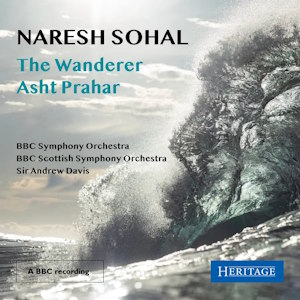
Naresh Sohal (1939-2018)
The Wanderer (1981)
Asht Prahar (1965)
Jane Manning (soprano); David Wilson-Johnson (baritone)
BBC Symphony Orchestra/Andrew Davis
rec. live 6 January 1973, BBC Broadcasting House, Glasgow, (Asht); 23 August 1982, Royal Albert Hall, London (Wanderer)
Reviewed from a stream on Apple Music
Heritage HTGCD135 [78]
Listening to a new set of some of Naresh Sohal’s string quartets recently (Toccata Classics TOCC0754, review), I was surprised to discover that two of them only received their first performances for that studio recording. I felt bafflement as to the current apparent neglect of Sohal’s music just as keenly when I listened to a recent release from Heritage Records (HTGCD135) containing his riveting The Wanderer in its performance from the 1982 Proms, for which it was commissioned. This is the only time this work has ever been performed.
Like most of Sohal’s music, the score here is rooted in the idiom of western classical music that he absorbed initially as a copyist for Boosey and Hawkes early in his career. The text which he set is a deeply personal Anglo-Saxon poem, whose protagonist is a warrior spiritually lost after the death of his liege lord. Sohal felt drawn to the, as he put it, ‘existential bleakness’ of the poem, something which he felt would be best served by the large orchestral forces he was adept at writing for. I have to say that Sohal’s ambition for this piece is matched by his realisation of it in the score and the wonderfully committed performance from David Wilson-Johnson and the BBC Symphony Orchestra and Chorus under Andrew Davis, who was a powerful advocate for Sohal’s music. The way soloist and chorus are used to portray the directionless musings and wanderings of the speaker is profoundly dramatic, the soloist being assigned the first speeches, but the chorus becoming increasingly involved and intrusive as the piece progresses, a myriad of voices in the speaker’s mind. The orchestral writing is eerie (particularly the recurring motif for solo flute), ominous, terrifying at times, desolate but also with some melodic patterns which suggest something more hopeful. I agree with Suddhaseel Sen who writes in his excellent booklet notes that after hearing this piece one regrets Sohal didn’t ever write an opera.
Sohal rejected the poem’s final stanza, which is, frankly, a tacked on piece of Chistian moralising, tonally and thematically at odds with what precedes it. Although I’m sure that Sen is correct when he writes that the omission was made because it did not fit with Sohal’s view of the desolation which haunts the rest of the poem, dramatically its addition would only have been bathetic. One can only salute Sohal’s sense of the theatrical in recognising this. As Paul Griffiths put it in a review pf the work in The Musical Times, the strength of the poem comes from its representation of ‘the authenticity of personal experience’ and not its messages ‘formulated by religious orthodoxy’. I should add that Heritage helpfully includes the text used by Sohal in a translation by Michael Alexander, the full version of which with consolatory ending is easy enough to find online.
This disc also includes Asht Prahar, an earlier work, premiered in 1970 by the London Philharmonic Orchestra under Norman del Mar. The performance here is from a subsequent studio recording with the BBC Scottish Symphony Orchestra, again under Andrew Davis. It is a single movement piece, somewhat different in musical character to The Wanderer, although also meditative and introspective at times. It’s inspired by the Indian division of the day into eight temporal units (which the Sanskrit words of its title refer to) and Sohal uses the structure this gives him with great formal invention. The often beautiful, perfectly coloured orchestral score cycles round the divisions until it circles back to the start with the identical timbre with which the piece began. The writing makes distinctive use of quarter tones to great effect, and it was an inspired idea to introduce a wordless soprano voice towards the work’s conclusion, here a radiant Jane Manning. Not for the first time in this work one is tangentially reminded of Daphnis and Chloé. The influence of Stravinsky is felt powerfully too at times, not least the Symphonies of Wind Instruments, but in the end, even at this early stage of Sohal’s career, there is no question one is hearing an original and distinctive voice. The BBCSSO sound utterly at home in the work’s often demanding writing and Andrew Davis conducts with aplomb.
Heritage have performed an invaluable service in issuing these remastered recordings, with first rate booklet essays which fill in much biographical and musical information. One hopes they may inspire the further performances both of these works manifestly deserve.
Dominic Hartley
Buying this recording via a link below generates revenue for MWI, which helps the site remain free