
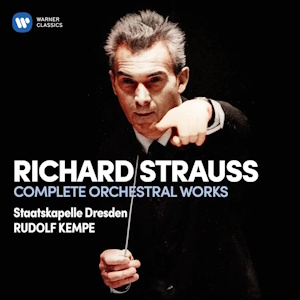
Richard Strauss (1864-1949)
Orchestral Works
Staatskapelle Dresden/Rudolf Kempe
rec. 1970-76, Lukaskirche, Dresden
Stereo ADD
Warner Classics 9029554251 [9 CDs: 657]
Back in 2002, Gwyn Parry-Jones very enthusiastically reviewed the “Great Recordings of the Century”, a single CD containing four of the orchestral works here and in 2012, Rob Barnett was equally positive in his review of the 35-CD “Richard Strauss Edition” box set by Brilliant, which includes them all and a lot more. There have since in passing been many complimentary references to Kempe’s Strauss recordings, but I do not think this 9-CD set has been considered as a separate entity. It was first issued in 1999 on EMI Classics 5 73614 2 and was re-issued as above in 2019, “remastered from the newly discovered original analogue East German master tapes”. This Warner issue has re-arranged the disc order and added to the first disc the three-and-a-half-minute “Moonlight Music” from the Intermezzo of Strauss’ opera Capriccio, which is not in the original EMI or Brilliant boxes. I have reviewed some of these recordings as part of the series of my surveys of major Strauss works, and Kempe invariably comes out well, if not always as the absolute top recommendation. I have previously observed that “as much as I admire and esteem Kempe’s Strauss, I sometimes find it to be a tad too polite and under-stated for my taste and default to Karajan, Maazel, Ormandy and their ilk.” This is by no means always the case; Karajan and Ormandy in particular have often proved to be the providers of my touchstone recording, but Kempe is remarkably consistent in achieving excellence and recordings such as the Don Juan – which I have not surveyed – below are surely among the very best.
Strauss devotee though I am, the left-hand piano works, the Couperin dances and violin concerto in this box set were all unknown to me; the horn and woodwind works I knew from an old EMI Eminence issue featuring distinguished horn-player David Pyatt. Some of these remain relatively obscure and may be your own introduction to works such as those on CDs 8 and 9 which are still, comparatively, only sporadically performed. The two horn concertos, for example – separated by a mere sixty years – are not among Strauss’ most popular compositions and neither is especially redolent of his characteristic manner. The first is conservative, stylistically retrospective, upbeat and beautifully crafted, the second is a gentle, reflective piece, also comparatively understated. The limpid oboe concerto, the first of Strauss’ post WWII works, has more of his typically elaborate invention about it; it is pervaded by a kind of pastoral innocence, with nary a shade to muddy its melodic profusion. Another late work, the rarely heard Duett-Concertino, is a gentle fantasia supposedly inspired by a Hans Christian Andersen fairy-tale about a princess (the clarinet) and a bear (the bassoon) and its music is often reminiscent of the chamber writing for the original version of Ariadne auf Naxos. I was familiar with the Burleske for piano and orchestra from Marta Argerich’s virtuoso performance in the 1992 New Years’s Concert with Abbado; Malcolm Frager is no less energised and engaging – indeed, all the soloists involved in these works are flawless. A second pianist, Peter Rösel, plays the two, middle-period, least-known works here for left hand only. The first is a dark, tempestuous creation; Strauss does not spare his soloist and Rösel plays very powerfully and fluently, ably abetted by the subtle accompaniment of Kempe, who never overshadows his soloist during the variations. The second is even grander, more complex and challenging, although lighter and more festive overall and inexhaustibly inventive in its exploitation of variations on a passacaglia bass. The central section mimicking chiming, tolling bells with the assistance of a glockenspiel is especially beguiling. None of these compositions ranks among Strauss’ greatest or most popular work but it is good to have them so well performed.
Returning to chronological disc order, the first CD offers that ultimate opening blockbuster, Also sprach Zarathustra. I assessed this in my survey and reproduce my verdict here:
“Kempe was always a sensitive, thoughtful and refined conductor – in some ways similar to Haitink – which explains why the fanfare is just that bit too soft and restrained with equal weight given to the E and E flat. Compensations are soon apparent in the detail and lyricism of the playing here; Kempe always valued transparency and brings out individual orchestral lines, such as with the cohort of cellos in the opening tune of “Von den Hinterweltlern”, and he launches into “Von der großen Sehnsucht” with real sweep and drive, assisted by swifter tempi than most and, of course, superb playing from an orchestra always associated with Strauss. The all-important climax to “Der Genesende” is thunderous and he also finds a subtly demonic, threatening quality in the darker passages without dragging. The concluding midnight bells section certainly does not suffer from any lack of passion and power and the ambiguous coda is meltingly played.
The EMI sound is very good with just a hint of tubbiness about it – and it’s not exactly naturalistic; balances are fine as long as you don’t mind a certain prominence being given to instruments – but that matches Kempe’s predilection for bringing out prominent musical lines. I place this recording in the second, “very good” category alongside those by Haitink, Tennstedt and Mehta.”
The second item, Tod und Verklärung, is another I have surveyed:
“Kempe is always a “safe” choice in Strauss – and I do not mean that condescendingly; furthermore, he is at the helm of one of the great Strauss orchestras with a long pedigree of having given premieres of his works. As a result, we hear an account which combines warmth and clarity and dramatic momentum; Kempe drives the music onward but knows when to apply rubato; the whole thing hangs together. The Dresden brass and timpani in particular are resplendent. Is the performance perhaps just a shade too “tasteful” – missing the abandon we encounter in more released recordings? Maybe, but there is a real snarl to the brass at 15:29, for example, and the build-up to the final section is magisterial before the glowing conclusion.”
The suite from Der Rosenkavalier and the “Moonlight Music” make lovely makeweights to those more substantial works; Kempe always excelled in the Strauss’ operas, hence my recommendations of his 1950 and 1956 mono recordings in Dresden and New York respectively; he absolutely revels in the waltzes.
On the second CD we have the two contrasting “character pieces” of Till Eulenspiegel and Don Juan followed by Ein Hedenleben. In my survey of the last, I described its virtues thus:
“Kempe was a master Straussian and if anyone rivalled Karajan is this domain, it was he, especially as he had the other greatest German orchestra at his disposal. There is a warm glow to that orchestral sound and a really purposeful drive to his direction here, in a performance which sets the right tone from the very first notes, such that as soon as I started playing this again, I forgot why I was doing so and was swept along by its momentum. I admit to having revised my opinion of Kempe in this work; I originally found him to be “too civilised”…but have now warmed to his manner and find him more exciting, even if he does not, perhaps, provide the visceral thrills of some other exponents. First violin Peter Mirring plays most seductively and the Dresden brass is superb, especially the horns.
Even if it is not as vivid as modern digital recordings, this has plenty of bass punch and is slightly brisker and somewhat sharper sound, revealing of more detail, than the live performance on next Profil below – and I prefer it.”
Till and Don Juan are both a joy; Kempe was always astute when it came to bringing out both the pointed humour and the drama in the scores. These are fleet, light, sprung accounts, full of live and vigour; detail after detail leaps out at the listener – no one, not even Karajan, points up character so vividly. There are so many places where Kempe brings a smile to the face or a jolt to the heart; to take a couple of examples at random, the way he makes the orchestra render Till’s mocking chortle is a delight and the love music in Don Juan swoons and sighs so seductively; in the heroic passages, the Dresden horns are epic. These have long been acknowledged as among the very best of his Strauss recordings.
The third disc gives us two very different depictive masterpieces which hardly be more disparate in mood and I have included recordings by Kempe of both in my surveys: of Metamorphosen, I write:
“Another relatively swift account, this has long been a favourite with many – which is hardly surprising given the pedigree of the orchestra and conductor concerned. Kempe had a gift for clarifying orchestral lines and textures and this is indeed a pellucid rendering, with a depth of sound to rival that of the VPO and the BPO. Again, typically of Kempe, there is rather more refinement and even delicacy in how he asks his performers to negotiate arpeggios and ornaments; this has a marginally airier feeling to it than Karajan and Previn, for example, but there is such drive and passion in the more urgent passages – which are sometimes, to my ears, taken just a little too fast for their melancholy too register, but I quibble; this is a great recording.”
However, I did not include this Dresden recording of Eine Alpensinfonie in my survey, but instead opted for his earlier one from 1966 with the RPO. Unsurprisingly, much of what I say about that recording also applies to this one – except that I think, if anything, Kempe is more released here and there is more of a sense of abandon in the orchestral playing; hence, my mild concluding caveat is less applicable. I certainly enjoy it enormously even if I miss the extra impact of digital sound. Nonetheless, things like the distant hunting horns are very well engineered and there is a sweep and coherence to this performance that I find most persuasive:
“By all accounts, Kempe commanded respect and affection from his orchestras and that is confirmed by the special sense of joy emanating from the music-making here…There is beauty, balance, power and tension in this Alpensinfonie; it is not the sonic blockbuster you get from Shipway, Sinopoli or Karajan and in truth I like a little more garish showmanship rather than the refinement Kempe applies, but everything is so well gauged that both the lyrical and the epic qualities emerge at every turn. The only hint of excess is in the amusing over-zealousness of the application of the cowbells.
Unless you are allergic to the brash allure of Strauss let off the leash – in which case I doubt that Eine Alpensinfonie is to your taste in any case – this will not satisfy – but I mention it as an option for those who value finesse over raw power.”
Despite my strong attachment to Strauss’ tone poems, I have never felt much affinity with either Don Quixote or Macbeth, but I recognise that the former on CD 4 is given a first-rate performance, especially given the stellar pairing of soloists in Paul Tortelier and Max Rostal, and of course Kempe brings the same qualities for strong characterisation as he demonstrates in Till and Don Juan – this is a warm, human performance. Both Kempe and Tortelier emphasise psychological depth and eschew any showiness, aiming instead for a subtler effect – a typical Kempe stance, in fact. Tortelier’s cello is highly expressive: tender and very vocal in affect. Nonetheless, the “set-piece” passages such as the “Battle with the Sheep” and “Ride through the Air” are suitably grand and atmospheric; the finale is touching, not mawkish.
I was unfamiliar with the Couperin dance suite but find the Strauss’ homage to this “most celebrated of the clavecinistes” charming: stately, courtly, very Handelian in their dignity but of course laced with French elegance and delicacy. Strauss preserves their “period” feeling while investing them with the richness of Romantic orchestration.
CD 5 presents two more earlier tone poems; in fact, Macbeth was the first. In my mind, Aus Italien is inevitably linked with Elgar’s In the South (Alassio) – both are heroic, exuberant and symphonic in form, although Strauss’ reminiscence is more sensual and youthful; Elgar’s is grander, more nostalgic. Kempe creates a wonderful sense of expectancy in the slow opening then caresses the strumming melody of the main pastoral theme and generates tension in the more dramatic passage before the return of that serene mood. The ruins section suggests the grandeur of Ancient Rome and once again the solemn brass take centre stage. The third movement is almost Debussian in the lightness and charm of its depiction of sea and sunlight, and the finale, with its quotations of “Funiculì-funiculà” whose vulgarity apparently outraged the refined sensibilities of the first audience, is executed con gusto.
My first acquaintance with Macbeth was via Neem Järvi’s 1989 recording with the Scottish National Orchestra on Chandos. The digital sound there is more vivid than in Kempe’s recording and I think if anything Järvi finds even more drama in the piece and nothing about Kempe’s delivery of, driven and sweeping though it is, convinces me that it is on a par with his later tone poems. Strauss revised it a couple of times and considered it a good piece but, genius though he was, his judgement of his own work was not infallible – hence he long bore a grudge that his ghastly first opera, Guntram, was rejected by Munich until he finally conceded its weakness – and even Kempe’s expert advocacy cannot elevate Macbeth to parity with Don Juan. It has its exciting passages but is generally unmemorable and bombastic.
The sixth CD is something of a hotch-potch in that it contains two biblically-inspired excerpts from an opera and a ballet respectively, a frothy little Viennese waltz from another ballet and a second pastiche-homage to 18C French style in the incidental music Strauss composed for Molière’s Le bourgeois gentilhomme. “The Dance of the Seven Veils” from Salome is every bit as sexy, slinky and thrilling as one might expect from a consummate Strauss conductor such as Kempe – his live recording of the whole opera in Orange in 1974 is well worth hearing (see my survey). The incidental music for the play is light and witty, artfully combining elements from two disparate centuries. It is simply lovely – a refreshing change from Strauss’ habitual “Big Band” sound, deploying only a handful of chamber instruments, and includes a theme redeployed in Ariadne auf Naxos. The Schlagobers waltz is a close cousin to those in Der Rosenkavalier on the first CD – lush and exuberant. The opening to Josephslegende is startlingly reminiscent of the beginning of that same opera written only four years or so earlier; it is a twenty-five-minute “symphonic fragment” which Strauss condensed from the original ballet which runs for over an hour and has been recorded in its entirety by Giuseppe Sinopoli on DG with the same orchestra as per here. It contains much beautiful, soaring Straussian melody and the Dresden orchestra plays it with intensity and passion, just as they did later for Sinopoli. The conclusion is typically magnificent – just an unabashed riot of glorious sound.
CD 7 contains the violin concerto and Sinfonia domestica. I surveyed the latter:
“This is a light, fleet account of the Sinfonia domestica, which reminds me more than any other of its kinship in mood and thematic material with Till Eulenspiegel. It is a graceful, genial performance and the Dresdeners show their class by the frequency with which they can turn on a sixpence/dime to play quietly and delicately. The nasal solo oboe is especially beguiling of tone and the sound is as fine as one could wish: warm, spacious, well balanced and detailed.
Although Kempe follows Reiner in seeking out the refinement in the score and bringing out the complex instrumental lines, he still manages – more successfully than Reiner, I think – to find both grandeur and pathos in it. My reading of various reviews elsewhere suggests that this is many people’s favourite and I can see why; there is something very human and lovable about it; the Wiegenlied and Adagio are especially tender and rapturous. For me, in the more rumbustious passages, the last ounce of abandon is missing, such as I find in Karajan and Szell, but Kempe builds so magnificently in the last five minutes of the finale, aided by an orchestra on fire, that it is only by virtue of odious comparisons that I would find him in the least wanting. The last great chord is like a pistol shot – thrilling.”
The violin concerto is essentially juvenilia and the mature Strauss did not have much regard for it. It is certainly over-brimming with confidence and displays a prodigious compositional technique, especially given that the composer was only seventeen years old. I can do no better than quote my colleague Rob Barnett, as he sums up the impact of this work very neatly: “Ulf Hoelscher is rapture itself here, secure and overflowing – you might say the same of the music itself. Here is a young composer totally in command of his creative resources even if the turbo-charged writing heaves with its creator’s signature hubris. The recording complements an exuberant performance of an exuberant work.”
Regarding the sound, as RB observes of these recordings, “They may now lack the extremes of impact of the best digital originals but are no slouch in terms of ripeness of reported detail.”
As a set, not every recording is necessarily the most gripping; as the recommendations in my various previous surveys attest, there are sometimes more arresting, thrilling performances to be had, but some here are among the very best and the overall integrity and sheer musicianship of Kempe’s Strauss recordings demand their place in every serious Straussian’s collection.
Ralph Moore
Buying this recording via the link below generates revenue for MWI, which helps the site remain free
Contents
CD 1. Also sprach Zarathustra, Op. 30; Tod und Verklärung, Op. 24; Der Rosenkavalier – Waltz/Suite; Capriccio – Intermezzo (“Moonlight Music”)
CD 2. Till Eulenspiegels lustige Streiche, Op. 28; Don Juan, Op. 20; Ein Heldenleben, Op. 40
CD 3. Metamorphosen (for 23 solo strings); Eine Alpensinfonie, Op. 64
CD 4. Don Quixote, Op. 35; Tanzsuite aus Klavierstücken von François Couperin
CD 5. Aus Italien, Op. 16; Macbeth, Op. 23
CD 6. Salome – Dance of the Seven Veils, Op. 54; Suite from Der Bürger als Edelmann (Le Bourgeois Gentilhomme), Op. 60; Schlagobers – Waltz, Op. 70; Josephs-Legende – Symphonic Fragment, Op. 63
CD 7. Violin Concerto in D minor, Op. 8; Symphonia Domestica, Op. 53
CD 8. Horn Concerto No. 1 in E-flat, Op. 11; Horn Concerto No. 2 in E-flat; Oboe Concerto in D; Duett-Concertino for clarinet, bassoon, strings & harp
CD 9. Burleske in D minor for piano & orchestra; Parergon zur Symphonia Domestica, Op. 73; Panathenäenzug, Op. 74
Principal soloists
Peter Damm — horn
Ulf Hoelscher — violin
Paul Tortelier — cello (Don Quixote)
Max Rostal — viola (Don Quixote)
Manfred Clement — oboe
Manfred Weise — clarinet
Wolfgang Liebscher — bassoon
Malcolm Frager — piano
Peter Rösel — piano
Peter Mirring – violin (Ein Heldenleben)













