
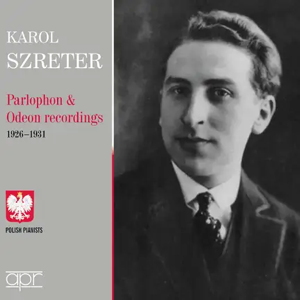
Karol Szreter (piano)
Parlophon and Odeon Recordings 1923-1931
Berlin State Opera Orchestra / Frieder Weissmann
rec. 1923-1931, Berlin, Germany
APR 6048 [2 CDs: 155]
I first came across Karol Szreter’s name when I was glancing through a handful of 78s in a second-hand book store. I found Parlophon E10769 with two Strauss transcriptions by this pianist I had never heard of. My passion for virtuoso Strauss transcriptions, ignited by the likes of Rosenthal, Godowsky, Tausig and Friedman, overrode the logic that I had no means of actually playing it. Eventually I found someone who could, and was amazed by the sparkling imagination and technical mastery on offer. Pearl’s two-CD collection of his recordings (GEMS0146) and an acquaintance in Germany helped me to get a pretty decent if not complete collection of his solo recordings. With slight changes, APR now re-issue those Pearl recordings with Andrew Halifax’s further restoration to Roger Beardsley’s original transfers. We can hear also two tracks from Szreter’s 1923 Vox discs, and the final waltz transcription, Wiener Blut, missing from the earlier release.
Szreter, born in Łódź in 1898 or perhaps 1899, gave his first concerts in 1907. He did not pursue a career as a prodigy. Instead, he travelled to St. Petersburg where a scholarship allowed him to study at the city’s conservatoire with one Prof. Dubassoff. He went on to study with a much more influential pianist, Busoni’s pupil Egon Petri. A successful career beckoned.
In 1930, Szreter made his debut in England where he was already known thanks to his recordings. Critical acclaim came from all sources but just three years later he succumbed to leukaemia. He was a prolific recording artist in his short life. Quite apart from his solo and piano concertante discs, there are numerous trio sides and works with instrumentalists the stature of Gregor Piatigorsky, Max Rostal and Ferenc Vecsey. They also include the first scant fruits of a Brahms chamber work series that was planned at the time of Szreter’s death.
Did I say critical acclaim from all sources? A story in the booklet tells of one notable but dissenting voice. Szreter was accompanying Gregor Piatigorsky. It transpired that a certain Sergei Rachmaninov stopped by to listen. Despite Piatigorsky’s sage advice to the contrary, Szreter approached Rachmaninov for his opinion of how he had played. Very badly! was the devastating response. Perhaps Szreter’s playing suffered if he knew Rachmaninov was listening. Yet, on the strength of his recorded output, it is curious to say the least.
All of the major works Szreter recorded are included here. Three Beethoven sonata and the fourth concerto plus Schumann’s Carnaval. The playing is impressive and with admirable drive right from the opening bars of the Pathétique with its finely nuanced balance of dynamics and its richly sung melody in the Adagio cantabile. The opening of the Moonlight may occasionally have a rather stiff accompaniment, and the tempo seems to move as the mood takes him, but the Allegretto has character and the finale is gripping. Most successful for me is the Pastoral with a passionate Andante con moto pushing forward as its intensity grows. The scherzo is playful and humorous. The change in timbre that comes over the bucolic finale in the central section is as sudden and threatening as thunderstorm on a sunny day.
The concerto is a wonderfully vibrant and sunny performance; Frieder Weissmann and the Berlin State Opera Orchestra are highly responsive to Szreter’s youthful playing and technically brilliant though there is more than enough light and shade for it to be lyrical too. The Andante con moto contains the most expressive in all his Beethoven and his sound in the low dynamics is beautiful. The finale, taken at quite a lick, perhaps sacrifices a little of its rhythmic buoyancy for momentum but there is still a great sense of dynamic and no shortage of fireworks. This is the only of two recordings I know with Anton Rubinstein’s cadenzas for the outer movements. They actually work very well and make very satisfactory use of Beethoven’s figuration and themes. The first-movement cadenza is a little cut but this is mainly declamatory music that would halt the flow of an otherwise energetic performance. For the full cadenza as well as cadenzas for this concerto by nine other pianist/composers seek out Jerome Lowenthal’s 2007 self-published double CD.
Schumann’s Carnaval sounds a little abrupt at the outset, especially without the customary repeats, but it settles down and many of the repeats are observed. Again youthful impetuosity is clear and the faster tempi are pushed on but Szreter does find plenty of repose where he can, contrasting the drama; Eusebius is quite personal with a lot of rubato, and there is an easy sense of line in Chopin. Reconnaissance has a fine sense of balance between Schumann’s two extremes of character. Szreter acquits himself very well in all aspects of this demanding work.
Two new tracks are examples of Szreter’s solo work with Vox in the 1920s. He captures the lyricism of Schubert’s serenade Hark, hark the lark and the sparkle of Liszt’s arrangement. It was coupled with Aleksander Michałowski’s stunning version of Chopin’s D flat waltz, which Szreter dashed off with utter panache. This panache and his grand technical armoury also inhabit Mendelssohn’s Scherzo and Liszt’s Hungarian Rhapsody, while he avoids excess in Liebesträum.
The other short pieces include a lovely little Grieg collection with a jolly Norwegian dance in Grieg’s own solo version, Anitra’s Dance that swirls with admirable grace and an evocative March of the Dwarfs. The intricacy of Emil von Sauer’s little music box, its difficulties increased by the mostly low dynamic, holds no fears for Szreter. The elegance and charm he brings to this is a foretaste of the charms to be found in the five waltz transcriptions that close this recital. He played the Grünfeld waltzes magnificently but pride of place here goes to his own glittering transcriptions. To my mind, they have the harmonic and technical wizardry of the transcriptions by Moriz Rosenthal and Eduard Schütt with the advantage that they capture a pianist at the height of his powers, poetry and polish, and a highly finished technique. What a shame that his Traviata fantasy, recorded in 1929 at the same time he made his second recording of Wiener Blut, never saw the light of day.
One track from the Pearl release that did not make the cut this time is one of a series of piano and orchestral arrangements that Szreter recorded with Weissmann and the Staatskapelle Berlin and Berlin State Opera Orchestra; Liszt’s Tarantelle from Venezia e Napoli was with Otto Dobrindt and an unnamed orchestra. One can see why these were not included but they are not so bad that they do not deserve release at some point. I particularly love the Brahms Hungarian dance arrangements with their riotous energy. I would dearly love to hear the Wagner/Liszt Spinning Chorus and Rubinstein’s Toreador et Andalouse which seem rather elusive. Comprehensive though this release is, there are twelve more works on Vox, the Saint-Saëns Variations on a theme of Beethoven for two pianos with Georg Bertram and the piano and orchestra works – that would be a lovely disc for the future.
This release is the first in a new series featuring Polish pianists. After the treasures of APR’s French series, I am eager to hear what is up next. Karol Szreter was a marvellous artist who could have been a major figure in the 20h century, Rachmaninov’s judgement aside. To have these recordings returned to the catalogue in excellent sound is a treat. Congratulations, APR.
Rob Challinor
Buying this recording via the link below generates revenue for MWI, which helps the site remain free
Contents
Ludwig van Beethoven (1770-1827)
Sonata No.8 in C Minor Op.13 (rec. 9 Jan. 1931)
Sonata No.14 in C Sharp Minor Op.27 No.2 (rec. 19 Aug. 1930)
Sonata No.15 in D Major Op.28 (rec.17 Apr. 1931)
Piano Concerto No.4 in G Major Op.58 (rec. 4 Nov. / 6 Dec. 1926)
Franz Schubert (1797-1828) arr. Franz Liszt (1811-1886)
Ständchen – Horch, horch! Die Lerch S.558 No.9 (rec. Nov. 1923)
Frédéric Chopin (1810-1849) arr. Alexander Michałowski (1851-1938)
Paraphrase on the Waltz in D Flat Major Op.64 No.1 (rec. Nov. 1923)
Robert Schumann (1810-1856)
Carneval Op.9 (rec. 6 May / 15 Oct. 1931)
Franz Liszt
Hungarian rhapsodie No.12 in C Sharp Minor S.244 No.12 (rec. 29 May 1927)
Liebesträume No.3 S.541 No.3 (rec. 22 Aug. 1928)
Felix Mendelssohn (1809-1847)
Scherzo In E Minor Op.16 No.2 (rec. 22 Aug. 1928)
Edvard Grieg (1843-1907)
Norwegian Dance in A Major Op.35 No.2 (rec. 22 Aug. 1928)
Anitra’s Dance from Peer Gynt Suite No.1 Op.46 (rec. 22 Aug. 1927)
March of the Dwarfs No.3 from Lyric Pieces Op.54 (rec. 22 Aug. 1927)
Emil von Sauer (1862-1942)
Boite à musique (Spieluhr) (rec. 22 Aug. 1928)
Johann Strauss II (1825-1899) arr Alfred Grünfeld (1852-1924)
Soirée de Vienne Op.56 (rec. 6 Dec. 1926)
Frühlingsstimmen Op.57 (rec. 22 Aug. 1927)
Johann Strauss II arr. Karol Szreter (1898-1933)
Wiener Blut (rec. 12 May 1928)
Künstlerleben (rec. 12 June 1928)
Die Fledermaus Waltzes (rec. 12 June 1928)













