
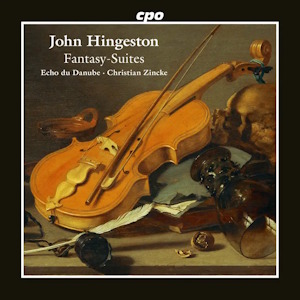
John Hingeston (ca. 1606-1693)
Fantasy-Suites
Ensemble Echo du Danube/Christian Zincke
rec. 2022, Ev. Petruskirche, Giessen, Germany
cpo 555 557-2 [62]
This release has John Hingeston’s date of birth at somewhere between 1599 and 1606, while one online source lists 1612. This is not uncommon for records of the period if they can be found at all, but the vague nature of such information is consistent with the lack of detail we have about this musician’s early life. The booklet notes for this release do a very good job of covering what is known, and we find out that he studied with Orlando Gibbons, and had a distinguished career as an organist and viol player who served Charles I of England, the Protector Oliver Cromwell and Charles II of England. He also taught John Blow, became a mentor to the young chorister Henry Purcell after his voice broke, and was organ-builder, tuner and keeper of wind instruments for Charles II after the Restoration in 1660.
Straddling musical life in what we might call today ‘historically interesting times’, Hingeston created a considerable quantity of chamber music for string instruments (and organ) and, as stated in the promo text for this disc, can be seen as standing as a “missing link” between the worlds of Orlando Gibbons, and John Blow and Henry Purcell.
Much of his surviving music takes the form of this selection of Fantasy-Suites recorded here. These consist of a freely composed fantasy movement, followed by one or more dance movements that often develop from stately almains to more lively corantos and sarabands, also increasing in complexity from double to triple time. Each movement is given its own track number on the CD, so that while each piece as a whole is between a fairly compact four and eight minutes, there are 27 tracks altogether. Instrumentation here is a string consort with baroque violins and gambas including the ‘great double bass’, with a small organ enriching harmonies and rhythmic textures.
There is an inevitable consistency of sonority throughout this programme, but the inner contrasts of the more reflective Fantazia movements, and the absence or presence of the organ, provide a decent amount of contrast for the alert listener, although you can of course just allow the whole thing to wash over you in candle-lit coziness. It is remarkable to read that Hingeston’s music has only recently been ‘discovered’ with performing editions appearing in the 1980s. An online search shows this recording as standing pretty much alone for recordings of his music, and we are fortunate that these are excellent performances made in state of the art sound quality. Ensemble Echo du Danube directed by Christian Zincke have previously appeared with their excellent Naxos recording Das Partiturbuch (review), and it is good to see them expanding into English 17th century music.
I was impressed with the works of William Lawes from this period (review), and while John Hingeston’s music doesn’t quite have the same sense of harmonic adventure and experiment it is filled with sublime melodic expressiveness and is certainly worth acquiring. If you are intrigued by unknown courtly music from around the Civil War period then this is a very fine recording indeed.
Dominy Clements
Buying this recording via the link below generates revenue for MWI, which helps the site remain free
Contents
Suite No. 2 à 6 in F Major
Suite No. 3 in A Minor
Suite No. 1 à 5 in F Major
Suite in G Minor/Major
Suite No. 8 in D Minor
Suite No. 2 à 5 in G Minor
Suite No. 1 in A Minor
Suite in C Minor
Suite No. 6 in D Minor
Suite No. 1 à 6 in A Minor













