
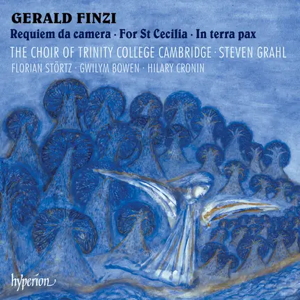
Gerald Finzi (1901-1956)
For St Cecilia. Ceremonial Ode, Op 30 (1946-1947)
In terra pax, Op 39 (1954, rescored 1956, transcr. organ by Robert Gower)
Requiem da camera (1923-1934, revised 1930s, transcr. organ by Francis Jackson)
Hilary Cronin (soprano); Gwilym Bowen (tenor); Florian Störtz (bass-baritone)
Augustine Cox, Thomas Simpson (organ)
The Choir of Trinity College, Cambridge/Steven Grahl
rec. 2025, Temple Church, London, UK
Texts included
Hyperion CDA68487 [62]
This isn’t the first disc of Finzi’s music which the Choir of Trinity College, Cambridge has made. I was greatly impressed by an earlier disc, recorded in 2017 and 2018 under the direction of Stephen Layton (review). This new disc is of particular significance, though. It’s the first, I think, that they’ve recorded under Layton’s successor as Director of Music, Steven Grahl. Furthermore, Hyperion have released it in the year that we mark seventy years since the untimely death of Gerald Finzi. Further importance is attached to the disc because the three works that constitute the programme are usually heard with orchestral accompaniment; here they appear – possibly for the first time on CD – in arrangements for organ accompaniment.
TheCeremonial Ode For St Cecilia was commissioned for a concert in the Royal Albert Hall on St Cecilia’s Day (22 November) 1947. Usually, Finzi, who was as fastidious over English literature as he was widely-read, selected for himself the texts which he wanted to set to music. On this occasion, though, as Francis Pott explains in his booklet essay, the choice was made for him: An Ode for St Cecilia’s Day by Edmund Blunden (1896-1974). The note by Diana McVeagh accompanying a different recording confirmed my suspicion that the poem was also commissioned for the occasion. Pott relates that initially Finzi was not enamoured of the Ode, though he admired Blunden’s work generally; however, he came round to it and after some creative negotiations between them the text was finalised. Listening to the present performance, I find it hard to imagine the work being performed in the huge space of the Royal Albert Hall because there is so much hushed music for a cappella choir; that said, a skilled large choir, such as the London Symphony Chorus on Richard Hickox’s late 1970s Decca recording can put it across very well. However, I think it’s one of the great achievements of this new recording that Finzi’s piece flourishes on a much more intimate scale.
I find that the organ transcription by Robert Gower works very well indeed. The majestic, fanfare-like opening grabs our attention, thanks to the reedy sounds deployed by Thomas Simpson and his judicious use of meaty pedals. The Trinity singers are splendid, whether in the declamatory passages, such as at the beginning of the work, or in the many episodes of quiet singing. As I listened, I thought that the scale of this performance really brought out the kinship with Finzi’s masterly Lo, the Full, Final Sacrifice. The tenor soloist is Gwilym Bowen. I’ve heard him several times in concert, mainly at the Three Choirs Festival, and I’ve always liked what I’ve heard; I’m not sure, though, that I’ve previously encountered him on disc. He’s excellent. The timbre of his voice, the clarity of his tone and diction, and his very natural expressiveness make him ideally suited to this music and, as the performance progressed, I became ever more keen to hear him sing some of Finzi’s songs. Everyone concerned combines to give a very fine performance of For St Cecilia; I enjoyed it very much.
In terra pax is one of my favourite Finzi works; I try to play a recording of it every Christmas Eve, so well does Finzi’s music ad his inspired selection of texts fit with the sentiments of that evening. Almost invariably, I choose the same recording, more of which in a moment. Francis Pott points out that it was as early as late December 1925, while living in Gloucestershire with his mother, that Finzi walked up Chosen Hill, a landmark between Gloucester and Cheltenham. As Pott says, the memory of “this moment of solitude and valediction beneath the stars” came back to Finzi more than twenty-five years later as he pondered the work which was to become In terra pax. (There’s a poignant sequel, not mentioned by Pott. In September 1956, after conducting the first performance of the work in its version for full orchestra in Gloucester Cathedral as part of the Three Choirs Festival, Finzi went for another walk up Chosen Hill, accompanied by Vaughan Williams. There he contracted an infection from a child, which when combined with his already weakened health, brought about his death within a couple of weeks.)
Up to now, In terra pax has existed in two versions: the original with accompaniment by strings, harp and, for one brief moment, a suspended cymbal; the second is the aforementioned version for full orchestra. The full orchestra version doesn’t quite work for me; the score becomes more ‘public’ and I don’t find that completely persuasive, even when you have a singer of the calibre of Roderick Williams involved in a performance (review). The original version has a more intimate ambience and a wintry feel to it. If you can find a copy, Richard Hickox’s Decca recording, made in either 1978 or 1979, distils a wonderful atmosphere and Hickox has the benefit of John Shirley-Quirk as the baritone soloist; that’s the version I reach for every Christmas Eve.
Now, we have a third version of the work with a transcription for organ by Robert Gower. I think this works jolly well, especially when played with the sensitivity that Augustine Cox achieves – he does the extended instrumental opening beautifully. The baritone soloist is the German singer, Florian Störtz. He’s appeared as soloist on a couple of previous Trinity discs and just recently I admired very much indeed his debut recital disc (review). He makes a very favourable impression here, too. In an expressive account of his first solo (‘A frosty Christmas Eve’) he sets the scene convincingly, drawing us in, even if he doesn’t quite match Shirley-Quirk’s rapt unveiling of the rural Christmas scene. Störtz’s singing falls easily on the ear; his tone is clear, the voice is evenly produced and his English is excellent. When the appearance of the Angel is heralded, I have to say I miss the cymbal roll, but that’s a small detail. What is much more important is the beautiful rendition of the soprano solo by Hilary Cronin. She’s as good as any soloist I’ve heard in this passage; she sings with great clarity and with pure tone. A little later, at ‘Glory to God in the highest’ Finzi’s music brilliantly evokes a peal of bells; the Trinity singers are outstandingly successful here. I just wonder if Steven Grahl could have beneficially introduced a little rubato when the altos and tenors sing their last phrase – though I hasten to say that nothing is marked in the score. There’s much to enjoy in Störtz’s delivery of his second solo (‘But to me, heard afar,…’) but I’m a bit disappointed that he doesn’t discreetly make a little more of that wonderful and completely unexpected key change at ‘tenderly’. To be honest, Shirley-Quirk is peerless at this point and, furthermore, the extra space that Hickox gives him at a slightly slower speed than Grahl adopts, brings out the poetry in a way that’s not matched on the Hyperion disc. So, overall, the Hickox performance remains the gold standard, though I prefer the Trinity College choir to the Richard Hickox Singers and Hilary Cronin gets my vote as the best soprano soloist. But even if the Hickox retains first place, I’ll be returning to this new recording; there’s an awful lot to enjoy and the organ transcription is wholly successful.
Francis Pott outlines in the booklet the somewhat tortuous composition history of Requiem da camera. Its origins lie in a 1923 song setting of Thomas Hardy’s poem, In time of ‘The breaking of nations’. By 1924, that song had become the third movement in a four-movement secular Requiem for baritone, SATB choir and small orchestra. However, only the instrumental Prelude was ever performed in the composer’s lifetime. The Hardy setting was at one point discarded and then reinstated in a revised form. The orchestration was not completed by Finzi but in the early 1980s Philip Thomas made a performing edition of the score, completing the orchestration. That was the version which Richard Hickox recorded for Chandos in 1991 (CHAN 8997). That’s the performance through which I first heard the work; I don’t know if anyone else has recorded it until now. It’s not the Thomas edition of the work that Steven Grahl has recorded, though. Pott relates that in 2013 Christian Alexander made a new edition of the score, “working directly from Finzi’s manuscripts without reference to Thomas”. So far, so good but Hyperion’s track listing (which I’ve reproduced in the header) indicates that we’re hearing a version of the score “transcribed for organ by Francis Jackson” with no mention of Alexander. Yet, if you delve a little deeper into Francis Pott’s essay you’ll learn that “Alexander’s edition for Boosey & Hawkes was used by the baritone soloist and chorus for this present recording, alongside an earlier organ transcription of the orchestral material by the late Francis Jackson”. If all this seems a bit confusing, let me hasten the say that the results sound wholly convincing.
Finzi’s quite extensive Prelude translates very well to the organ, I think, and that success is amplified by the sensitive, poetic way in which Augustine Cox plays the music. In the following choral setting of nine stanzas from John Masefield’s poem August 1914 there’s a good deal of unaccompanied music, which Grahl’s choir sings excellently, with fine feeling for both the words and the music. There are some brief solo passages in the choral movements; normally, I expect these would be sung by choir members but here we have the luxury of Hilary Cronin and Gwilym Bowen to do the honours. Florian Störtz gives a very fine account of the aforementioned Hardy poem; the accompaniment by organ works well. Finzi ends with a choral setting of Lament by Wilfred Wilson Gibson (1878-1962); Gibson was, along with Edward Thomas and Rupert Brooke, one of the pre-World War I group known as the Dymock poets. Gibson’s words are infinitely touching and so is Finzi’s deeply sincere setting of them. Requiem da camera is, unsurprisingly, darker in tone than the other two works on this disc; it also is less quintessentially Finzian, perhaps, but it’s a fine and gently eloquent work. One of many perceptive points that Francis Pott makes in the booklet is to reference Vaughan Williams’ ‘Pastoral’ Symphony; I would be more than a little interested to hear the two works paired in a concert programme. Requiem da camera deserves to be much better known and this organ version may well encourage enterprising choirs to take it up.
Indeed, that seems to me to be one of many selling points for this disc. These days, a lot of choral societies may be unable to afford to give concerts with orchestra, especially if the music is less than well-known. Here, Steven Grahl and the Choir of Trinity College, Cambridge demonstrate that all three of these fine works can be successfully performed with just an organ to accompany the choir.
There are many other selling points, of course. The music is enriching and, as I hope I’ve shown, the standard of performance is as high as we would expect from this fine choir. The highly experienced team of producer Adrian Peacock and engineer David Hinitt has looked after the technical side of things; they have recorded the music expertly. Francis Pott’s excellent booklet essay is informative and full of perceptive insights.
John Quinn
Buying this recording via the link below generates revenue for MWI, which helps the site remain free














The Requiem da Camera has been recorded at least once, since the Hickox version – on Naxos in 2014, a disc called ‘Flowers of the Field’, also featuring Butterworth, Gurney and Vaughan Williams. This was reviewed on the old MWI by Michael Cookson. From the booklet notes, re the Finzi: ”This recording is of a new edition and completion by Christian Alexander which was first performed in Australia in 2013.”