
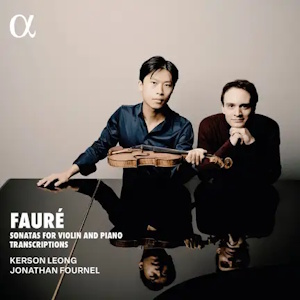
Gabriel Fauré (1845-1924)
Sonatas for Violin and Piano; Transcriptions
Kerson Leong (violin), Jonathan Fournel (piano)
rec. 2024, Domaine Forget de Charlevoix, St. Irénée, QC, Canada
Alpha Classics 1177 [70]
This intelligently organized programme contains Gabriel Fauré’s two violin sonatas and shorter works, arranged for violin and piano, placed between the sonatas. Violinist Kerson Leong and pianist Jonathan Fournel partner well, and show an apt sensibility to this repertoire. Leong is Canadian, an associate artist of the Queen Elisabeth Music Chapel in Belgium, where he was mentored by Augustin Dumay. He plays the 1741 Guarneri del Gesù “ex Bohrer Baumgartner”. Fournel is French, and also studied at the Queen Elisabeth Music Chapel. The elegance of these performances is palpably demonstrated by their musical background.
There is a great deal of competition for Fauré’s First Sonata. Leong and Fournel compare well with the Francophone accounts by Dumay/Collard (Erato) and Grumiaux/Crossley (Decca). Leong’s tone is sweet and light. Fournel’s arpeggiated piano parts ripple nicely. The balance between violin and piano seems ideal. I prefer their Gallic style, as I do for the above-mentioned, over the more demonstrative style of Perlman/Ax on DG. The present artists also succeed in the somber nature of the second movement that contrasts with the joie de vivre of the rest of the piece. Leong’s tone here and throughout reminded me of Dumay’s. They take the Mendelssohnian scherzo at a good lick, all light and sparkle. I hear the influence of Fauré’s teacher Saint-Saëns in this movement. The finale is appropriately relaxed and graceful. This movement is a close cousin thematically to the composer’s First Piano Quartet.
The Violin Sonata No.2 could not be more different from its predecessor. It is a late masterpiece, with darker atmosphere and more complex harmony in the key of E minor. Leong in a dialogue with Fournel, which serves as the booklet note, describes this sonata as “like gazing into a pool of rippling water: at first you can’t discern what lies beneath, but as the surface clears, it becomes a crystalline vessel that draws you into an inner journey of many shades”. The duo are equally attuned to the character of his work, as they were to the earlier sonata. The first movement is powerful and moody, rather chromatic, but with a lovely second subject. It becomes dramatic and turbulent before concluding loudly on a major chord. The second movement is a wistful song, very touching and poignant. Leong finds it desolate, but I do not see it that way. There is tension to be sure, but it can be ardent and passionate, too. After this, the finale comes as quite a balm – gentle and lyrical. It has something in common with the First Sonata, though with more complex harmony. Leong describes it as “a kind of serene acceptance” of life’s experiences, but the sonata ends jubilantly on an E major chord.
Most of the short pieces here are arrangements by other hands. The first of these is a nocturne that Fauré arranged himself from his orchestral Shylock Suite, Op.57. This version for violin and piano loses nothing from the original in my estimation, unlike the Fileuse (Spinning Song), as arranged by Leopold Auer, from Pelléas et Mélisande. I found the piano there to be intrusive, whereas the orchestral original is subtler and gentler. Best of all is Fauré’s own Berceuse, one of his most popular works and a real earworm. This simple lullaby is exquisitely played here. Leong and Fournel do justice to the other pieces, as they do to the sonatas. The recorded sound is present and close. I found that lowering the volume a bit enhances the playback.
This is another high-quality product from Alpha that should win Fauré’s fans new friends. The conversation in the booklet is enlightening, but a fuller discussion of the works and their provenance would have been beneficial.
Leslie Wright
Buying this recording via the link below generates revenue for MWI, which helps the site remain free
Contents
Violin Sonata No.1, Op.13 (1875-1876)
Nocturne, Op.57, No.5 (1889) arr. Fauré
Les Berceaux, Op.23, No.1 (1879) arr. Kerson Leong
Fileuse, Op.80, No.2 (1898) arr. Leopold Auer
Clair de lune, Op.46, No.2 (1887) arr. Albert Périlhou
Berceuse, Op.16 (1879)
Après un rêve, Op.7, No.1 (1877) arr. Kerson Leong
Soir, Op.83, No.2 (1894) arr. Albert Stoessel
Violin Sonata No.2, Op.108 (1916)














Thanks for this review, Leslie! I was unfamiliar with Faure’s violin sonatas, and that second one is a knockout. I think your analysis (tension, but ardent and passionate…a more optimistic finale) gels with how I heard it as well. But whatever Leong’s interpretation of the work may be, he gives it a lovely, cantabile performance throughout. Beautiful album!
Back in the good old days (i.e. 1995), when Naxos CDs were still £4.99, you could take a chance on music you didn’t know, by performers you’d never heard of. My disc of the Faure Violin Sonatas, with three shorter pieces, by Dong-Suk Kang and Pascal Devoyon, was a particularly happy buy.