
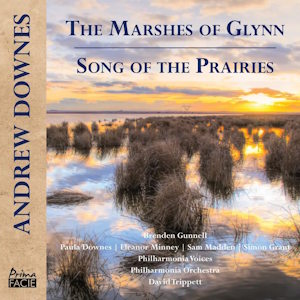
Andrew Downes (1950-2023)
The Marshes of Glynn, Op.33 (1985)
Song of the Prairies, Op.44 (1988)
Brenden Gunnell (tenor)
Paula Downes (soprano), Eleanor Minney (mezzo-soprano), Sam Madden (tenor), Simon Grant (bass)
Philharmonia Voices, Philharmonia Orchestra/David Trippett
rec. 2024, The Alexandra Palace, London, UK
Texts included
Prima Facie PFCD282 [58]
Here are two substantial cantatas by Birmingham-born composer Andrew Downes, dating from his formative years as a creative artist. Both works make imaginative use of their vocal and orchestral forces.
The Marshes of Glynn was commissioned by the Birmingham School of Music (now the Royal Birmingham Conservatoire) to commemorate the opening of the city’s Adrian Boult Hall in February 1986. It is a setting for tenor soloist, mixed choir and orchestra of the substantial poem of the same name by the 19th-century American poet Sidney Lanier (1842-1881). The text is a hymn to the glories of nature and the warmly lyrical music reflects the celebratory aspect of the words.
The piece is cast in three unbroken movements. It begins evocatively with a broadly paced, scene-setting introduction for horns, bassoons, muted trumpets and strings that establishes the stillness and nobility of the woodland setting that surrounds the marshes. This prefatory material recalls, to these ears, at least, the very opening of Vaughan Williams’ Fifth Symphony and the horn melody in the introduction to Weber’s Der Freischütz Overture and yet establishes instantly Andrew Downes’ own distinctive musical voice, characterful and directly communicative. Elsewhere in the movement, the composer uses his orchestral forces sparingly but wisely, lacing the initial choral statement with ear-catching solos for flute and violin and later gifting the choir and then the soloist unaccompanied passages during their respective descriptions of the trees and woods. A spiritual-like episode for soloist and choir, also unaccompanied, provides a pivotal moment as, presently, sustained, visionary chords for full orchestra, crowned by a trumpet benediction, reaffirm the tenor’s newfound confidence. By turns inviting and invigorating, the woodwind writing is particularly inventive in the movement’s closing stages in which the tenor’s reiterated cries of ‘free’ precipitates an exultant conclusion.
The central movement depicts the clear, free expanses of the marshes. Over shimmering strings, swirling solo flute and violin suggest the joyous freedom of bird flight. This material is revisited more expansively by the choir as the singers convey the twisting lines of the marshes. In expressive, a cappella paragraphs, choir and soloist outline the immensity of the marshes, sea and sky and the movement ends with a powerful sequence for chorus and orchestra, containing vigorously imitative writing.
Invoking the opening material, this time presented on trumpet and high violins, the finale begins in mystical vein. Heralded by a solo cello line, a cor anglais theme illustrates a nest-building marsh hen, an image taken up by the soloist in a hymn to the greatness of God. In due course, rippling woodwind, glistening strings and bright percussion represent water flowing over the marshes, a subject adopted by the choir, who, unaccompanied, sing of the stillness of sea and marsh united. In a brief coda, soloist and choir pay tribute to the creatures beneath the waters and a final a cappella choral sequence brings the piece to a joyful close with bold, spacious chords.
Andrew Downes’ melodies constantly beguile and delight the ear in a rewarding score of integrity and conviction that shares the virtues of the English choral tradition at its finest. Tenor Brenden Gunnell invests the solo lines with a noble authority, whether brightly declamatory, as in the closing stages of the opening movement, or quietly confessional, as in his tender, recitative-like first appearance in the central Allegro. The Philharmonia Voices and Orchestra are no less committed in their approach to the music, which is persuasively paced and shaped by conductor David Trippett.
Song of the Prairies is a setting for soprano, mezzo-soprano, tenor and bass soloists, semi-choir of high voices, full chorus and orchestra of the 1833 poem ‘The Prairies’ by the American poet William Cullen Bryant (1794-1878). Commissioned by the Shrewsbury School Sixth Singing Weekend, it was first performed in the Alington Hall of Shrewsbury School in April 1989 under the direction of John Rutter. In a brochure produced for the event at which the piece was premiered, the composer described the work as ‘dedicated to the expression of the beauty and power of nature’, going on to call it ‘a passionate protest, mingled with nostalgia, at man’s appalling treatment of his natural heritage’. The instrumentation is notable for the inclusion of a piano and a large percussion section.
The opening movement is wonderfully ebullient and speaks in the composer’s own fervent and tuneful musical language. There are moments of quiet reflection for unaccompanied voices, but the overall impression is one of irrepressible joy. The following Andante is the score’s still centre and the choral forces come to the fore in this thoughtful and searching movement that contains solemn, almost chant-like vocal lines. The following Moderato exploits percussion and piano in its outer sections, but more introspective episodes are again provided by the vocal forces. The finale begins gently with tenaciously repeated phrases, which resume after a tender choral passage. The work ends warmly and movingly as, over shimmering strings, trumpets calmly give out the work’s memorable principal theme before the music fades away.
David Trippett guides his vocal and instrumental forces cogently with a flexible, yet entirely focused approach to the overarching musical narrative. The material’s striking juxtapositions of meditative choral writing with lively, rhythmic sections are rendered entirely convincing in this spontaneous-sounding but carefully considered account.
Andrew Downes is a composer of refreshing honesty and directness and his natural melodic invention and invariably poetic use of judiciously deployed musical forces constantly elevate the two works presented on Prima Facie’s well-recorded, attractively produced release. This very welcome addition to the recorded catalogue is highly recommended.
Paul Conway
Buying this recording via the link below generates revenue for MWI, which helps the site remain free














When I heard Brenden Gunnell in this piece I thought that this shows so much about what makes him one of the best Heldentenors singing today! His voice is gorgeous, powerful, and on top of that he gives us beautiful piano singing which melts the heart. I rarely leave reviews but I had to for this one. It’s simply wonderful!
Thanks for this review, Paul. To anyone who enjoyed this album, I wholeheartedly recommend Downes’ symphony cycle with the Czech Phil conducted by Vrabec. That was my introduction to him, and it’s a really great listen: varied, passionate, memorable, and beautifully played.