
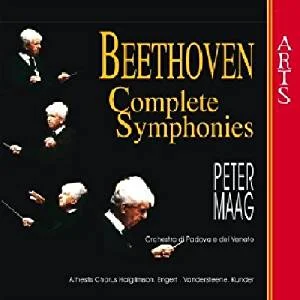
Ludwig van Beethoven (1770-1827)
Complete Symphonies
Orchestra di Padova e del Veneto/Peter Maag
rec. 1994-95
Arts 47370-2 [5 CDs: 369]
My own taste in complete sets of Beethoven symphonies veers towards the conservative and venerable: I especially prize those by Cluytens, Konwitschny and Karajan (especially the first two) and have little time for their supposedly authentic treatment; this set conducted by Peter Maag, however, represents something of a compromise with a more modern aesthetic.
Maag was something of a connoisseur’s conductor; modest, aesthetic and spiritual, he eschewed stardom and the limelight, and did not always have the most prestigious orchestras at his disposal but his musicality has long been admired. Here he directs a reduced orchestra, of which he was principal conductor from 1982 until his death in 2001; it is closer to what Beethoven would normally have experienced, but these are not “period” performances as such, just slightly smaller in scale. It would be idle to assert that the Orchestra di Padova e del Veneto rivals the great orchestras in weight and refinement but the smaller forces permit a transparency and a naturalness of expression in these symphonies without any sense of bombast. Winds are more prominent and textures are clearer but appropriate vibrato is employed and there is still a lyrical warmth about the playing. Despite that lyricism, the performances feel quite concise as Maag does not take first movement exposition repeats, or the repeat in the Scherzo of the Fifth.
The collection is an amalgam of three live performances and six studio recordings made over two years in Lonigo and Padova, in the Veneto region. The sound is good although for some the reverberant acoustic of the Basilica di Sant’Antonio makes the Ninth somewhat problematic. The sound is generally spacious and suggestive of a concert hall throughout, regardless of the four different locations used. For me, a particular issue is that the timpani are sometimes insufficiently prominent and hard-edged.
We begin with the Eroica, which is very expansive and fluid; Maag emphasises its lyricism over its drama which some might find understated while otherwise will appreciate its warmth. The Funeral March has great dignity and the Scherzo dances amiably – the horns are admirably well-tuned and euphonious. The Finale is highly melodious and the clarity of the ensemble and recordings permits to Maag bring out the individual voices in the fugal elements in its variations. This is not a tempestuous Eroica; rather than being in the “Sturm und Drang” mode, it is highly “Italianate” in manner. Its companion on the first disc is the First Symphony – which, contrary to everything I am told by scholars and musicologists, has never in the least sounded to me like a continuation of the Mozartian-Haydnesque “classical” tradition but rather pure break-away Beethoven, heralding a new Romantic sensibility. It is given a lively, committed performance – although once again, I find that the broad recording acoustic dulls the impact of things like the deliberately disconcerting key changes in the first movement. Nonetheless, Maag’s insistent rhythms and the drive of the playing carry the day. The remaining three movements are similarly brisk and in no wise lacking lift. The strings are very spry in the finale.
The second disc combining the second and fourth symphonies has received the highest critical acclaim. First, the sound is somewhat crisper and the performance more emphatic; I really like the fleet suavity of the transition from the slow introduction to the main subject. The alertness of the playing and the punchiness of the accents in the swirling Allegro are very winning and it is particularly here that I find the orchestra to be as satisfying as supposedly more illustrious counterparts. The climax to the first movement is really dynamic; the contrasting Larghetto beautifully shaped: both lyrical and sturdy by turns. The Scherzo is fleet and pointed; the finale similarly puckish and driven. The “slender Greek maiden between two Nordic giants” begins as it should, very atmospherically, with “cat-like tread” in the introduction, and the outburst at 2:25 is suitably weighty and the conclusion to the movement is bold. The Adagio is noble and maintains momentum; the Allegro vivace sprung and lilting; the moto perpetuo finale properly animated. There is a blithe assurance and a sense of direction about the whole of this performance which is entirely convincing.
Disc 3 pairs live recordings of the Fifth Symphony with the Pastoral. Again, to me, everything about Maag’s judgement here in the Fifth seems right; contrary to his predominately unhurried approach to the cycle as a whole, he is especially urgent. Despite this being live, I can hear no difference in sound quality from the preceding symphonies. The famous first movement is propulsive and thrilling; the Andante is relaxed but I am surprised by the heft the orchestra generates in the second theme, the decorated reprise of the first theme and the return of the first theme in coda. Maag lends the Scherzo a somewhat sinister via his application of rubato and leaning heavily on the downbeat. The double basses do sterling work in the Trio. The finale is boisterous and exhilarating.
The Sixth is gentler and more leisurely than we are used to hearing it nowadays; some might find that Maag’s tempi border on the sluggish at 46:34; indeed, it is probably the slowest among mainstream recordings, in the tradition of his mentor Furtwängler, along with Bernstein and Klemperer, who take a couple of minutes less. It certainly allows the music to bloom but there are undoubtedly moments when the tension sags. This is not noticeable in the third and fourth movements, both Allegro – the thunderstorm, for example, is dramatic – but at well over ten minutes the Allegretto finale is distinctly languid. The applause included at the end is the sole indication of it being a live recording.
The opening of the Seventh is enough to make any listener sit up; here is another assertive, almost brash, flourish and after the languor of Maag’s Pastoral we are back in the more audacious world of his Fifth Symphony. The doleful Allegretto develops into a powerful expression of grief, then Maag makes a telling distinction between its prevailing A minor melancholy and the shift into A major consolation. The Presto is by no means slow and certainly sounds sprightly enough. The manic finale goes well but I’m not keen on the blatant accelerando just after the brief introduction; it should surely be subtler and more gradual as there is no specific instruction beyond the generic Allegro con brio. There is a similar sudden speeding up six minutes in, which I find a bit crude. Nonetheless, the peroration is all dizzy euphoria.
Surely the little Eighth is more of an overshadowed maiden than the Fourth? Anyway, Maag delivers a neat, affectionate account of this most cheerful of the nine, giving the Minuetto surprising heft and finishing with a joyful flourish. The orchestra manages a particularly deep, burnished sound here, belying the number of their company and the humorously prolonged sequence of C major chords makes it mark as a good joke.
Alongside the Pastoral, the live recording of the Ninth is said to constitute the relative weakness of this set, not by reason of the playing or conducting but because the reverberation of the basilica muddies the sound and the sung music proves to be too great a challenge for the choir and soloists. The Athestis Chorus was in fact a Baroque-oriented vocal group, and Maag is on record saying how they brought a “pleasant freshness” to the music. (I first skim-read their name as the “Atheists Chorus” which might have constituted a good ironic, dyslexic joke – but I then discovered that its name originates from the ancient Roman Ateste, the Latin name for Este, a town in the Veneto region of northern Italy where the choir was founded and is thus a reference to its Venetian identity.) Regarding those complaints, I find no fault with the spacious acoustic and certainly have no quarrel with the execution of the first three movements. If I make only a few limited comments about them, it is because I find them to be entirely satisfactory – energised and precise; even the timpani are more audible. Yes; the Adagio is slower than most by two or three minutes – massive and contemplative, as befits a conductor who took a two-year break mid-career to go on retreat in a Buddhist monastery – but it does not drag and the playing is beautiful; the orchestra were obviously very well rehearsed. That leaves the monumental finale. I find the opening fanfare a little ponderous but that is in keeping with Maag’s concept and the contrasting martial music trips along engagingly, while the string chorale beginning four and half minutes in really sings.
The soloists are more than adequate. Bass-baritone Friedmann Kunder has a rather plaintive timbre and the top notes are clearly a stretch but he is audible and competent; Belgian tenor Zeger Vandersteene hasn’t a very penetrating tone but can get his voice around the notes and cope with the murderous tessitura; I fear that the mezzo role is one of the most thankless and largely inaudible in the repertoire, and as far as I can tell, Ruthild Engert is doing a good job. Best of all, is American soprano Amanda Halgrimson who really soars. The chorus is fine; clearly it is smaller in number than usual but the women have a pure, bell-like tone which carries and the men are capable of generating considerable weight. The final few minutes pack the requisite punch.
Most of the individual CDs are still available (not the Ninth), and all as downloads; the complete boxed set is somewhat harder to find.
(There is a misprint in the timings on the back cover of the first CD: the runtime for the Andante cantabile should read 7:59, not 4:59.)
Ralph Moore
Ninth Symphony performers:
Amanda Halgrimson (soprano)
Ruthild Engert (mezzo-soprano)
Zeger Vandersteene (tenor)
Friedmann Kunder (bass-baritone)
Athestis Chorus
Recording details
Lonigo, Vicenza (2 & 4 – studio); Auditorium Pollini (5 & 6 – live), Auditorium Modigliani (1, 3, 7 & 8 – studio) & Basilica di Sant’Antonio (9 – live), Padova, Italy
Buying these recordings via the links below generates revenue for MWI, which helps the site remain free
 Symphonies 1 & 3 ~ Symphonies 2 & 4 ~ Symphonies 5 & 6 ~ Symphonies 7 & 8 ~ Symphony 9














Interesting review, and something I’ll check out. But one question and one comment spring readily to mind. I always want to know with recordings of Beethoven’s symphonies if the violins are divided: I think a lot is lost when they’re not.
As for the length of No. 6, indeed 46:34 is on the slow end, but barely slower than Bohm’s 45:35. Ashkenazy’s loving performance comes in at 46:29. To judge the matter fairly I need to know what repeats Maag takes. But that’s quibbling.
Fair point about the violins, Steve; yes, the violins appear to be divided antiphonally (first violins on the left, second violins on the right), in line with Maag’s normal practice with that orchestra and as he did with his Mozart recordings, in order to create a chamber-like, transparent sound.
Regarding the repeats, I do say at the end of the second paragraph, “Maag does not take first movement exposition repeats, or the repeat in the Scherzo of the Fifth”. The Sixth is a little leisurely for my taste but I much prefer that to hyper-HIP-haste.
Maag is certainly due higher recognition. Aside from his Mozart symphony cycle with the same orchestra and some of his operas, there are completely neglected recordings of the Schubert and Mendelssohn symphonies.