
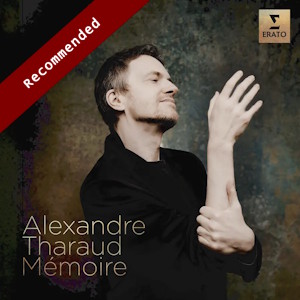
Alexandre Tharaud (piano)
Mémoire
rec. 2025/26, Maison de l’ONDIF, Alfortville, France
Erato 002146372 [65]
Alexandre Tharaud has very carefully chosen twenty-seven short pieces by twenty-seven different composers, all French, from the early 18th century to the late twentieth century. This is certainly a programme of miniatures: the longest is less than five minutes, the shortest under one. It is ordered more or less chronologically, which allows the music to flow seamlessly as styles evolve.
The Couperin piece that opens the album is one of his best known. I know it from Angela Hewitt’s sublime Couperin recordings on Hyperion, but this is very different to hers, much quicker, less hypnotic and more urgent; I love them both.
We jump forward a century – surely there was something to choose from the late 18th or early 19th centuries – to a much less expected item, a piano work by Charles Gounod, a charming if slight salon piece. Equally unexpected is a Nocturne by Bizet, characterised by rippling rhythms in the left hand. The Massenet Mélodie is much better known in its vocal form. It is anything but slight, hauntingly sad – it is an elegy after all – with dark undercurrents. Of the pieces new to me (and that was most of them), this was the standout.
The two “big” (by numbers of recordings) pieces – Debussy’s Girl with flaxen hair and Satie’s Gnossienne No.1 are beautifully played, delicate and poignant. Well known in other guises are Ravel’s The Enchanted Garden from Ma mère l’Oye and Fauré’s Cantique de Jean Racine, here sensitively transcribed by Tharaud.
As the choices move towards the end of the 20th century, we encounter some very unfamiliar names, among them, one of Tharaud’s teachers, Jeanine Rueff. The musical style remains tonal, melodic and thoroughly enjoyable. Some listeners (but certainly not me) might have preferred to hear some 20th century works that reflected the mid-century trend towards atonalism, but this isn’t intended as a history of French piano music, and such pieces would have totally disrupted (and ruined) Tharaud’s programming.
I don’t intend to comment on each of the twenty-seven, suffice to say that there isn’t an ill-chosen one among them. The predominant mood is gentle, but Tharaud has ensured that it doesn’t take over; there are enough faster and more dramatic pieces, such as the Chabrier Scherzo-valse, to ensure that one doesn’t simply drift away.
The piano sound is warm and glowing, which totally suits the music, and Tharaud’s playing is likewise appropriate; none of the pieces require a virtuosic technique, but rather sensitivity and imagination. Tharaud’s notes explain his personal connection to the choices, rather than attempting to annotate each piece.
I have no criticisms at all, only a regret that there wasn’t more. Tharaud mentions having to pass over several composers, including Rameau, Ibert and Auber, but with a runtime of 65 minutes, there was surely space. Rameau is the most obvious absentee, because the single Baroque work of Couperin’s does seem a bit lost. But I shouldn’t be greedy, as this has been balm in a troubled world.
David Barker
Contents
François Couperin 1668–1733
Les Barricades mystérieuses (Ordre 6e de clavecin: No.5)
Charles Gounod 1818–1893
Impromptu CG 580
Jules Massenet 1842–1912
Mélodie (Élégie jouée dans Les Érinnyes)
(10 Pièces de genre Op.10: No.5)
Léo Delibes 1836–1891
Valse lente (Coppélia, Act I: No.1)
transcr. piano solo Alexandre Tharaud
Claude Debussy 1862–1918
La Fille aux cheveux de lin (Préludes, 1er Livre CD 125: No.8)
André Messager 1853–1929
Mazurka (Ballet d’Isoline, No.4)
Maurice Ravel 1875–1937
Le Jardin féerique (Ma mère l’Oye M.60: No.5)
transcr. piano solo Alexandre Tharaud
Jean Wiéner 1896–1982
Java
Erik Satie 1866–1925
Gnossienne No.1
Germaine Tailleferre 1892–1983
Impromptu
Gabriel Grovlez 1879–1944
La Sarabande (L’Almanach aux images: No.3)
Francis Poulenc 1899–1963
1er Nocturne (8 Nocturnes FP 56: No.1)
Gabriel Fauré 1845–1924
Cantique de Jean Racine Op.11
transcr. piano solo Alexandre Tharaud
Georges Bizet 1838–1875
Nocturne in D WD 55
Adolphe Adam 1803–1856
Pas de deux (Giselle, Act II: No.15)
rev. & arr. Henri Büsser
Emmanuel Chabrier 1841–1894
Scherzo-valse (10 Pièces pittoresques D.39: No.10)
Lili Boulanger 1893–1918
D’un vieux jardin (3 Morceaux pour piano: No.1)
Reynaldo Hahn 1874–1947
Adieux au soir tombant
(Le Rossignol éperdu, Série IV. Versailles: No.51)
(from Hahn’s ballet La Fête chez Thérèse, Act II: Duo mimé)
Claude Delvincourt 1888–1954
Omelette au rhum (Croquembouches: No.1)
Jean Françaix 1912–1997
Louis XIII (Si Versailles m’était conté: No.2)
Camille Saint-Saëns 1835–1921
Feuillet d’album Op.169
Paul Paray 1886–1979
Berceuse
Marcel Bitsch 1921–2011
Le Chalumeau d’or (Songes merveilleux: No.4)
Darius Milhaud 1892–1974
Printemps, 1er cahier Op.25: II. Souple
Jeanine Rueff 1922–1999
Le soir, tout s’endort… (Vacances, 2e volume: No.20)
Jean-Michel Damase 1928–2013
La Belle au bois dormant (Féeries Op.38: No.1)
Jef Le Penven 1919–1967
Crépuscule (5 Pièces pour piano: No.1)
Buying this recording via the link below generates revenue for MWI, which helps the site remain free














Thanks for this review, David. This album might easily have passed me by– how many recitals of salon-esque piano miniatures are there? — but for your very positive review, and, having given it a listen, it really is one of the best of its kind. The programming, the playing, and the recording are all just excellent. I’m glad you recommended it!