
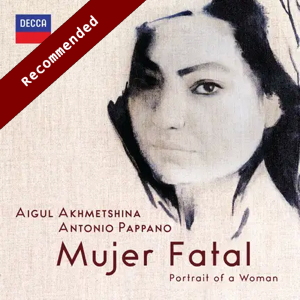
Aigul Akhmetshina (mezzo-soprano)
Mujer Fatal: Portrait of a Woman
Antonio Pappano (piano)
rec. 2025/2026, World Heart Beat Embassy Gardens, London, UK
Texts and translations included
Decca 4872240 [65]
Decca has provided this marvelous new release with their current star, Bashkirian mezzo Aigul Akhmetshina. This lovely recital disc features a beautiful collaboration between Akhmetshina and her close colleague Antonio Pappano, which ensures that it is a welcome addition to the catalogue.
The theme of this recording is this artist’s exploration behind the meaning of a mujer fatal or femme fatale. This was prompted by a year in which she was entirely occupied with touring around the world, performing in various productions of Bizet’s Carmen. Between them, Akhmetshina and Pappano explore the deeper experience of a femme fatale, not just the surface expectation of a sultry, hands-on-the-hips type of seductress. What emerges here is a very three dimensional and individual portrait from this excellent singer.
The first track is a song, newly composed for Akhmetshina by Alena Roussanova, entitled “Mujer Fatal”, from which this album takes its name. The song is hypnotically lovely, especially when the melody takes flight in a cry of “Please stay, make my breast that place where your soul takes shelter.” Akhmetshina’s beautifully rounded voice pulls this song together in a soulful vignette, which is rightly the highlight on this CD. Indeed this singer’s highly disciplined vocal timbre makes her one of the brightest lights on the classical music scene today.
Despite the more thorough examination of the femme fatale label, the traditional expectation of a dangerous type of sensuality is ignored here; in the two Montsalvatge songs, Akhmetshina’s smoky-toned sensuality makes one hear these songs anew. After this, one might be forgiven for thinking that Victoria de los Ángeles’ classic account of these song is almost prim sounding by comparison.
Bizet’s Song of the Arab Hostess brings in the traditional Spanish-Moorish themes that one might not expect to encounter on such a recital. Here Akhmetshina reveals a gorgeous chest voice, which she doesn’t use to excess, but rather to accent her performance. While it is fascinating on the surface, I can’t quite get forget another version of this song which takes an airier, more classically poised approach: that of Dutch soprano Ely Ameling on her Serenata album.
Here I have to acknowledge Antonio Pappano’s wonderful accompaniments, which go beyond mere support and prove to be an artistic contribution in its own right. Occasionally, as in the Guardel song, he employs great flourishes which suit the mood of the piece perfectly which in the hands of a lesser artist would risk the accusation of seeming to draw undue attention to himself. No; this is most definitely a recital which has been approached as a duet between two impressive artists in their own right.
Rimsky Korsakov’s The Nightingale and the Rose takes Akhmetshina well into soprano territory and she does not shirk from the challenge by stinting on her tone at such heights. This rather leads me to hope that the day will come when she can assume the larger roles for a dramatic mezzo like Princess Eboli or Amneris. Yet even as one thinks this, one also earnestly hopes that that day will remain a long way off.
Is everything perfect on this disc? Well not quite. While the group of American standards from the pre and post war eras are given pleasing performances overall, Akhmetshina’s command of English, while excellent, is not completely idiomatic. Much the best of this group of tracks is an especially poignant account of Leonard Bernstein’s Somewhere.
In addition, I was slightly disappointed with the final choice of Britten’s quirky “Tell me the Truth About Love”, which concludes the recital on a somewhat negative tone. Perhaps the substitution of the same composer’s “As It is Plenty”, while still being a quirky song, would have given things more of a lift – thus it would have ended the recital on a musical pinnacle, though not necessarily an emotional one.
One thing to note is that the review copy of the disc had some momentary digital blips noticeable towards the beginning of Satie’s Je te veux: an isolated but annoying incident.
Mike Parr
Buying this recording via the link below generates revenue for MWI, which helps the site remain free
Contents
Elena Roussanova: Mujer Fatal
Montsalvatge: Canciones negras (5)
No. 1, Cuba dentro de un piano
No. 4, Canción de cuna para dormir a un negrito
Guastavino: La rosa y el sauce
Gardel: El dia que me quieras
Velázquez, C: Besame Mucho
Bizet: Adieux de l’hôtesse arabe
Ravel: Vocalise-étude en forme de habanera
Satie: Je te veux
Balakirev: I Loved Him
Tchaikovsky: None but the lonely heart, Op. 6 No. 6
Rimsky Korsakov: The Nightingale and the Rose Op. 2 No. 2
Minkov: The Crying Guitar
No. 5, Landscape
Gershwin: The Man I Love
Bernstein: Lucky To Be Me (from On the Town)
Bernstein: Somewhere (from West Side Story)
Weill, K: Speak low
Britten: Cabaret Songs
No. 1, O Tell Me the Truth About Love














Thanks for this review, Mike. You inspired me to give Mujer Fatal a listen, and it really is so much fun, particularly those Montsalvatge songs. It fully justifies a ‘recommended’ tag, and I appreciate your thoughtful review of it!