
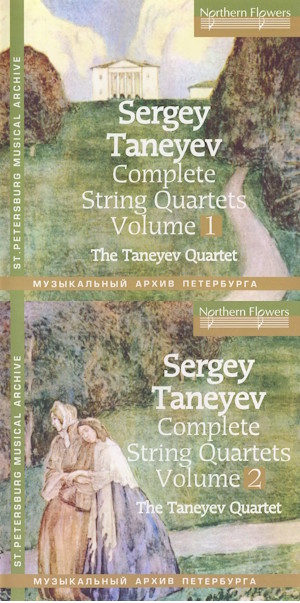
Sergey Taneyev (1856-1915)
String Quartets Volume 1
String Quartet No 1 in Bb Minor Op 4 (1890)
String Quartet No 4 in A minor Op 11 (1900)
The Taneyev Quartet
rec. 1977/78, St. Petersburg Recording Studio
Northern Flowers NF/PMA9933 [70]
String Quartets Volume 2
String Quartet No 5 in A major Op 13 (1903)
String Quartet No 7 in Eb major (1880)
The Taneyev Quartet
rec. 1977/78, St. Petersburg Recording Studio
Northern Flowers NF/PMA9934 [50]
Unlike the case with his symphonies, Taneyev did not happily or fully come to the string quartet medium until I890, when he was thirty-four, this despite the low opus number. The rather prolix First Symphony, composed whilst he was still a student under Tchaikovsky, has no opus number. In all, there are nine quartets, three of which pre-date No 1 recorded here, and these are in the process of being re-released on the Northern Flowers label, having been recorded in the late 1970s.
Taneyev was a very significant figure; he gave the first performance of the first piano concerto of his teacher, Tchaikovsky, and was a prolific composer, but he is also famous for his catchily entitled ‘Invertible counterpoint in the strict style’, completed in 1909. He became Director of the Moscow Conservatoire and Rachmaninov was one of his pupils.
I found myself quite surprised and thoroughly pleased by the 1st Quartet. It falls into five movements, the second and fourth being, respectively, a moving Largo and a memorable Intermezzo. The middle one is a rather elfin Presto with some delightful textures. The finale is a highly original perpetuum mobile, which has a real sense of propulsion and is full of youthful energy.
Lasting about thirty-seven minutes and although not in cyclic form, the String Quartet No 4 has a brief slow introduction, the harmonies of which not only inform the course of the dramatic, sonata form first movement, but can be discerned in other movements. It has an inbuilt drive and passion exemplified by the lengthy first movement.
There are occasions, however, when the fifty-year-old recording does not cope with the almost wild counterpoint in the climactic moments and, it must be admitted, some of the technical challenges do not seem to be quite met. However, the Allegretto vivace which follows beautifully mitigates the mood. It is in ternary form and is deliciously light-footed, reminding me of scherzos in Borodin’s quartets except it is even more interesting. The remaining movements are of ten minutes each. I would describe the Adagio as lyrical, elegiac, songlike; the very brief booklet notes describe it as ‘the untroubled beauty of nighttime silence’ which also contains ‘languor, passion, pleading’ and more – take your choice. But the finale is rather different; there is a brief Adagio introduction but then the presto kicks in. It has what could be described as an unremitting, Tchaikovskian emotional charge which holds your attention. Here, Taneyev’s mastery of counterpoint is often displayed with each instrument fully engaged in the unfolding drama. There is a brief, sudden reminder of the opening music before the tumultuous final page. This is a very fine quartet and needs to be heard more often.
I found the String Quartet No 5 to be a bit of a disappointment, but then, the composer himself did call it ‘childish’, ‘archaic in nature’ and ‘nearly free of textural sophistication’. The main problem is that the material does not capture one’s imagination. It falls into four movements with the second, an Adagio being the most interesting. It is lyrical and, as the brief notes say, it ‘develops unhurriedly’. The first movement is classical with two subjects and a development section of little sophistication. The third is an Allegro molto with a bagpipe tune ‘wittily imitated in the middle section’. The finale could have been written fifty or more years before and is again classical in form. It lasts for twenty-three minutes.
The rest of Volume 2 is devoted to the four-movement String Quartet No7 which is just under forty-minutes. Taneyev did not publish this work in his lifetime, and it predates the Quartet No 1 when he was still under his teacher’s spell; its number was added by a publisher. The first movement is the longest of all of these works under review and that is largely because the already lengthy exposition is repeated. The composer obviously wanted to please Tchaikovsky, as he apparently wrote in a letter to him, and both of them loved Mozart. So, this is a very classical movement not only in form but in its melodies which clearly Taneyev shaped deliberately in a classical style. It also almost feels monothematic with its rising arpeggiated figure rather overworked. With the second movement (which is almost as long), marked Adagio cantabile, we are in a more Romantic world. The booklet is quite correct in saying that it is ‘an emotion-laden cantilena’ its middle section is especially impassioned, and that there are ‘complex polyphonic passages’. The form of the ensuing Scherzo is rather singular: it has a slow introduction and a reprise of the same at the end. The main idea is a sort of tarantella, but it is cut short by a slower ‘trio’ section. The faster music never seems to really catch fire. The finale is a mixture of charm and exuberance as one might expect from a ‘classical’ quartet with a modulation to the dominant for a dreamier second subject. Again, certain ideas are a little over used.
Clearly the Taneyev Quartet had a strong understanding of these works. They were founded in 1946, and made many recordings in the 60s and 70s, including Shostakovich. You will need to have your treble control at its lowest for the rather bright sound of the recording – at least, I had to.
You will have gathered that I much prefer the music on Volume 1 and that could be a good place to start. There are three more CDs in the series.
Gary Higginson
Other review (Volume 1): Gavin Dixon
Buying this recording via the link below generates revenue for MWI, which helps the site remain free
Buying this recording via the link below generates revenue for MWI, which helps the site remain free













