
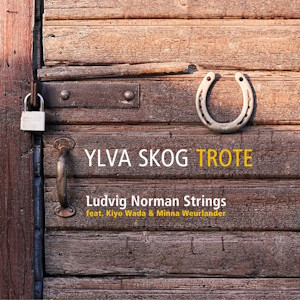
Ylva Skog (b. 1963)
Trote, for accordion and string quartet (2018)
Stabilitas loci, for string quartet (2020)
Piano Quintet (2020)
Caminar, for string quartet (2017)
Exspecto, for piano sextet (2024)
Minna Weurlander (accordion)
Kiyo Wada (piano)
Ludvig Norman Strings
rec. 2024/25, Grünewaldsalen, Stockholms Konserthus, Sweden
Reviewed as lossless download
dB Productions DBCD222 [58]
Ylva Skog is Swedish, and this is the eighth release on the Swedish label dB Productions to include her music, the third dedicated solely to it. We’ve only reviewed one of these, which included her first violin concerto (review), and Rob Barnett described her music as “passionate minimalism”. I haven’t heard the concerto and undoubtedly Rob’s adjective is apposite for it, but while there are certainly aspects of minimalism in some of the five chamber works on this new release, passionate is not how I’d describe them: quiet, static and restrained come to mind.
Trote means “trot” in Swedish, apparently to do with the rhythms in the first movement. I can’t say that is what came to mind when listening, rather a Piazzolla tango that couldn’t quite get underway. The other two movements definitely fit the minimalist description – quite repetitive, the third movement constantly in motion but not really going anywhere. The writing for the accordion seems quite simple, and overall, I found the work a little lacking, without doubt the weakest of the five.
Stabilitas loci means “stay in one place” in Latin, entirely appropriate given the circumstances in which the work was written. The year 2020 will tell you all you need to know. At almost ten minutes, there isn’t really material to fill the time, but perhaps that’s deliberate, reflecting the difficulty in finding enough things to do during lockdown. It is rather hard for one’s attention not to drift in and out whilst listening.
After the stasis of Stabilitas loci, the changing moods of the Piano Quintet are a welcome change. It was written in memory of a family pet rabbit, and begins with a beautifully soulful first movement, recalling the day when the loved animal had to be put down. Happier memories of it, alive and hopping around, surface in the second movement, resolving into acceptance in the final movement. It is perhaps the least minimalist of the five works, and while the more energetic episodes are still relatively restrained, there is good variation across the three movements. I very much enjoyed it, and felt it had some commonality with the music of Latvian composer Georgs Pelēcis, whose music I love.
The connection to Pelēcis grew stronger in Caminar (stride in Spanish): the same graceful, if simple, melodies, the hypnotic rhythms and the general sense of wanting to please the listener. It did rather fizzle out at the end, rather than have a definite and obvious ending, which was a little disappointing, but I did like it.
The final work is the most recent, another with a Latin name, and a connection to the pandemic. Exspecto means “to wait”, and Skog explains in her booklet notes that “I am still waiting for the world to be the same”. There is a consistent thread through the first two movements of energy being summoned but not being able to break the inertia. Only in the final movement is there a more constant drive, but even here it is restrained. The writing for the piano is fairly simplistic and subsidiary to the strings (Skog is a cellist), and while the music does bring to mind that waiting, it doesn’t make for an especially involving listen.
The sound quality is very good, and the notes contributed by the composer are helpful in establishing the premise behind each work. It’s hard to judge the performances, but the Ludvig Norman Strings are members of the Royal Stockholm Philharmonic, so they are obviously very fine players. Given this is music by a living Swede, played by Swedes and recorded in Sweden, the conclusion has to be that the performances have met with the approval of all concerned. I would have liked a little more oomph in places, but I don’t think that this is what the composer intended.
It is music that I have been happy to make the acquaintance of, and is pleasing to the ear, but it does suffer from a lack of variety in tempo and dynamics. The Piano Quintet is, by some margin, the best of the five.
David Barker
Buying this recording via the link below generates revenue for MWI, which helps the site remain free













