
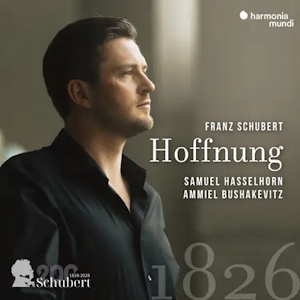
Franz Schubert (1797-1828)
Hoffnung
Samuel Hasselhorn (baritone)
Ammiel Bushakevitz (piano)
rec 2025, b-sharp, Berlin
German texts and English and French translations included
Contents beneath review
Reviewed as a download
Harmonia Mundi HMM 902779 [72]
This is the third instalment of Hasselhorn and Bushakevitz’s project to record a number of Schubert songs exactly two hundred years after their composition, leading up to the bicentenary of the composer’s death in 2028. My colleague Göran Forsling reviewed the two previous discs (Die Schöne Müllerin andLicht und Schatten) very enthusiastically. Let me say immediately that I share his liking for the expressive, clean and convincing performances by both these artists.
Hasselhorn’s career is now practically ten years old. His live appearances include opera (a good deal of Mozart), oratorio and Lieder, while his already numerous recordings are devoted mostly to the last category. He is clearly looking after his voice: it is extremely precise and constantly in the middle of the note, without spread or loss of quality. In terms of interpretation, his enunciation is crystal clear, and his interpretation sympathetic and varied.
The accompanying booklet is refreshingly informative. After a short statement by the artists, justifying the choice of the title “Hoffnung” (hope) for this album, there is a longer text by Roman Hinke, containing interesting and erudite comments about the relationship between Schubert’s life in 1826 and his artistic development at the time, with reference his Lieder, but also to other works.
The recital opens with Im Freien, which immediately sets the tone. The optimism, being Schubertian, is not exactly exuberant, but there is a serenity which the artists convey nicely, through the baritone’s gentle tones and the piano’s lilting accompaniment. This is the only song in common with Sophie Rennert’s recent Schubert recital, reviewed by Ralph Moore and myself (here and here). I find them both very good in their different ways: Rennert and Middleton are more restrained, whereas Hasselhorn and Bushakevitz are somewhat more extravert.
One could compare Hasselhorn’s renditions of various of these songs with those of some of his forbears. I would, for example, compare him very favourably with the youthful – and clearly prefer him to the older, more mannered – Dietrich Fischer-Dieskau. However, comparison with other singers is not really relevant, firstly because Hasselhorn’s vocal production and interpretative skills really cannot be found wanting, and secondly because it misses the point: the interest of this compilation lies in its thematic unity, around the idea that Schubert was, in the year 1826, going through a period of relative optimism and hope. Approached in this way, this album makes very interesting listening.
Not all the songs are serene. The little-known Über Wildemann prefigures Rückblick in Winterreise, with its tumultuous emotions, expressed with striking freedom; the singer alternates nicely between head voice and chest register, and the accompanist draws some remarkable sounds from the piano. Lebensmut is a similarly dramatic song, but imbued with a thoroughly life-affirming spirit.
Alinde and the famous An Sylvia use a conventional form of similar verses, and are performed with very pleasing delicacy by the singer, and crispness by the pianist. Am Fenster also uses the standard strophic form, but, as the booklet points out, variety is introduced to convey the changing emotions.
Die Blume und der Quell is a curiosity, having been left unfinished – or rather hardly started – by Schubert, who wrote only the piano introduction, and the vocal line of the first verse. Here, it has been completed by the pianist, Ammiel Bushakevitz, in a manner that I find perfectly convincing, and it is performed with characteristic richness on the piano and varied expression by the baritone.
In the middle of the recital is a group of songs which one has often heard performed by other artists; here, the performances rank, in my view, with the best. Im Frühling, which plays in typically Schubertian manner on the major/minor modes is done charmingly; Fischerweise is taken very fast and lightly, the accompaniment really propelling it forward; and An die Laute is lovely, the baritone’s smoothness combining with the lute-like colours of the piano.
The recital ends on a mood of serenity, with three songs evoking peaceful sleep. Two of them are lullabies. In the one that is specifically named as such – Wiegenlied – the performers carefully maintain the peaceful mood from start to finish. Der Vater mit dem Kind, the final song, shares with Wiegenlied the regular, restful pulse of the slow 2/2 rhythm. However, when, in the second verse, as the father’s thoughts turn melancholically to “past times”, and Schubert disrupts the regularity of the rhythm, the piano and the voice accentuate this destabilising effect, producing a very interesting rhythmical vagueness. This song, with its delicate depiction of fatherly love, ends the recital on a resolutely hopeful note.
Samuel Hasselhorn is clearly an excellent Lieder singer. The voice is even and warm (though without the bass-baritonal richness of, say, Thomas Quasthoff), and displays an agreeable robustness when put under pressure. There is very tasteful control of dynamics, at the service of expression, and the words are pronounced in an unaffected way which adds to the naturalness of the interpretations.
Ammiel Bushakevitz’s piano is recorded quite close, producing a rich, relatively dark tone; I would occasionally have liked the balance knob to have been tweaked a fraction in favour of the voice. The artists seem to be constantly thinking as one, completely agreeing in the rhythmic freedom of their interpretations.
This is an album which convincingly illustrates the richness and, yes, optimism, of Schubert’s song production in 1826, thanks to sensitive performances by both singer and pianist.
David James
Buying this recording via the link below generates revenue for MWI, which helps the site remain free
Contents
Im Freien D.880
Sehnsucht D.879
Über Wildemann D.884
Alinde D.904
An Sylvia D.891
Die Blume und der Quell D.874
Im Jänner D.876
An die Laute D.905
Fischerweise D.881
Im Frühling D.882
Der Wanderer an den Mond D.870
Das Zügenglöckchen D.871
Totengräberweise D.869
Ständchen D.889
Lebensmut D.883
Trinklied D.888
Am Fenster D.878
Wiegenlied D.867
Um Mitternacht D. 862
Der Vater mit dem Kind D.906













