
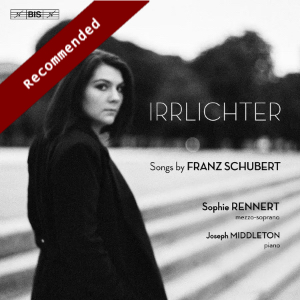
Franz Schubert (1797-1828)
Irrlichter
Sophie Rennert (mezzo-soprano)
Joseph Middleton (piano)
rec. 2024, Hohenems, Austria
German texts and English translations included
BIS BIS2458 SACD [70]
David James has already glowingly reviewed this album and it was one of April’s Recordings of the Month; I refer you to his review for some perceptive commentary. Everything about this release is appetising: the slim, tasteful, black and white cardboard packaging, the inclusion of texts and translations, the reputation of the artists and the selection of songs – plus, of course, the wholly reliable BIS sound engineering.
The selection of Lieder here features some which will be less familiar, although others, such as “Die Taubenpost” and “Erlkönig” have a long discographical history. For the first song, “Der Zwerg”, I have to try to shake off the indelible recollection of Jessye Norman’s rendering of it but Sophie Rennert’s highly dramatised account really absorbs me; she varies the colour and vibrato in her voice very skilfully, draining it for the end of the penultimate verse on “ihr die Sinnen” and deploying serviceable lower register. Her impeccably crisp diction further enlivens her narratives and the more rarely heard “Des Fischers Liebesglück” attains a mesmeric, dreamlike quality which is most effective. The rhythmic precision and intonational accuracy of her singing in the ecstatic “Willkommen und Abschied” are very impressive and make the most of the song. I occasionally faintly regret the inclusion of the occasional lesser-known song here such as “Im Freien” or “Kolmas Klage”– neglected, perhaps, because they are not especially memorable compared with the best of Schubert’s astonishing output of 600+ songs, while still being of obvious quality, especially when they are this well performed. However, we return to more frequented territory with “Gretchen am Spinnrade” which she sings with mounting desperation without ever losing control of her line and phrasing. The delicacy and fluidity of Jospeh Middleton’s pianism throughout are crucial to the maintenance of tension; those qualities are much in evidence, too, in the introduction to songs such as “Schwestergruss”.
So many great artists have sung Schwanengesang; Rennert and Middleton provide a highly musical but restrained account of “Die Taubenpost”; I could do with little more lift, lilt and abandon as I find it a touch bland here. “Der Winterabend” is one of those typically Schubertian sings which acts as a compendium of all the tropes so recognisable in his songs: the telling key changes, the restless semiquaver piano underlay, the sudden little upward turns in the vocal line, the tenderness and sense of homecoming in its resolution – just lovely. “Im Abendrot” is also restrained, graced with much soft singing and the pianist’s harp-imitative arpeggios.
“Erlkönig” is of course the best-known song here. Rennert’s voice does not really have the colouristic range to challenge more extrovertly theatrical exponents such as Bryn Terfel but within the scope of her own gentle mezzo-soprano she characterises very effectively, creating three distinctive voices. I have a particular attachment to Brigitte Fassbaender’s superlative account of “Nachtstück” with Graham Johnson and I have to say that Rennert has neither the vocal resources or temperament to begin to approach the drama and impact of that version – yet hers is still a fine piece of singing. The recital ends with “An den Mond in einer Herbstnacht”, a song previously unfamiliar to me. It is a rather strange, rambling outpouring of morbid, Romantic Angst, not especially memorable in melodic terms but sung and played here with great sensitivity.
Joseph Middleton’s accompaniment is invariably apt, flexible and responsive. Rennert does not have as dark and distinctive a mezzo as, for example, Brigitte Fassbaender, Christa Ludwig or Janet Baker, all of whom so often represent my gold standard in Schubert Lieder, but she is a complete artist of great interpretative accomplishment and her voice, with its shimmering vibrato and evenness of production, is intrinsically beautiful.
Ralph Moore
Previous review: David James
Buying this recording via the link below generates revenue for MWI, which helps the site remain free
Contents
Der Zwerg, D. 771
Des Fischers Liebesglück, D. 933
Willkommen und Abschied, D. 767
Im Freien, D. 880
Kolmas Klage, D. 217
Gretchen am Spinnrade, D. 118
Schwestergruss, D. 762
Die Taubenpost, D. 965a
Der Winterabend, D. 938
Im Abendrot, D. 799
Erlkönig, D. 328
Nachtstück, D. 672
An den Mond in einer Herbstnacht, D. 614













