
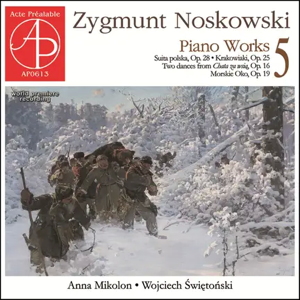
Zygmunt Noskowski (1846-1909)
Piano Music 5
Suita polska (The Polish Suite) Op.28 (c.1880)
Taniec cygański and Kołomyjka (Gypsy dance and kolomyika, a Ukrainian dance) from the folk drama Chata za wsią (The Cottage Beyond the Village) Op.16 (publ.1885)
Krakowiaki (eight Krakowiak dances) Op.25 (publ.1889)
Morskie Oko (Eye of the Sea) for piano four hands Op.19
Anna Mikolon (piano)
Wojciech Świętoński (piano secondo, Op.19)
rec. 2025, Showroom Kawai, Warsaw, Poland
Acte Préalable AP0613 [69]
Zygmunt Noskowski may not be the first to come to mind when Polish composers are mentioned but as a teacher he numbered Karol Szymanowski, Grzegorz Fitelberg, Henryk Melcer and Mieczysław Karłowicz amongst his students. His own studies were with Stanisław Moniuszko. He was prolific across a wide range of genres: symphonic works, chamber and vocal music, and a good deal of music for piano solo. He was also active on the Warsaw music scene through his association with the Warsaw Music Society and as a professor of composition at the city’s Conservatory. This is Acte Préalable’s fifth volume of his output for piano solo and four hands (reviews: AP0188 ~ AP0355 ~ AP0382 ~ AP0415). The series looks set to continue beyond this disc; several opus numbers remain unrecorded.
A glance at Noskowski’s piano works reveal a penchant for Polish dances – polonaise, mazurka and others – that rivals Chopin’s. This disc concentrates heavily on those, and a couple of other national dances are thrown in for good measure. In the Polish Suite,Noskowski brings together two polonaises, three kujawiaks, two mazurs and an oberek. The latter is a fast, spinning dance with high kicks and jumps. Chopin incorporated some aspects of oberek and kujawiak into his mazurkas. His Fantasy on Polish Airs includes a kujawiak; the title “oberek” does not appear in his catalogue.
The suite does not really have a slow dance, unlike most suites one could name. The closest here is the penultimate dance, a polonaise which is broad but not especially slow; while its opening section is somewhat elegiac, its pomposo section is rather twee in comparison. Neither this nor the stately polonaise that opens proceedings are particularly Chopinesque. Even so, Noskowski borrows from Chopin such elements as some contrapuntal writing in the dances and the lyrical sections in the second and lilting third kujawiak (No.4 and 6 in the suite). Otherwise these are vigorous, energetic pieces, and their ebullient bravura suits the concert hall. I particularly like the fifth piece, the single vivacious oberekwith interesting turns of chromatic harmony along the way; the sly modulation from D major to B flat is just one example.
Noskowski’s five-act stage piece Chata za wsiq (The Cottage Beyond the Villa), a music-and-dance “folk drama”, was staged in 1884. Pianist Anna Mikolon plays two short extracts that Noskowski arranged from the dance music, a Gypsy dance and kolomyika, a Ukrainian dance. The former would not sound out of place alongside Dvořák’s Slavonic Dances or Brahms’s Hungarian Dances, especially in the central allegro. Kolomyika, resembling a hopak, is fast and vigorous. It gains harmonic and textural interest after a relatively unremarkable start. It would be interesting to hear what orchestral colour Noskowski brings to these dances.
The Krakowiak is a syncopated, energetic dance in duple time, usually performed by several couples, that originated in Kraków and Southern Poland. Noskowski’s eight Krakowiaks are elegant concert dances – in the same way that Chopin’s Mazurkas are not really suitable for dancing. I mention Chopin’s Mazurkas, but these pieces as a set are more closely aligned – stylistically and from a virtuosic point of view – with Brahms’s Hungarian Dances, as in the ballet dances. Even though they highlight a different national dance, they inhabit the same genre, and were even published in versions for piano duet and for solo piano heard here.
The brisk opening of the very entertaining first Krakowiak struck me as a cross between a Poulenc mouvements perpetual and a soundtrack to a Western, but its Polish nature asserts itself over the course of its several contrasting sections. Noskowski has a sure grasp of keyboard texture. In addition to the first, I would point out the fifth Krakowiak, with its theme reminiscent of Schubert. Unlike the other dances in the set, this does not feature different sections but rather offers a short series of varied keyboard figurations on the single theme. The single piece in a minor key, the third Krakowiak, opens in mournful mood, but even here the atmosphere is mostly bright and breezy in its central sections.
Anna Mikolon is joined by Wojciech Świętoński for the final work on the disc, an arrangement for piano duet of the concert overture Morskie Oko. Morskie Oko (Eye of the sea) is a lake in the Tatra Mountains, which Noskowski visited in his youth; it remains a popular tourist destination to this day. The triplet figuration and low register give the lake a rather ominous presence but things brighten up with rather pastoral music as the work progresses. Noskowski intended no programme for the piece, just a chance to portray the lake in the many moods characteristic of its position in the high mountains. Mikolon and Świętoński capture these moods well. While some colour is lost, the first oboe solo where the triplet motif becomes a theme, for example, is a good interpretation of the orchestral original.
Previous reviewers have responded positively to earlier volumes. I can only do the same for this entertaining addition to the series.
Rob Challinor
Buying this recording via the link below generates revenue for MWI, which helps the site remain free













