
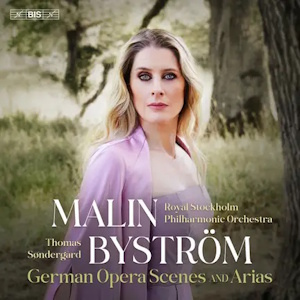
Malin Byström (soprano)
German Opera Scenes and Arias
Royal Stockholm Philharmonic Orchestra / Thomas Søndergård
rec. 2020-2023, Stockholm Concert House, Stockholm, Sweden
Texts and translations included.
BIS 2775, hybrid SACD [60]
I have been lucky enough to hear Malin Byström live as Fiordiligi, Salome and Strauss’s Countess Madeleine, so I should preface all of the remarks below by saying that she is a fine, fine artist, gripping to watch on stage, a creature of the theatre, and has a great and deserved following. I should also underline that a preference for voices is very personal thing, and that two highly committed music lovers can respond to the same voice in completely different ways.
There is much about this disc, however, that left me feeling very torn. Byström’s is not, for me, a conventionally beautiful voice. It is structurally secure and has all the equipment needed to do the challenging German repertoire on display here. Yet I find it much easier to respect than to love.
There is a silvery, bright quality to Byström’s voice but, to my ears, that is not always accompanied by a sense of security and power. Consequently, there is regularly a sense of struggle to attain the note. Now, she always gets there, often triumphantly, and so the listener can always enjoy the sound thus created. Sometimes, however, that makes it difficult to relax into the tone. Only rarely could I listen to this disc without a sneaking suspicion that the vocal picture could shatter into fragments at any moment.
That is at its most worrying when the orchestral picture is at its most lavish which, in this case, means the Strauss extracts. The orchestra sound consistently sensational, playing like an ensemble of experts for Thomas Søndergård, who shapes every track on the disc with security and confidence. The players roil, tumble and exult during the opening number from Die ägyptische Helena, and they conjure up the whole gory gamut of effects for the final scene from Salome in a most exhilarating manner. Byström sounds like she is managing to ride the Helena wave effectively, but often only just. She is more convincing as Salome, one of her signature roles, mostly because of her commitment to the words. She articulates them with semi-demonic energy, making it an exhilarating way to end the disc. In the final passages, her breathy desire over the severed head is as creepy as it is remarkable. However, it is more her acting ability than the splendour of her singing that makes this Salome interesting.
In fact, it is her more restrained, lyrical singing that I found more appealing. She sings the Capriccio Countess with an air of cultivated restraint, and she is particularly lovely when singing back the tune of the sonnet. Leonore’s Komm, Hoffnung has a gorgeous air of gentle nobility to it, in contrast to the energetic sections around it, and there is an uncommonly lovely legato to Agathe’s Leise, leise. Yet she sounds like she is ladling on the tone a bit too thickly in Marietta’s Lied, which contrasts notably with Søndergård’s restrained control of the orchestral palette.
It is an unusual recital disc, therefore, where you come away loving the orchestra more than the singer, but so this one proved for me. The luscious sweetness of Capriccio, the rolling ecstasy of Helena, the sugary beauty of Die Tote Stadt, they are the things that will stick with me, more so than Byström’s singing. Even so, if you feel differently about Byström’s voice, then you might respond to this disc completely differently.
Simon Thompson
Buying this recording via the link below generates revenue for MWI, which helps the site remain free
Contents
Ludwig van Beethoven (1770-1827)
“Abscheulicher! Wo eilst du hin?” from Fidelio
Erich Wolfgang Korngold (1897-1957)
“Marietta’s Lied” from Die Tote Stadt
Richard Strauss (1864-1949)
“Morgen mittag um elf!” from Capriccio, op.85
“Zweite Brautnacht!” from Die ägyptische Helena, op.75
“Ah! Du wolltest mich nicht deinen Mund kussen lassen” from Salome, op.54
Carl Maria von Weber (1786-1826)
“Wie nahte mir der Schlummer” from Der Freischütz













