
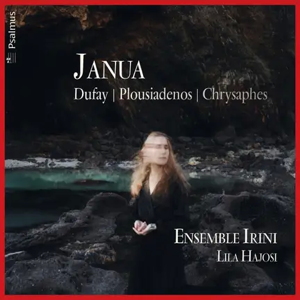
Janua
Ensemble Irini/Lila Hajosi
rec. 2025, Cité de la Voix, Vézelay, France
Psalmus PSAL052 [58]
The title of this recording refers to the god Janus who has two faces, looking towards the past and the future. Here he looks one way towards Byzantium and the Greek Orthodox religion, the other towards Rome and Christianity. The music therefore mixes mostly Isorhythmic motets by Dufay with works by Byzantine composers.
The rapprochement between Rome and Constantinople started well with Pope Eugene IV in 1431 initiating several attempts to meet with Emperor John VIII and Joseph II, Patriarch of Constantinople. Dufay was very much caught up with these political manoeuvres both in composing for the Pope and having the Malatesta family as his patrons. Cleophe and Sofia Malatesta both married into the family of Palaiologos in the city in January 1421. Dufay may well have travelled there himself. He obviously had much sympathy for the city, as he composed four laments after its fall; the only one which survives is recorded here.
Lila Hajosi the director of the Ensemble Irini, has divided the disc into three sections. The first begins with Dufay’s connection with the Malatesta’s and Apostoli Glorioso (‘Glorious apostle, chosen by God to bring the gospels to the Greek people’). Ever since Dufay’s predecessor Johannes Ciconia, the isorhythmic motet had been the pre-eminent form for celebrating great occasions of state. The text celebrates the wedding of Cleophe and Theodore. This, and Vasilissa, Ergo Gaude (Therefore rejoice, Queen, for you are worthy of praise,) are good examples and are highly intellectual and complex; the latter is often thought of as his earliest surviving work (1420-21). They are immediately followed by the Byzantine hymn Potiron sotiriou by Lampadarios, choirmaster at the Hagia Sophia, set to a text often used at weddings.
The second part of the programme ‘covers Dufay’s arrival at the Papal Court’ (booklet essay) and the first work is one of Dufay’s finest, Ecclesia Militatis, which praises the new Pope mentioned above and is especially thrilling in this fine performance. It is aptly followed by Canon for the council of Florence by Janus Plousiadenos (‘With faith we honour the holy synod’). Dufay’s Nuper rosarum Flores commemorates the pope’s consecration of Florence Cathedral in 1431. We later hear the Trisagion by the nineteenth century composer Kaloyeros which acts as a ‘symbolic banner bearer for the Byzantine church at the council of Florence’.
By the time Dufay was in his early fifties, the situation had deteriorated and the third part of this programme reflects just that. The Fall of Constantinople in 1453 was a bloody affair. Constantine XI, the Byzantine Emperor, had hoped that union with Rome would unlock some military assistance as the Ottoman invasion under Mehmet II approached the city, but many Orthodox clergy refused to recognise the supremacy of Rome and the Latins saw the Greeks as schismatics. After the battle, Dufay’s Lamentatio Santae Matris Ecclesiae Consantinopolitanae says ‘I watch the fairest of men suffer, /With no consolation from mankind’, and the tenor reads ‘All her friends have betrayed her….’. The final track, O Theos Ilthosan Ethni by Chrysaphas, is the longest, and includes the Dies Irae and Psalm 79 ‘O God the nations have come….and have destroyed your Holy Temple’.
The Ensemble Irini is quite a large group of nine singers and two sackbut players. As Hajosi admits, the latter might be considered a little anomalous, but they make a fine impression especially when they enter after several bars in the motets, doubling the lower line. Paul van Nevel does similarly on his disc of the complete Dufay Isorhythmic motets (‘O gemma lux’ on harmonia mundi HMC 901700). There are also two secular songs of Dufay, allotted to just the instruments.
I readily admit that the performance of the motets is as good as I have ever heard, if not better. These pieces are difficult to grasp and control, but the singers’ phrasing and colouring of the lines make sense of the complex counterpoint and the interweaving of two or three texts.
The disc is spaciously recorded and comes with colour photos, a neat, beautifully presented cardboard casing with a fixed booklet containing an essay by Théodora Psychoyou of Paris-Sorbonne University and three essays by Lila Hajosi explaining how the programme was planned and some of the historic backdrop to this most dramatic period in medieval history.
Gary Higginson
Buying this recording via the link below generates revenue for MWI, which helps the site remain free
Contents
Guillaume Dufay (c.1399-1474)
Apostolo Glorioso
O Gemma lux
Ma seule amour
Vasilissa, Ergo Gaude
Lampadorios (14th Cent)
Potirion Sotiriou
Joannes Protopsaltes (b.1866-?)
En Ti Erythra Thalassi
Dufay
Ecclesia Militantis
Janus Plousiadenos (fl.1450)
Canon pour le Concile de Florence
Dufay
Nuper Rosarum Flores
Recordare Domine
Salve Flos Tuscae
Kyriakos Ioannidis o Kaloyeros (c.1840-1906)
Trisagion
Dufay
Lamentatio Sanctae Matris Ecclesiae Constantinopolitanae
Manuel Doukas Chrysaphes (fl.c.1450)
Dies Irae and O Theos Ilthosan Ehni














Thanks for reviewing this, Gary. I have to say I very rarely love an album of early music as much as I did this one.
My own two-cent contribution here is that any prospective listeners really need not worry themselves too much about the ‘historical concept’, which seems to really be leading the way in terms of promotion & articles about this disc. And I understand! It’s a cool idea. But even if 15th century politics and church history are of no interest, I would still strongly recommend this disc. Getting to hear the dialogue between these two musical traditions is an experience like no other. The beauty and clarity and depth of the singing is enchanting. This has stayed on my mind for several days, and purely for musical reasons, as it were.