
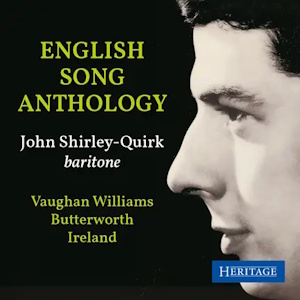
John Shirley-Quirk (baritone)
English Song Anthology
Viola Tunnardano, Martin Isepp, Eric Parkin (piano)
rec. 1963-66
Heritage HTGCD116 [60]
Since 1971, my reference point in English art song has been John Shirley‑Quirk’s recording of Vaughan Williams’s Songs of Travel, accompanied by Viola Tunnard. This was coupled with more songs by RVW, John Ireland, Charles Villiers Stanford, Frederick Keel and Peter Warlock. (SAGA XID 5211 mono, 1963; STXID 5211 stereo, 1966).
It has remained in my collection ever since as my personal “go‑to” recording of this incomparable song cycle, and that early encounter set a standard I have never felt the slightest need to revise. I feel privileged that this LP was my first introduction to English Lieder.
The present Heritage CD release is a concatenation of the 1963 album together with Butterworth’s Six Songs from A Shropshire Lad from Saga XID5260, 1966, and a selection from The Songs of John Ireland (Saga XID 5207, 1964). To muddle matters, Saga later issued a compilation (SAGA 5473, c.1980) that includes all the repertoire now gathered on this 2026 reissue. For the aficionado, Heritage previously issued English Song (2‑CD set, HTGCD 283/4, c.2014), presenting the complete 1960s Saga recordings across two discs. Sadly, that set has since disappeared from their catalogue.
There is no shortage of information about John Shirley-Quirk available on the internet as well as the considerable essay included in the present disc’s liner notes. However, a few words may be of interest to readers who are less familiar with his achievement.
He was born in Liverpool on 28 August 1931; he had an unusual musical formation. Upon graduating from Liverpool University with a degree in chemistry, he entered the Royal Air Force to fulfil his national service. On demob, Shirley-Quirk taught chemistry at Acton Technical College. While teaching, he studied singing, joining the Purcell Singers and eventually becoming a Vicar-Choral at St Paul’s Cathedral, London.
Rising to prominence during the 1960s, he was associated with Benjamin Britten and joined the English Opera Group, where he defined several of Britten’s iconic baritone roles. He was equally successful in oratorio, bringing his talents to Bach, Handel, and Elgar: his recordings of the St Matthew Passion and The Dream of Gerontius remain widely respected. He collaborated with leading conductors of the day, including Britten, Boult, and Marriner.
A principal element of Shirley-Quirk’s career was his work as a recitalist, with a masterful command of French, German, and English song. His broad repertoire ranged from Purcell and Schubert to Finzi, Ireland, and Warlock. He was also a well-respected teacher and mentor, later joining the faculty at the Peabody Institute in Baltimore. John Shirley-Quirk died at the age of eighty-two in Bath on 7 April 2014.
The main event on this new Heritage disc is clearly RVW’s Songs of Travel, first performed on 2 December 1904. Two years after the composer’s death, the final number, I have trod the upward and the downward slope (published in 1960), was added to restore the cycle to its intended nine‑song form. The present recital offers the songs in the order Vaughan Williams conceived, rather than the complicated sequence in which they were originally published. This ordering reflects the composer’s own design, and the 1963 Saga recording was the first to present all nine songs in that intended sequence. This reissue is, therefore, a valuable historical document.
The listener new to this cycle can regard it as a kind of English Winterreise (or Scottish, as Robert Louis Stevenson was born in Edinburgh), where the singer, “always tramping away into the distance”, enjoys the pleasures of the road, is ensnared by love, and ponders the mysteries of the universe, as well as giving his own epitaph in the final song.
As a lovelorn teenager my favourite was Youth and Love – I was the lad that “Cries but a wayside word to her at the garden gate/Sings but a boyish stave and his face is gone” – torn between homely love and the desire for adventure. Now, as a seventy-something, I warm to The Infinite Shining Heaven with a falling star that seems to descend from the sky to offer personal comfort in one’s latter years.
Shirley-Quirk’s evocative account of Linden Lea, one of RVW’s early nods to folksong, is a gift to the listener. Equally remarkable is his performance of Silent Noon, surely one of the most beautiful songs in the entire English repertoire.
George Butterworth’s Six Songs from A Shropshire Lad sets well-known poems by A.E. Housman and was completed in 1911. This cycle is a finely constructed meditation on youth, transience, and the shadow of death, each infused in Housman’s innate melancholy. Shirley-Quirk gives a remarkable performance, shaping a sequence whose quiet eloquence has long secured its place as a cornerstone of English art song.
I enjoyed the John Ireland settings. The group opens with the overwrought My Fair, the first of his Songs Sacred and Profane (1929-31) in which the soloist brings out the turbulence and impassioned undertow of Alice Meynell’s poem. Most listeners will know Benjamin Britten’s delightful arrangement of Yeats’s Salley Gardens set to an old Irish tune; less familiar is the eponymous fourth number of Ireland’s cycle, which is poised intriguingly between art song and folksong. Love and Friendship with words by Emily Brontë is the first of Three Songs written in 1926, serving as a rueful meditation on the sweet but fading rose and the longer lasting holly. Shirley-Quirk relishes the boisterous I have Twelve Oxen. Equally well performed is Ireland’s most popular (and hackneyed) song, Sea Fever, to a text by John Masefield, where the sailor longs to return to the sea.
The concert closes with three unrelated songs. Drake’s Drum, drawn from Charles Villiers Stanford’s Songs of the Sea op.91. This song evokes patriotic resolve, maritime legend, and Henry Newbolt’s stirring – if now sadly less fashionable – vision of England’s steadfast spirit. Shirley‑Quirk plays it up to the hilt, giving the piece all the swagger and colour it needs. Frederick Keel’s Trade Winds, (John Masefield), drifts with a gentle, sea‑worn melancholy, its lilting vocal line and rocking accompaniment conjuring distant shores, salt air, and the quiet pull of wanderlust. The final track is a real “toper.” Peter Warlock’s Captain Stratton’s Fancy (John Masefield) majors on the obvious fact (to the poet) that rum is the best drink and drinking is the finest occupation in the world. Warlock originally collected this song and Mr Belloc’s Fancy in a set colourfully titled Two True Topers’ Tunes to Troll with Trulls and Trollops in a Tavern (No. 1 Rum; No. 2 Beer, c.1921), though they were never actually issued under that name. The Fancy makes a fine robust conclusion to this most enjoyable recital.
As noted above, the liner notes written by Tully Potter give a good overview of Shirley-Quirk’s career, along with exceptionally brief notes about the songs on this CD. No texts are included, though all are easily available on the internet.
Little information is given about the three superb accompanists. Viola Tunnard (1916-74) was an English pianist, who worked closely with Benjamin Britten, served as the first collaborative pianist of the Philharmonia Chorus, toured with Joyce Grenfell during WWII, and mentored leading singers including Janet Baker and Peter Pears, earning a reputation as “the musician’s musician.”
Martin Isepp (1930–2011), Austrian‑born British pianist and harpsichordist, was a distinguished accompanist and Glyndebourne coach, partnering singers such as Janet Baker, Elizabeth Schwarzkopf and of course, John Shirley‑Quirk.
Finally, Eric Parkin (1924-2020) is well known to lovers of British music with his advocacy of composers such as Ireland, Bax, Moeran and Billy Mayerl; his numerous Chandos and Lyrita recordings always display an instinctive sympathy towards this repertoire. The liner notes omit to record that he died six years ago, giving only his birth year.
For over fifty years, John Shirley-Quirk’s 1960s Saga recordings have stood as a benchmark for English art song. Moving effortlessly from quiet, melancholic wanderlust to rowdy tavern songs, this welcome reissue catches the legendary baritone at the very top of his game. It remains as deeply moving and essential today as it was when first recorded.
John France
Buying this recording via the link below generates revenue for MWI, which helps the site remain free
Contents
Ralph Vaughan Williams (1872-1958)
Songs of Travel (Robert Louis Stevenson) (1904)
Linden Lea (William Barnes) (1901)
Silent Noon (Dante Gabriel Rossetti) (1903)
George Butterworth (1885-1916)
Six Songs from A Shropshire Lad (A.E. Housman) (1911)
John Ireland (1879-1962)
My Fair (Alice Meynell) (1929-31)
The Salley Gardens (W.B. Yeats) (1929-31)
Love and Friendship (Emily Bronte) (1926)
I Have Twelve Oxen (Anon.) (1918)
Sea Fever (John Masefield) (1913)
Charles Villiers Stanford (1852-1924)
Drake’s Drum (Henry Newbolt) (from Songs of the Sea) (1904)
Frederick Keel (1871-1954)
Trade Winds (John Masefield) (1902)
Peter Warlock (1894-1930)
Captain Stratton’s Fancy (John Masefield) (1921)













