
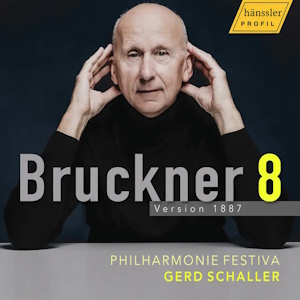
Anton Bruckner (1824-1896)
Symphony No.8 in C minor (first version, 1887. ed. Schaller)
Philharmonie Festiva/Gerd Schaller
rec. live, 20 July 2025, former Cistercian Abbey, Ebrach, Germany
Hänssler Profil PH25005 [2 CDs: 81]
Last September I very favourably reviewed Gerd Schaller’s live recording of his own edition of the 1890 version of this, for me the greatest of symphonies, and I refer you to Ken Ward’s perspicacious review of it on Seen & Heard for further background information and some clarification regarding the differences between the two main versions. This latest issue of the performance of the original version concludes the BRUCKNER2024 project which comprises of every incarnation of every symphony, and alongside Haydn’s Creation provided a fitting climax to celebrate the 35th season of the Ebracher Musiksommer, held in the grand former Cistercian abbey in that tiny Franconian town.
There are nowhere near as many recordings of the 1887 version as of the later one; my favourites hitherto have been by Simone Young, as part of her complete cycle, and Kent Nagano on the Farao Classics label – although the latter may be considered eccentric in that he stretches out the runtime to ninety-nine minutes, whereas Young clocks in at a more conventional eighty-three, with timings not so different from Schaller’s here.
If the opening of the first movement isn’t as driven as that of Schaller’s performance of the 1890 version, it is still dark and aggressive, the transition into the equally menacing second subject somehow seamless; only five minutes in, with the succession of horn, woodwind and brass solos does the minatory mood momentarily relax before the return to high tension. Schaller’s grip over these migrations of mood is absolute; there is ever a dull or slack moment in the execution of Bruckner’s astonishing development of ideas. The “cantering-a-horseback” passage at nine and a half minutes in before the return of the falling opening theme is like another episode in the exploits of a picaresque hero; there is a kind of narrative grandeur to the way the movement unfolds. Of course, the blazing conclusion, later replaced by a more mysterious, and indeed decorous, quiet ending, only enhances and confirms that sense of titanic struggle, the horns and trumpets stomping out their repetitive challenge.
The Scherzo always works so well in abbey acoustic, aping as it does a carillon, and here the feeling of urgency is carried over from the first movement, the speed perhaps helping to mitigate any suspicion that Bruckner is overworking the repetitions in this first version. I always feel that the second Trio rightly superseded its predecessor, which has a more homely, earthbound atmosphere; it is nonetheless played here with a kind of affectionate wistfulness before the return of the Scherzo, culminating in a suitably rambunctious crescendo and climax.
The Adagio is in no sense sentimentalised; Schaller maintains a strong, steady pulse, emphasising its stoicism and grandeur – a starkness reinforced by the reduced contribution of the three harps, which were given greater prominence in the later version – although obviously music replete with such lush harmonies and melodies of “a dying fall” cannot fail to tug the heartstrings and the strings play here with such burnished warmth while the horns resound nobly. The question, however, in any account of this movement in its original form, is always whether the scoring of six cymbal clashes – two sets of three – remains an embarrassment. Nagano cheats by reducing each set of three to only one strike, but it may be convincingly argued that, properly done as they are here, their presence underlines the more overtly dramatic nature of Bruckner’s first thoughts. Listening to this performance, such is its coherence that I almost forget to appreciate the unfailingly consistent quality of the orchestral playing throughout, yet it is not something we should take for granted.
The Finale opens a steady gallop with terrifically hieratic and stentorian contributions from the brass percussion. Schaller adopts throughout a very direct, assertive manner, melding the succession of disparate motifs together in intensely cohesive fashion. If we heard echoes of Siegfried in the Adagio, in the close to the symphony shades of Das Rheingold suggest what I somewhat whimsically labelled in my review of Simone Young’s set as Bruckner’s “own Christological Valhalla” and we end on a note of celebratory peroration.
Ralph Moore
Buying this recording via the link below generates revenue for MWI, which helps the site remain free














