
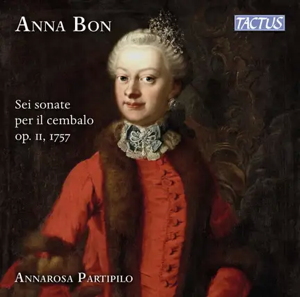
Anna Bon (1738-after 1767)
Sei sonate per il cembalo, op. II (1757)
Annarosa Partipilo (fortepiano)
rec. 2024, Palazzo Annibaldeschi, Monte Compatri, Italy
Reviewed as a download
Tactus TC730202 [73]
Anna Bon (di Venezia) is one of the better-known female composers of the 18th century. Her reputation is largely due to her first publication, a set of six sonatas for transverse flute and basso continuo Op. 1 of 1756, which is available in several recordings and has also been the subject of interest of recorder players. The two further collections she published have been largely neglected. The last printed edition, dating from 1759, is a set of six divertimenti for two transverse flutes and basso continuo Op. 3. Two years earlier a collection of six sonatas for harpsichord appeared as the Op. 2. This is the subject of the disc under review.
Little is known about Anna Bon. She may have been born in Russia, as her parents, the scenographer and librettist Girolamo Bon (or Boni, Bono etc) and the Bolognese singer Rosa Ruvinetti may have worked there at the time. She added ‘di Venezia’ to her name, as at the age of four she entered the Ospedale della Pietà as a pupil. She was a paying pupil, unlike most other pupils, who were orphans. She was probably staying there during the travels of her parents. By 1755 she was, with her parents, at Bayreuth, in the service of Margrave Frederick of Brandenburg Culmbach and his wife Wilhelmine, a sister of Frederick the Great. After Wilhelmine’s death musical activities at the court came to a kind of standstill and in the next years the family participated in opera performances elsewhere. In 1762 the Bons moved to Eisenstadt, where they entered the service of Prince Nikolaus Esterházy. In 1767 Anna married an Italian tenor with the name of Mongeri. No musical activities are known from that year onwards.
All three collections of Anna Bon’s music were published in Nuremberg. The title-page of the Op. 2 says, translated into English: “Six sonatas for harpsichord dedicated to the Serene Highness of Ernestine Auguste Sophie, Princess of Sachsen Weimar etc etc, composed by Anna Bon from Venice, Virtuosa of Chamber Music of the Serene Highness of Frederick, Margrave ruling over Brandenburg Culmbach etc etc, and at the present day seventeen years old, Opus Two”. The age indicates that she was a prodigy. Whether she played the harpsichord herself is not known, but keyboard lessons may have been part of her education. These sonatas are not very virtuosic, but well-written.
They consist of three movements in the order fast – slow – fast, which are of different length. Notable, for instance, is the andantino from the Sonata No. 1, which is the longest of the set, taking more than eight minutes. In comparison the andante from the Sonata No. 2 is very short (1:34).
The movements are different in structure: they are in binary or ternary form; some movements have repeats, others are through-composed, and there are also variations. In two of the sonatas all the movements are in the same key, in others the middle movements are in the relative minor or the parallel minor and one in the subdominant. As was customary in keyboard music of the mid-18th century, most of the thematic material is in the right hand; the left hand is often confined to the role of accompaniment. However, these sonatas also contain movements or episodes where the left hand is given to play a more active role. At some passages the left hand imitates a phrase of the right hand, for instance in the allegro which opens the Sonata No. 4. There are also passages in which a phrase covers a large part of the range of the keyboard. The opening movement of the Sonata No. 2 is dominated by dotted rhythms, whereas in the second movement the left hand has a partly independent role. Minuets were fashionable in the mid-18th century. The Sonata No. 3 closes with a minuet and trio, the Sonata No. 6 with a minuet with variations. The Sonata No. 5’s opening allegro moderato includes pauses and sequences of demisemiquavers.
At some moments Annarosa Partipilo repeats a phrase piano. She is fully entitled to do so, but the scores don’t include any dynamic indications. I am surprised by her statement in the liner-notes that “[the] writing adapts equally well to the harpsichord and the fortepiano, as in this recording: the indicated dynamics – typically on two levels – allow the performer to explore contrasts and nuances that foreshadow the Classical style.” I have looked at the score – both the original and a modern edition, available at Petrucci Music Library – and I have not found any such indication.
This brings to the issue of the choice of instrument. The title indicates the harpsichord, but that does not need to be taken literally in that it would exclude any other keyboard instrument. However, given that the printed edition dates from 1757 and the sonatas may have been written in the years before, the choice of a fortepiano is very debatable. At this time the fortepiano had not fully established itself, and among amateurs – those for whom these sonatas may have been intended – the harpsichord (or the much cheaper clavichord) was still the most common keyboard instrument. If a fortepiano is used, it should be a Silbermann or another instrument of that kind. Annarosa Partipilo plays an instrument built by Johann Hasselmann around 1800. That is completely anachronistic. This instrument cannot do real justice to these sonatas.
Annarosa Partipilo is undoubtedly a fine player. I like the liberties she takes here and there, and her embellishments. I also appreciate the fact that she observes all the repeats. What I regret is a lack of differentiation between stressed and unstressed notes. Too often the notes within a bar are played the same way, instead of taking some time away from the unstressed notes or playing them a little softer. This, and the use of a far too modern fortepiano, make it hard to recommend this album without serious reservations.
Johan van Veen
http://www.musica-dei-donum.org
https://twitter.com/johanvanveen
https://bsky.app/profile/musicadeidonum.bsky.social
Buying this recording via the link below generates revenue for MWI, which helps the site remain free
Contents
Sonata I in G minor
Sonata II in B♭ major
Sonata III in F major
Sonata IV in C major
Sonata V in B minor
Sonata VI in C major













