
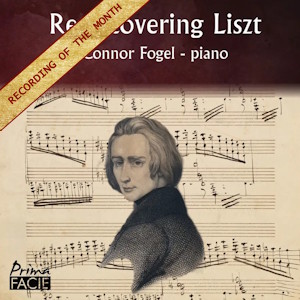
Franz Liszt (1811-1886)
Rediscovering Liszt
Connor Fogel (piano)
rec. 2025, St Elizabeth’s Church, Manchester, UK
Reviewed as 44.1khz/24-bit digital download
Prima Facie PFCD284 [68]
Connor Fogel studied piano at the Royal Welsh College of Music and Drama and enjoys a varied career as a concert pianist, musicologist, and musical director for theatre. His numerous awards, not surprisingly, include 2nd prize in the 2019 International Liszt Society Piano Competition. He has also written numerous articles on historically informed performance for The Liszt Society (UK). I’ve been aware of his very fine Liszt performances from recital videos on YouTube.
The album Rediscovering Liszt, recorded on a 1922 Bösendorfer grand, is recreation of two solo recital programs performed by Franz Liszt in the 1840s. Programming even one of the four daunting large-scale transcriptions on the present release is quite an undertaking.
The disc opens with Ouverture de l’opéra Guillaume Tell de Rossini, S552, a faithful transcription (not a free paraphrase) composed in 1838. It preserves the four distinct sections of the original score. I was immediately struck by Fogel’s bold yet elegant phrasing in the opening Andante. He enjoys employing plenty of wonderful pianistic devices including desynchronized hands, extra rolled chords, and breaks off some of the ends of phrases (marked staccato in the score) for an interesting effect. The melodic line is maintained throughout and Fogel gets a clear and expressive singing tone out Bösendorfer. The Allegro is taken at quite a staggering speed and the more difficult (and colourful) ossia passages are played very effectively. What stands out throughout is exceptional rhythmical control and balance within saturated textures. Double notes, broken octaves, and unusual trills are all dispatched with ease. Fogel’s colourful tone and refined phasing delight in the Andante (with the famous cor anglais solo) and the melody is projected clearly amidst all the figuration. The highlight of the overture is the famous allegro vivace. Repeated notes, which pose fewer issues for strings, and horns in the orchestral score, can become a significant difficulty in a transcription where the pianist is at the mercy of his particular instrument that day. Fogel handles the exceedingly complicated textures with ease. There is plenty of power without sounding harsh, and the choice of tempo is spot-on. This is very exciting playing and stands alongside other fine recordings including Kemal Gekić and Leslie Howard.
The next offering is a world premiere recording of the Réminiscences de ‘Lucia di Lammermoor’ S.397 (1836), in Adolf von Henselt’s (1814-1899) 1878 edition of the work, which was based on how Henselt hear Liszt play it in concert. Curiously, Liszt’s initial conception was deemed too long by the publisher, and it was printed as two separate works: Réminiscences de Lucia di Lammermoor S397 (based on the closing sextet), and the Marche et Cavatine de Lucia de Lammermoor S398. Fogel wisely avoided programming the latter on this disc, as it features a similar coda which might feel anticlimactic if both works were presented back-to-back. Fogel’s tonal command is on full display in this daunting work, with its many complex arpeggio figurations. Henselt’s edition offers some minor alterations to the score but largely follows original 1840 publications, incorporating all the extra ossia passages. It is truly a delight.
Liszt’s Réminiscences de Don Juan S.418 (1841) has long been a concert favourite and programmed by countless great artists of the past. Ferruccio Busoni made his own performer’s edition of it in 1918. Ignaz Friedman and Vladimir Horowitz included this terrifyingly difficult yet profound work in their debut recital programs, and it has remained a concert staple for the past century. In 1876, Liszt arranged the work for two pianos (S.656), and Connor has incorporated many of the extended cadenzas and variants found in it back into the solo score. Connor’s powerful tone in the Grave section as well as his complete mastery of all the tricky chordal runs and notoriously difficult finger work (from chromatic scales to extended tremolos), all while maintaining the melodic line, is truly beautiful. The Là ci darem la mano duet variations (with a longer introduction taken from S.656) emerge as pure poetry under Connor’s hands. He employs the pianistic effect of playing bass notes before the melody (to achieve a better separation of voices within a texture) quite effectively here. Connor navigates the dizzying pianistic textures within these variations with ease, preserving the elegance of the underlying material. The final section of this fantasy is based on the “Champagne aria” (‘Fin ch’han dal vino’) from act 1. Connor wisely chooses to play the shorter transition section leading up to it which keeps the structure tighter, considering the various additions earlier in the piece (optional, longer passages exists in both the original solo piano version and Liszt’s 2-piano arrangement). The Champagne aria itself is played with abandon. Constant left-hand leaps and mixed octave and chordal textures abound; Connor plays some of the most delusively difficult piano writing with ease and never loses the melody. The final più presto and prestissimo section brings the marvellous performance to an exciting conclusion.
The remainder of the disc is devoted to rarely-heard first versions of works, and it’s quite fascinating to compare them with their better-known final versions. I was able to access the rare scores (not published in Liszt’s lifetime) of Ave Maria S557d and La sérénade S.559a in the Liszt Society Journal Music Section Volume 44 (2019). The Ave Maria S557d from c.1837 is identical texturally to the well-known version published in 1838 in S.558, aside from a long coda added by Liszt, marked religioso. Connor’s slightly faster choice of tempo here helps preserve the melodic line and ensure that the thick texture remains in the background. The bassline is well-defined throughout, with rich bell-like tones permeating the work, and the filigree figurations are astonishing in their lightness and control. The final coda by Liszt, with its chorale-like texture, brings the transcription to a poignant conclusion. La sérénade S.559a has very few differences compared with the final version, the most notable being the extra two measures added to each phrase with the well-known “echo” effect. Connor’s exquisite balance, mastery of articulation and tonal control really helps bring this work to life. The detached accompaniment is layered perfectly with the melody and long bass notes, and the tasteful additions to the final cadenza sound organic. Liszt’s first known public performance of the Der Erlkönig transcription was in May 1838, Vienna. Given how incredibly saturated the well-known S.558 version is, it’s not surprising that there are few audible differences between that and the early draft. Connor’s repeated octave technique is fabulous and he has plenty of stamina to deliver a truly fiery performance, full of poetry and colour.
Liszt’s La serenata e l’orgia – Grande fantaisie sur des motifs des Soirées musicales de Rossini was written in 1836 and later underwent slight revisions (including an extended coda) for publication in 1840. This earlier version has previously been recorded only by Leslie Howard. Connor’s exquisite tone really shines in La serenata. Liszt’s many specific markings (cantabile, dolce, smorzando, dolcissimo, sotto voce and even cantando amorosamente) all emphasize the gentle character of this material and this can be heard in the way Connor approaches this first section. L’orgia (marked FFF and giocoso) is quite astonishing. Under Connor’s hands, each glittering variation is realized in its fullest colour. The finale is quite exciting. Liszt’s tempo markings (vivamente, sempre piu forte ed animato, molto energico, strepitoso, and sempre piu presto) leave little room for doubt and there is plenty of bravura in this stupendous performance.
Liszt’s Grand Galop Chromatique (1838) was one of his most popular works, appearing on his recital programs every year from 1838 through 1847 and Hofmeister’s sheet music sales (1838-1844) dwarfed their entire Chopin catalogue print run. Liszt offered simplified ossia passages to ease execution in some of the hardest movements. Connor opts to play the densest variants and maintains the tempo (presto) with aplomb. There’s plenty of colour and bravura in this performance. The final few pages are quite exciting and Connor includes a cadenza in alternating octaves present in some editions. It’s a fitting close to this brilliant program.
This is one of the most exciting and original all-Liszt discs I’ve heard in years. The entire concept of resurrecting Liszt’s original concert programming and playing the works in a historically informed manner is quite unique. The rare editions used are quite fascinating and allow Connor’s individual voice to be expressed. The recorded sound is beautiful and captures the vintage Bösendorfer in its full glory. This is a release I would return to again, and again. Bravo!
Michael Kaykov
Contents
Ouverture de l’opéra Guillaume Tell de Rossini, S552
Réminiscences de Lucia di Lammermoor de Donizetti, S397
Réminiscences de “Don Juan” de Mozart – Grande fantaisie, S418
Ave Maria (Ellens dritter Gesang) – Mélodie de Schubert, S557d
La sérénade (Ständchen, Leise flehen) – Mélodie de Schubert, S559a
Le roi des aulnes (Erlkönig) – Mélodie de Schubert, S557a
La serenata e l’orgia – Grande fantaisie sur des motifs des Soirées musicales de Rossini, S422i
Grand galop chromatique, S219
Buying this recording via the link below generates revenue for MWI, which helps the site remain free













