
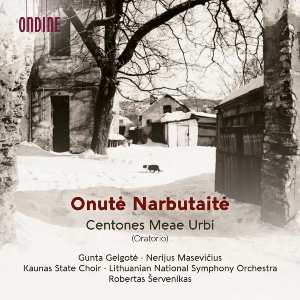
Onutė Narbutaitė (b. 1956)
Centones Meae Urbi (Oratorio) (1997)
Gunta Gelgotė (soprano), Nerijus Masevičius (bass)
Lithuanian National Symphony Orchestra, Kaunas State Choir/Robertas Šervenikas
rec. 2024, Lithuanian National Philharmonic Hall, Vilnius, Lithuania
Reviewed as a digital download
Ondine ODE1455-2 [71]
The critical word in Onutė Narbutaitė’s Latin title is “centones”. It turns out not to have anything to do with cano/cantus, as I thought at first it might, but rather, means “patchwork” or “hodgepodge”. It can refer both to patchwork quilting, using different types of fabric to make a garment, and also to the artistic genre we would call ‘collage’. For example, when the 4th-century Christian poet Proba wrote a life of Christ by re-purposing hexameter lines from Vergil, she called it a cento vergilianus, “A Vergilian Patchwork”.
Patchwork or collage has a musical pedigree as well, of course. I am thinking here of techniques like the quodlibet in baroque music, perhaps most famously in the 30th variation of JS Bach’s Goldberg Variations, in which two unrelated popular folk melodies are woven together – or of the 19th-century “potpourri” genre, in which composers such as Louis Spohr would arrange themes from different Mozart operas into virtuoso chamber works.
However, for the most part, we have to wait for the 20th century and Modernism to see collage really hit its stride as an artistic technique in the West. The first collages in the visual arts come from Pablo Picasso and Georges Braque in the early 1910s; they named the genre for the ‘pasted’ (collé) paper they used to make mixed-media artworks. Composers like Charles Ives and Gustav Mahler arguably preceded them. Ives’ Central Park in the Dark (1906) uses fragments from different styles, different registers, and different idioms, to audibly describe all the different sounds (cars, owls, parades, ragtime piano playing…) all happening simultaneously in Central Park.
One might, then, expect Lithuanian composer Onutė Narbutaitė to have written such a work; a polystylist account of the sounds of ‘her city’ (in this case, Vilnius), maybe something like Alfred Schnittke’s symphonies, which quote widely and make for a jarring, yet fascinating, listening experience that jump from genre to genre and time period to time period.
Yet that is not quite the experience of listening to this work. Narbutaitė writes with clarity and integrity; she establishes a soundworld early on which develops but is consistently maintained. She explicitly states that there is only one quotation: one fragment from Polish national composer Stanisław Moniuszko accompanies a line by Adam Mickiewicz. Otherwise, all the music is her own. It is a patchwork thematically, rather than sonically.
With that out of the way, let’s turn to Narbutaitė herself, Lithuania’s best-known female composer, as her website says. This must be the case, but she is still, in my view, tragically underappreciated. There is only one other review on MusicWeb for a full CD dedicated to her music, the 2008 Tres Dei Matris Syphoniae (Three Symphonies of the Mother of God), which, incidentally, features the same Lithuanian National Symphony Orchestra under the baton of Robertas Šervenikas. In his review, Hubert Culot calls the third symphony both “imposing and accessible”, and finds multiple listens to be “generously reward[ed]”. This, as we will see, is also the case for her Centones Meae Urbi.
Narbutaitė has been publishing music since 1977, but this present work is surely one of her highpoints so far, a 70-minute oratorio for chorus, soloists, and orchestra for which she was awarded the Lithuanian National Culture and Art Prize in 1997. The premise of this oratorio is that Vilnius itself is something of a collage: a mix of peoples, cultures, and languages, which is reflected by the array of lyricists set. I quote from the Ondine website:
“Ališanka, Eugenijus; Bible – Old Testament; Bilducius, Joannes; Daunys, Vaidotas; Kulbak, Moyshe; Mickiewicz, Adam; Miłosz, Czesław; Nidevicius Leopoliensis, Simon; Royzius Maurus, Petrus; Rudamina, Joannes; Sarbiewski, Maciej Kazimierz; Strzelec, Petrus”
Lithuanian, Polish, Latin, and Yiddish are all represented here.
Centones Meae Urbi is in six movements: the opening and closing act as a sort of framing device, sung by “the Poet”. This figure is not explicitly named, but it is sung by soprano Gunta Gelgotė. The text is supplied by 20th-century Polish writer Czestaw Milosz.
After a slightly eastern-sounding opening figure on (perhaps) the birbyne, a Lithuanian folk instrument that sounds like a slightly buzzy oboe, we have a brass fanfare to lead into the Poet’s lines, chanted unaccompanied. Narbutaitė writes with great economy here: there is a lot of focus, silence, and space. Eventually, a male chorus enters beneath the Poet, and this provides an opportunity for Narbutaitė to use cross-rhythms. The prevailing mood here is serious and intense.
The middle four movements follow the seasons, beginning in “Autumn”. In Lithuania, autumn is a season associated especially with All Saints Day (Nov. 1), and this inspires Narbutaitė to write some of her most ‘romantic’ choral writing, with bells tolling and deep, sonorous chords. At times you could almost be hearing something by John Rutter. At around 5:30 we have our first bass solo, courtesy of Nerijus Masevičius. This section is marked by dissonance in the orchestral accompaniment. The end of this movement returns to the religious-sounding choral passages with a low drone, which always reminds me of Slavic church music.
“Winter” follows, with a flurry of light percussion building up into some very avant-garde sounds and textures–the kind of thing you might expect to hear on the NEOS label. It is handily the most challenging movement here, but when I returned to this album, I felt I could follow the logic of it a little better: this is ‘cold’ music, nearly frozen solid, gaunt and dark.
If you have never been to Vilnius (I have not!), I recommend a quick Google image search of the Vilnian baroque architecture while listening to the third movement, “Spring”. This movement begins with a rolling drum-and-brass intro and plenty of choral fireworks that sort of remind me of Bach or Handel updated via the post-war avant-garde. It is authentically joyful, provided that you’ve come to understand Narbutaitė’s language, and it makes a wonderful contrast after “Winter”. This culminates in a depiction of a spring-time procession, replete with birdsong and sighing vocal effects.
Finally, “Summer”, which is dedicated to Jewish Vilnius. The orchestra begins at its loudest and most monolithic, before giving way to another chanted section. It is an energetic, impassioned piece, which only quiets down towards the middle and becomes more traditionally elegiac. The bass chorus towards the end, singing the lamentations of Jeremiah, is incredibly affecting, as is the explosion of timpani.
In the final movement of the work, we return to the sound of the opening. The male chorus beneath the Poet’s commentary, leading into a slow, spacey outro with bells.
This work has been recorded once before, also by Šervenikas in 1997, which was released on Vilnius Recording Studio VSCD-063 in the year 2000. I have not yet been able to hear this one, but the 2024 recording for Ondine is fresh, clear, and energetic. I will not pretend that Narbutaitė’s music is immediate or easy, but any fans of composers like Aho, Rautavaara, Peterssen, or Schnittke should really consider taking a little excursion to Narbutaitė’s Vilnius.
Aidan Gray
Other review: Hubert Culot
Buying this recording via the link below generates revenue for MWI, which helps the site remain free













