
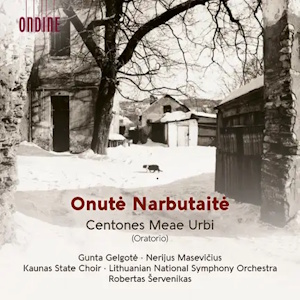
Onutė Narbutaitė (b.1956)
Centones Meae Urbi (1997)
Gunta Gelgotė (soprano), Nerijus Masevičius (bass-baritone), Kaunas State Choir, Lithuanian National Symphony Orchestra / Robertas Šervenikas
rec. 2024, Grand Hall of the Lithuanian National Philharmonic Society, Vilnius, Lithuania
Texts and translations included
Ondine ODE 1455-2 [70]
Here is Lithuanian composer Onutė Narbutaitė’s substantial works, oratorio Centones Meae Urbi. The title could be translated as “patchwork of my city”. That would allude to the complicated historical background of Vilnius and, more generally, Lithuania, and to the city’s long multicultural history. The composer chose to reflect it all by setting words in almost all languages ever spoken in Vilnius and Lithuania. Pride of place goes to the poetry of the Lithuania-born Polish poet and Nobel prize laureate, Czesław Miłosz. His long poem City without a Name (1965) serves as a red thread of sorts in the oratorio, and there appears part of another poem of his.
The literary sources are quite varied. There are inscriptions on old tombstones at Vilnius cemeteries; texts by anonymous authors and contemporary Lithuanian authors; words of better-known poets such as the Lithuania-born Polish Romantic Adam Mickiewicz; Jeremiah’s lament; and excerpts from newspapers in various languages generally heard in Vilnius over the years. The composer’s challenge is to make a coherent whole out of what may at first sight seem somewhat disorganized. The oratorio is structured in four large sections which roughly represent the seasons of the year; they are bookended by an opening section, The Poet’s Return, and a concluding one, The Poet’s Farewell. Fragments of Miłosz’s poem City without a Name run through the entire work to connecting all the seemingly disparate sources.
The introduction and The Poet’s Return begin with a long solo on the birbynė, a traditional Lithuanian single-reed instrument resembling a clarinet. There follows the first Miłosz setting, shared by the soprano singing a Lithuanian translation and the choir singing in Polish. The next section, Autumn, is built mainly on four episodes designed as epitaph or “promenade at the Bernardines Cemetery”. The texts, mainly tombstone inscriptions from Vilnius cemeteries. include a fragment by Mickiewicz ending with beautifully simple words: “Take this little leaf – it’s been touched by my hand – This is my last gift”. This ends with a short P.S. by Miłosz: “Books, we have written a whole library of them / Lands, we have visited a great many of them / Battles, we have lost a number of them / Till we are no more”.
Winter is almost a choral-orchestral symphonic poem based on a text by Eugenijus Ališanka. The overall tone is bleak but, at the very end, things are not entirely lost; they hang like smoke absorbed into clothing and leaving “a smell of eternal winter”. The handling of the text and its implications, quite remarkable, is clothed in highly imaginative music. This section might well be the most personal part of the entire work.
Spring is the longest movement, and the most narratively episodic. It falls into three subsections. Royal Welcome, setting a text from 1579, reminds one of the time of the Grand Duchy of Lithuania and its union with the Kingdom of Poland. Sung in Latin, it is full of pageant, swagger and patriotic fervour. “As the sun lights up the fields in early spring / You, noble ruler, will light up Vilnius […] As water from the rivers refreshes the green poplar / So will you, King”.
The second section, Spring at Lukiškes, evokes the season as symbol of rebirth and new life. The music soon shows, however, that this was but a fleeting moment surviving only in imagined memory. The final section, Procession, describes a journey to the Basilica of the Visitation of the Blessed Virgin Mary in Trakai. The hymn-like prayer asks for peace and safety on the journey. The procession also symbolizes the passage of time between seasons.
Summer is far from the jubilant climax that one might have expected. Quite the contrary: it refers to the darker corners of the city and of its history. First comes a choral tapestry of excerpts from Vilnius newspapers from 1906-1911. (I do not know exactly what they are about: there is no translation.) There follows a long extract from a poem by Moshe Kulbak (Vilne – 1926). Sung in Yiddish by soprano and bass-baritone, it describes “ominous things hiding in the dark corners of the city”. This rather pessimistic outlook seems to prolong the equally dark sayings in Jeremiah’s Lament, sung in Hebrew. Another poem by Milosz, From the Rising of the Sun, reminds one that nothing has really changed in spite of the passing of time: “They hadn’t changed since the day Napoleon / passed through the town. Nothing has changed here”. To quote Ben Lunn excellent booklet notes (which I have used liberally, with thanks): “Despite the grandeur witnessed in Spring, Summer is a strong reminder of how Vilnius has been the home of great loss and destruction”.
This leaves us with The Poet’s Farewell, again from City without a Name. It acts as a commentary and summary of the preceding movements. It is capped by a short epilogue on a text by Vaidotas Daunys: “When they ask me: do you believe, that in this city lies the secret of life? – I reply: I am its participant.” Narbutaitė clearly could make these words her own. The oratorio ends with a peal of bells, to remind one that Vilnius is a city with many steeples and spires.
Onutė Narbutaitė’s Centones Meae Urbi is a substantial piece of strongly expressive and sincerely felt music. It is undoubtedly of great importance for the composer, born in Vilnius with which she has an almost visceral connection. It also obviously means much to all concerned, for they sing and play with utmost commitment and enthusiasm. All in all, this is a splendid release on all counts. Performance and recording are of the highest quality.
Hubert Culot
Earlier review: Aidan Gray
Buying this recording via the link below generates revenue for MWI, which helps the site remain free













