
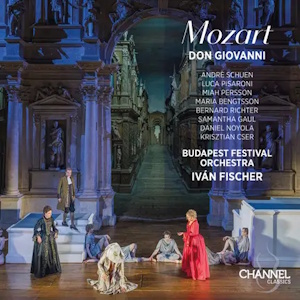
Wolfgang Amadeus Mozart (1756-1791)
Don Giovanni – Drama giocoso in due atti (1788)
Budapest Festival Orchestra/Iván Fischer
rec. live 2025, Vicenza.
Booklet with notes in English, German and French; libretto in Italian and English.
Reviewed as a download.
Channel Classics CCS49926 [3 CDs: 169]
This new recording of Don Giovanni was made live during performances at the Vicenza Festival in October and November 2025. New recordings of Don Giovanni are not common: there seem to be only four others currently available that were actually made this century, not counting video recordings and the many re-releases. What has this new recording got to offer in comparison with these other recent ones?
Fischer uses modern instruments (except, that is, for a fortepiano), producing a light, “period” sound. (It is difficult to believe that the orchestra contains the 53 instruments, including four double basses and four horns, which are listed in the accompanying booklet.) As a result, the orchestra produces a pleasantly transparent texture. Donna Elivra’s “Ah chi mi dice mai,” for example, is accompanied with remarkable crispness, and the mocking strings in the Catalogue aria are admirably light. The prominent woodwind is particularly effective in “Giovinette che fate all’amore,” where it creates, in contrast to Donna Elvira’s preceding, pathetic, recitative, a mood of rustic celebration. In a more sombre context, the accompaniment to the last part of Donne Elvira’s recitative before “Mi tradì quell’alma ingrata” makes very touching use of the sound of the vibrato-less strings, be it the attractive timbre in the lower register, or the purity of the higher, drooping, phrases. In the aria itself the woodwind accompanies with very beautiful, delicate colours, and gives the whole of the performance, here as elsewhere, a chamber-music feel.
This style of orchestral playing implies the need for a particular type of singer, which we indeed mostly find in this recording. The voices are generally tidy, precise, and on the light side. The delicacy of the orchestral playing means that the singers do not, most of the time, have to push their voices, and so the result is usually pleasant and mellifluous.
Andrè Schuen has been singing the role of Don Giovanni for more than ten years. His Don uses charm, rather than virile appeal, to seduce the women; in his interaction with Zerlina, he has a suavity that occasionally reminds me of Thomas Allen, and he sings the serenade in a head voice which is attractive, though one might have wished for a little more variation in the tone. His interactions with Leporello are entertaining. He can sing with more bite where necessary, as in the “Stone Guest” scene, though the voice can become rather dry on occasion, and those who are looking for a bigger-voiced, more incisive Don, particularly in the more dramatic passages – in the style of Waechter or Gobbi, to mention just two famous baritone exponents of the role – will not find what they want here..
The role of Leporello is sung by Luca Pisaroni, who has been singing this part for more than twenty years, and has recorded it before, in 2012. Since then, his timbre has darkened somewhat from the light baritone which Ralph Moore noted in his review; he now sounds slightly more buffo, though some might prefer a voice which is more easily distinguishable from Don Giovanni’s: they both have roughly the same weight, though Schuen does usually sound that bit finer, and Pisaroni rather coarser-grained, as one would expect. Having said that, I like his solidity and attractive timbre, and it is a pleasure to hear his (and Schuen’s) idiomatic Italian and his dramatic commitment, for example in his convincing “Dite di no” in the final scene.
To continue with the male roles, Don Ottavio is sung by Bernard Richter, who also has considerable experience, particularly in Mozart. His first entry makes a slightly untidy impression: to my ear, he doesn’t sing many of the notes that are written in the short recitative preceding Donna Anna’s “Ma qual mai s’offre, oh Dei,” and in “Dalla sua pace,” he makes the G’s sound higher than they should. But his tone can be attractive when not under pressure, as in “Il mio tesoro.” The robust, passionate nature of his Don Ottavio almost makes us forget that the character spends the whole opera uttering threats that are never translated into action. His reproachful “Crudele!” towards Donna Anna, for example, is heartfelt; all in all, he creates a thoroughly believable character.
The role of Masetto is sung agilely by the young Mexican Daniel Noyola, whose rich bass is easily distinguishable from the two lightish (bass-)baritones. Krisztián Cser as the Commendatore doesn’t give the impression of having a big voice – which would be out of place in this particular recording – but he uses his resources carefully, never forcing, producing an attractively dark, bronze tone, which combines very nicely, in the graveyard scene, with the three trombones and accompanying woodwind.
The three soprano roles are sung by two experienced singers, the Swedish sopranos Marie Bengtsson (Donna Anna), and Miah Persson (Donna Elvira), and the young German Samantha Gaul (Zerlina). Gaul is suitably fresh and young-sounding, but also capable of making an impact when necessary; it is a pleasure to hear her doing justice to the role.
Bengtsson is capable of some very expressive singing, as in the passage when she realises that Don Giovanni is her father’s murderer. But often, when under pressure, (as in “Or sai, chi l’onore,” or the “Fuggi” duet), the voice lacks dramatic punch, and the vibrato can widen, particularly above the stave.
I find myself wanting to make almost the same comments on Persson in the role of Donna Elvira, and am tempted to say that it would have been preferable, rather as in the case of Schuen and Pisaroni, if their voices had been a little less similar. Both voices have expressive qualities, but lack the sort of attack that I would like to hear, and both can lose some quality above the stave. In the case of Persson, this lack of punch is particularly evident in her potentially dramatic irruption into the Don’s house in the last scene, which (maybe because of tiredness, in the live performance,) fails to make the impact I would like to hear, sounding almost casual. I do, however, have a slight preference for Persson over Bengtsson; I hear a more fruity timbre, and a little more solidity.
As I suggested above, the conducting is charming, interesting and crisp. The big ensembles generally work well, and there is real weight in the orchestra when needed. There are, though, a couple of moments in the final scene (as in the transition to the Allegro on “Da qual tremore insolito”) when it seems to me that the coordination in tempo is not quite as precise as it would have been in a studio recording.
There are a couple of moments in the opera which encapsulate, for me, its particular genius. One is the short trio at the death of the Commendatore, a moment of suspended awe falling between the high drama of the sword-fight and thebuffo banter between Don Giovanni and Leporello. Here, though finely performed, it falls a little short of the special quality I think it should have. The other is the short but remarkable passage (“Protegga il giusto cielo…), when the two Donne and Don Ottavio arrive at the ball in the Act 1 finale; to my ear, it could be made to sound just a bit more magical. In this latter case, it may be down to the singers: neither of the women negotiates this tricky, delicate music as tidily as, say, Sutherland and Schwarzkopf, despite the inherently smaller and potentially neater character of their voices.
There are also moments when, despite the spirited conducting, more could, I think, have been made of some of the comic scenes, like the delightful trio where the Don lends his voice to Leporello who is supposed to fool Donna Elvira into confusing the two men. Many proponents of the role underline the burlesque quality of the scene by “hamming up” the Don’s protestations of love and penitence, but here, Schuen tends to understate it, and for me it falls rather flat. (Though both he and Pisaroni, in the following scenes, get more humour out of their reciprocal impersonations.)
I must now come to the one single characteristic of this recording that differentiates it from practically all other recent recordings. You may have wondered why I have, a couple of times, referred to the “Stone Guest” scene as the “final scene” – well, that’s because, in this version, it is! Fischer has decided to end the opera on Don Giovanni’s disappearance into the flames of hell, omitting the last six minutes or so that Mozart and Da Ponte wrote. He explains his decision in the accompanying notes; we are free to agree or disagree. I find the stark alternative he gives us in his conclusion (“You can disapprove of Don Giovanni’s evil actions, and agree with his punishment. Or you can allow yourself to love him, and see his fate as a tragedy.”) rather unconvincing – isn’t this very ambivalence essential to the opera’s appeal?
Two inaccuracies in the English translation of the libretto caught my attention (I hope there are not more). My Italian is not very good, but one doesn’t need to be an expert to realise that the stage direction “Don Ottavio balla minuetto con Donna Anna” cannot be translated as “Don Ottavio starts dancing with Zerlina”. Similarly, also in the finale of the first act, I don’t understand why the Don’s simple encouragement to the assembled company to have fun (“Su svegliatevi da bravi!”) should, when repeated by the chorus, be translated, very inventively, in very flowery language.
So what of the comparison between this recording and the four other 21st-century versions to which I referred at the start? In none of them do we have the dramatic voices, like those of Ghiaurov or Wixell, Aroyo or Ti Kanawa, which grace the two versions from the 1970’s which Ralph Moore recommends in his survey. The aim these days is to create an apparently more authentic interpretation, in which lighter, more transparent orchestral playing goes hand in hand with tidier voices. Much of the time, this is the case, though some listeners will miss the impact that those bigger voices, and those of their illustrious forebears, could make in some scenes, as well as, maybe, a heavier orchestration.
I will refer briefly to the other four recent available recordings, all of which have been reviewed on this site. The earliest, by Halasz in 2001 (review) is conducted in a brisk fashion, and the main role is sung impressively by Bo Skovhus, who has a light, neat voice but is capable of more attacking singing in the dramatic scenes. René Jacobs’s 2007 version (review) really dances along, with some superb playing by the orchestra, and some excellent, stylish singing, though the Commendatore lacks the requisite weight, resulting in, for me, a lack of gravitas in the big scene. It is in Nézet-Seguin’s 2012 recording (review) that we find what is maybe some of the most impressive singing, in the persons of D’Archangelo and DiDonato, both very good at that age, and Villazon, back on form after his vocal problems. Unfortunately the Commendatore here sounds lighter than the Don in their climactic confrontation. Finally, we have the rather eccentric 2016 version by Currentzis (review), currently only available as a download; there is some really good singing here, if not, maybe, from the Don himself, and the liberties which the conductor takes with the orchestral colours and even the notes themselves, particularly in the recitatives, make for a fascinating performance.
I must say that, for me, no single version stands out among these five recent recordings. In all of them, the orchestral playing is pert and lively, and the singing is always at least competent, and precise. The 1970’s versions I mentioned above, conducted by Karajan and Davis, offer a very different listening experience, as, of course, do the versions from the 1940’s and 1950’s which are also recommended in Ralph Moore’s survey. If one wishes to acquire a 21st-century recording of Don Giovanni, it will, in the end, come down to one’s personal preferences. I would encourage readers not to limit themselves to my brief opinions on the other recordings, but to read my colleagues’ reviews in full; they should be a valuable aid in making a decision.
David James
Buying this recording via the link below generates revenue for MWI, which helps the site remain free

Cast:
Don Giovanni: Andrè Schuen (baritone)
Leporello: Luca Pisaroni (bass-baritone)
Donna Elvira: Miah Persson (soprano)
Donna Anna: Marie Bengtsson (soprano)
Don Ottavio: Bernard Richter (tenor)
Zerlina: Samantha Gaul (soprano)
Masetto: Daniel Noyola (bass)
Il Commendatore: Krisztián Cser (bass)














Fischer possibly chose the original Prague version of the score where there is no concluding sextet; Mozart added it later. If that is the case then there should be no “Mi tradi” or “Dalla sua pace” either. There is a short extra duet for Zerlina & Masetto which Mozart later removed.