
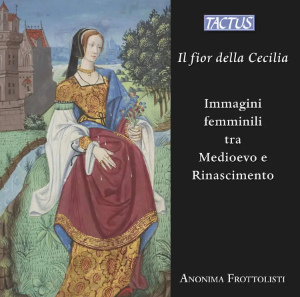
Il fior della Cecilia
Images of women between the Middle Ages and the Renaissance
Anonima Frottolisti
rec. 2025, Accademia Resonars, Monasterio di San Leonardo, Assisi, Italy
Tactus TC480002 [57]
The women in question are those found in myth, legend and various other sources – and they are women who refused to give in to pressure from, mostly, fathers to marry, or marry only the men of their choice.
However, I think that the best way to begin to understand the background to this CD is for me to quote some of the text of Dufay’s song La belle se siet. I translate: “The fair lady sits at the foot of the tower…Her father asks, ‘Do you want a husband?’; she replies, ‘I do not want a Lord, I want my love who is rotting in the tower’. The father fiercely shouts, ‘He is to be hanged tomorrow’ but the daughter replies, ‘Then bury me by him, so people will say here was true love’.” In the frottola (see below) La bella Franceschina by Marenzio, the girl’s father has set her up with a wealthy count but she protests most vehemently because the man she wants to marry is in prison. Of course, it might be best for girls never to marry – as recommended in Binchois song Filles a marier: ‘If you marry/You will regret it/And when? Within a year’. Or there is Josquin’s playful Mon mary m’addifamée: ‘My husband has defamed me’ (sic).
The women in question are Jeanette e Peronette, (tracks 1-3), the next is simply called ‘La Belle’ (tracks 4-6), then La Bella Franceschina (7-10) and La Bella Rosina (11-13), then (14-18) a section called ‘La Traditora e ‘Amore non Corrisposto’ (The traitor and the unrequited love) and the final tracks are devoted to La Bella Cecilia. Each of these ladies rejects the orders of her father and family and remains faithful to her true faith/love even if it means her own death. Their stories, through the folk traditions of Italy were well known and composers based music on the folk melodies such as the last track, entitled simply, La Cecilia.
As the group’s name on this disc suggests, the music largely consists of ‘Frottola’. This was a popular form in many parts of Europe but mainly gained a foothold in humanist Italy around 1500 when composers like Marco Cara and Bartolomeo Tromboncino wanted to use a style that was both expressive and direct – in other words, completely opposed to the complex contrapuntal style of their contemporaries. Frottolas are marked by repetitive dance rhythms, often quite syncopated, and simple melodies harmonised in a fairly set style. Sometimes, the time signature will move between three and two within the song, as in La Pastorella; on other occasions, the verse will be a solo with a harmonised burden as in Non peccando by Caro. Often, the songs are, one might say, ‘catchy’.
Particularly engaging is Track 1, which introduces us to the simple French folk tune Ne pleure pas Janette and the next track offers us a two-part instrumental version based on it. Also, rather intriguingly we have a curious troped Kyrie which uses the tenor melody of La belle se siet which, we read, is the ‘earliest example of a mass based on the tenor derived from the homonymous Chanson’. I wonder if the rest of the three-part mass is worth hearing. Otherwise, it is extremely interesting to find such a wide variety of composers, some of whom will be practically unknown.
As is usual with Tactus, although there are two very useful essays by Massimiliano Dragoni and Emiliano Finucci, we are given only basic information otherwise, so I cannot report the names of the singers and instrumentalists which make up Anonima Frottolisti, but for this recording, fourteen are listed on their website. Also, no texts are supplied, you must go on www.tactus.it/testi and then add the code 480002; however, they do not appear to have been translated into English.
There are three ‘Letture’, that is readings, which, I assume, tell at least, part of the story of La Bella Franceschina and La Bella Rosina, but, sadly, I have not found these translated either. The website is not easy to negotiate.
The voices are almost always accompanied, colourfully, and I think quite rightly, by mostly string instruments, although some wind are included and Rosina by Ambrosia is played just by them.
The monastery in Assisi throws up some interesting acoustics, with some tracks allowing a strong sense of the building with the performers a little distant. Otherwise, the recording is immediate and excellently balanced.
Gary Higginson
Buying this recording via the link below generates revenue for MWI, which helps the site remain free
Contents
1. Anon. Ne pleure pas Janette
2. Anon. Franchoise nouvelle
3.Anon Peronette
4. Guilluame Dufay (c.1398-1474) La Belle se siet
5. Guglielmo Ebreo da Pesaro (1420-1484) Belreguardo
6. Anon: Kyrie dalla Messa La belle se siet
7. Pietro Aretino (1492-1556) Lettura: A Franceschina
8. Gilles Binchois (1400-1460) Filles a marier
9. Lettura: La Quarta parte delle rime alla rustica
10.Luca Marenzio (1553-1599) La Bella Franceschina
11.Anon: Poi chel ciel e la fortuna
12. Angelo Beolco (1502-1542) Lettura: Ruzante
13. Giovanni Ambrosio (1420-1484) Rosina
14. Anon: Quando lo pomo
15.Josquin des Prez (1445-1521) Mon mary m’addifamé
16. Anon: Las Pastorella
17. Marchetto Cara (c.1465-1525) Non peccando altri che ‘l core
18. Bartolomeo Tromboncino (c.1470-1535) Vale diva
19. Anon: Danza
20. Pierre Oriole (c.1440-c1483) Trista che spera
21. Anon: La Cecilia













