
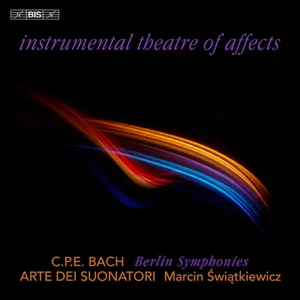
Carl Philipp Emanuel Bach (1714-1788)
Instrumental Theatre of Affects
Berlin Symphonies Wq 173, 175, 176, 178-180
Arte dei Suonatori / Marcin Świątkiewicz (harpsichord)
rec. 2025, Witold Lutosławski Concert Studio of Polish Radio, Warsaw, Poland
Reviewed as lossless download
BIS BIS2759 SACD [65]
Of all JS Bach’s composer sons, Emanuel’s music has made the most impression on the catalogue. His huge collection of keyboard music, solo and concerto, has been the subject of an extraordinary project on BIS, running to around sixty releases. His symphonic output is rather more limited, totalling eighteen works, written in Berlin and Hamburg, and the Wq182 set written in the latter city has been recorded frequently. He wrote eight symphonies in his three decades in the Prussian capital, working in the court of Frederick the Great, and their catalogue presence is more limited. This recording presents six of them, in their original scoring for strings only (with harpsichord). Marcin Świątkiewicz explains in the notes that the remaining two, which included wind parts from the start, will be included in the third volume of this series. Volume 1 presented the six Hamburg symphonies, and has not been reviewed on MWI, a shortcoming which I will remedy.
Emanuel Bach’s symphonies are quite different to many others written in the middle of the 18th century (and the extensive Naxos series The 18th Century Symphony shows just how many were written). The great majority are graceful, elegant and not particularly dramatic, whereas Bach’s are, to use modern parlance, very much more in your face. They require a virtuoso orchestra, which Frederick was happy to pay for, and feature some driving rhythms asking audiences to pay attention (not always the case in those times) and key changes that would have surprised and delighted those audiences. I was going to use the adjective “relentless”, but Bach is never averse to abruptly slow things right down, before returning to top speed. If he lived now, you could imagine him driving a car flat out or hard on the brakes!
Those tempo changes can make a full hour-plus recording a demanding listen, but Bach, of course, wasn’t planning for them to be heard consecutively. That said, Marcin Świątkiewicz writes in the notes that the order – not chronological – is intended to present a dramatic arc, clearly indicating that he believes that one can listen to all six in one sitting. Because these works are presented in their strings-only versions, there might be some concern that a degree of sameness creeps in, without winds to add some colour and variety, but Bach’s compositional skills mean that this isn’t the case. The performers are also key in this.
Arte dei Suonatori is a Polish ensemble, established more than thirty years ago, and specialises in works of the 17th and 18th centuries. They use historical instruments and performance practice, but without the extremes in sound or tempos that some similar ensembles employ. They are only nine or eleven in number, but sound fuller than that. There is an edge to the strings, but nothing too severe, and the tempos sound about right. I listened to a few other versions, such as those by the Akademie für alte Musik (Harmonia Mundi) and the CPE Chamber Orchestra (Berlin Classics), and found this new recording to be their equal or better. My favourite of the six – the G major Wq180, the last written – is given a quite splendid reading, with oodles of energy and drama, but no sense of being rushed.
This is my first time hearing Arte dei Suonatori, and I have been very impressed by their musicality and virtuosity, and look forward to hearing their other CPE Bach recordings. Sound quality is very good, as you would normally expect from this label, as are the notes.
If you have these works already, this new recording, good as it is, doesn’t render them superfluous, but if you are in the market or you are a CPE aficionado, interested to hear the original versions, then this is a must-hear.
David Barker
Buying this recording via the link below generates revenue for MWI, which helps the site remain free
Contents
Symphony in E flat major, Wq 179, H. 654 (1757)
Symphony in G major, Wq 180, H. 655 (1758)
Symphony in E minor, Wq 178, H. 653 (1756)
Symphony in F major, Wq 175, H. 650 (1755)
Symphony in G major, Wq 173, H. 648 (1741)
Symphony in D major, Wq 176, H. 651 (1755)













