
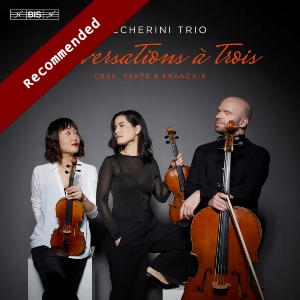
Conversations à trois
Jean Cras (1879-1932)
Trio pour violon, alto et violoncelle (1926)
Eugène Ysaÿe (1858-1931)
Trio à cordes ‘Le Chimay’ Op.posth (1927)
Jean Françaix (1912-1997)
Trio à cordes (1927)
Claude Debussy (1862-1918)
Clair de lune (1905, arr. Nicholas Shardlow)
Trio Boccherini
rec. 2024, Siemensvilla, Berlin
BIS BIS2708 SACD [63]
My 2024 chamber music highlight was a disc of Hungarian string trios performed by the Boccherini Trio (review); it thoroughly deserved the Recording of the Month status. I expressed a hope that the trio might explore the French string trio repertoire, including works by Jean Françaix and Jean Cras. Rather wonderfully, not only is this disc just as musically and technically fine, but exactly that music appears!
Jean Cras’s Trio pour violon, alto et violoncelle, in four movements, is the longest work here at 24 minutes. The liner notes revisit a theme from the earlier disc, the history and heritage of the string trio as a chamber grouping. I did not know that Luigi Boccherini’s own trios were published as Conversazioni a tré (conversations for three, the disc’s title). This underlines and echoes Cras’s intention to write a work of equal parts focusing as much on the linear polyphony of the writing as the vertical homophony.
Cras was a part-time composer. His day job was in the French Navy, where he rose to the rank of Rear Admiral before his untimely death at just 53. Yet the Trio shows remarkable refinement and skill, so unsurprisingly the work is his most recorded (a relative term), usually like here as part of a recital by more than one composer. There is a performance on the defunct, and lamented, Timpani label which is part of an excellent all-Cras collection. The violinist is the marvellous Philippe Graffin alongside violist Miguel da Silva and cellist Henri Demarquette. The style of that performance is very close to this one, but the music has a slightly tubby sound – not as appealing and sophisticated as this very fine SACD/DSD recording.
The trio was a product of three months on board the cruiser Lamotte-Picquet while it was moored in Brittany. As much of Cras’s music, the work reflects a wide range of musical influences. They range from the predictable air of French Impressionism and Neo-Classicism to perhaps less-expected Middle-Eastern and North-African modes and melodic shapes, and French folksong. Liner note writer Stephen Johnson hears Franck as a strong presence in the opening movement, but I thought the main theme has echoes of Debussy’s String Quartet.
Cras was never a musical innovator but he absorbed influences and then wrote very attractive music that managed somehow to process those influences in an individual way. This is especially clear in the second movement, Lent. Folk drones and melodies built from unexpected scales sound strikingly modern a century later. The playing of the Boccherini Trio is exceptional here. They recreate the dissonant keening of the music with a wonderful adaptation of technique with vibrato minimised and pitches bent to evoke a muezzin-like song. Cras’s genius is just how much atmosphere and character he creates from just the three instruments.
The third movement, Animé,is a musical world away, all strummed pizzicati and dancing melodies. The central section, swayingly sensuous, has a brief passage that seems to nod again at Debussy’s quartet before the dance returns. Stephen Johnson characterises the Très animé as a kind of three part invention that morphs into a Breton/Celtic reel. As the whole work, this is a very demanding task for all three musicians. In this performance, it whirls along with freewheeling energy and ease. Given that each movement has a very distinct character, it is easy to imagine that this is a series of musical postcards from Cras’s own “ports of call”. For sure, this is one of the great 20th-century string trios, and it receives as fine a performance here as I have heard.
I have reviewed a very fine performance of Eugène Ysaÿe’sString Trio ‘Le Chimay’ seventeen years ago. Compared to Cras’s piece, this is a restless, unsettled work. A few minutes shorter, it is in a single movement with six defined sections. The musical language is reminiscent of composers such as Korngold and Zemlinsky – there is great harmonic fluidity around an essentially tonal centre. Ysaÿe wrote the work a year after Cras wrote his, but it explores the boundaries of the tonal and atonal in a way Cras had no interest in doing.
Ysaÿe was one of the great violin soloists of the first half of the 20th century so there is no surprise that he makes extreme demands of all three players but especially the violinist. According to the liner notes, one critic has characterized it as “ruthless”. As on the disc of Hungarian music, violinist Suyeon Kang is technically imperious, and she has a wonderful range of expressive playing. Curiously, the work had to wait more than three decades after Ysaÿe’s death. It was first performed in the Belgian town Le Chimay, hence the nickname. Quite why it was not promoted in the composer’s lifetime is unclear. It is another impressive work, even if it is not as immediately attractive as the trios by Cras or Jean Françaix easily are.
Stephen Johnson neatly characterises Françaix’s four-movement, thirteen minute work as “light, airborne, playful”. That could apply to much of his output. If Cras was willing to meld Impression with Neo-Classicism, Françaix was much more embedded in the latter. He was not the only composer to draw on the rich French heritage of Baroque and Classical music for inspiration. Yet he allied this with piquant harmony and rhythm that owed much to the popular music movements of the 1920s in vogue particularly in Paris. The spinning-top fast waltz of the second movement Scherzo – vivo and the high spirited rumbustious closing Rondo – vivo especially embody these qualities. There may be echoes of Ibert’s Divertissement in the parodying high jinks of the finale. This is more a case of the two works springing from a common musical ground rather than any direct pastiching. A galumphing, deliberately overblown ending (horribly hard!!) pulls itself together before a knowing wink and “that’s all, folks” quiet ending. This is genuinely witty writing, again superbly played.
As an encore, we get violist Nicholas Shardlow’s arrangement of Claude Debussy’s Clair de Lune. Shardlow, who at 16 won a prize in the 2003 Guardian/BBC Proms Young Composers Competition, is now a member of the Royal Stockholm Philharmonic Orchestra. The arrangement is made and played effectively, although it is the only time I do not think Kang’s portamento is wholly appropriate. I might sound a little curmudgeonly to say I would have preferred another original score, perhaps Trois Voeux à un nouveau-né by Alfred Desenclos, which I mentioned in my earlier review. But in its own right it is a heart-breakingly beautiful piece, played here with tender warmth.
The BIS engineering and production (Marion Schwebel for Take 5 Music Production) is up to their usual high standard. It supports the music and musicians in the best possible way. Writing for just three essentially monophonic instruments is a considerable technical, musical and expressive puzzle. The three main works here triumphantly rise to the challenge, and receive superbly refined and accomplished performances.
Nick Barnard
Trio members: Suyeon Kang (violin), Vicki Powell (viola), Paolo Bonomini (cello)
Buying this recording via the link below generates revenue for MWI, which helps the site remain free













